I feel a-swirl. I want to walk on the edge!

Silence frees us from the need to control others … A frantic stream of words flows from us in an attempt to straighten others out. We want so desperately for them to agree with us, to see things our way. We evaluate people, judge people, condemn people. We devour people with our words. Silence is one of the deepest Disciplines of the Spirit simply because it puts the stopper on that.

Richard Foster, from his book Freedom of Simplicity

Listening.

This is something that I have had to make an effort toward in my life.  I say too much, usually.  I am overly instructive with my children.  I am extremely enthusiastic with my friends.  I have too much going on in my head and it comes out in a frenetic pace both on Facebook and here.  I feel like I’m constantly “throwing up” all over every one.

Hearing.

I have such trouble hearing God.  I get impulses.  I get emotional responses.  I feel.  I emote.  I become afraid.  I become inspired.  But do I ever really hear God?  I believe what I do matters to God.  And then I don’t, believe.  I am a devout doubter.

I read his word.  When I am connected to the word, I have no doubts.  He absolutely speaks.  God is active.

I read blogs and articles, and follow the news.   My heart surges and leaps and responds.

Children in Haiti.  * Rape victims in Rwanda. * HIV * Girls in Afghanistan. * Forgiveness.  * Child rearing.  * Writing.  Photography.  *America.  Other. * Poverty.  Wealth. * visual Anthropology. * Educated.  Un.  *Racism.  * Sexism. *Immigration.  *Refugees.  *Aid work. * Adoption.

Primal scream! I feel a swirl.  I am schizophrenic, or at least I feel it.

“Let your heart guide you. It whispers softly, so listen closely.”

Purpose and calling.

I read an article in the New York Times about a woman who heard about the plight of Congolese women on an Opera.  She was so moved that she turned her life upside down to help.  She lost her business, fiancé, and home.  She lives to help these people.

Don’t get me wrong, I don’t want to follow that path — losing family and love and home.

Listen.

Oh, don’t get me wrong I believe as long as I am listening my heart will be breaking for others.   But I long for just want the one thing.  The one thing to live my life for.  The one thing to learn about. The one thing to go back to school to study.

I’m 43 for God’s sake.

I have half my life to live and I want to live it with purpose.

With some sense of destiny and knowledge that God called.

I fear that I do not know how to listen.  Pray with me that I would be listening.

I would Live with intention.

I want to Walk to the edge. I want to live on the edge.

Listen hard. Continue to practice wellness and contentment.

I just want to know…

The schizophrenic in me went to the library

The schizophrenic in me went to the library and found a few books I want to read.  So, I’m thinking of taking time off from the internet for a while (I’m going to try) so that I can read.

I am already reading CJ Cherryh Foreigner series.  I am on book four of ten. I read that at night.

The Depression Cure — The 6-Step Program to Beat Depression without Drugs by Stephen S. Ilardo, PhD.

Because I do intend to go off my medication this year.  It’s a matter of how not when.

Cool Careers without College for People Who Love Video Games by Nicholas Croce.

For my son, Jake, who has some learning challenges.  I don’t know if it is more to inspire myself or my son, but I just need a little hope as it relates to Jacob.

Speaking Treason Fluently — Anti-Racist Reflections from an Angry White Male by Tim Wise.

Saw this book mentioned on a blog I was reading.  And the author is highly recomended.

Empowering Your Sober Self by Martin Nicolaus.

Sobriety is a daily decision as well as relearning certain patterns.

No Enemy to Conquer — Forgiveness in an Unforgiving World by Michael Henderson with foreward by the Dalai Lama.

I am writing an article about forgiveness.

The Mother Factor — How your Mother’s Emotional Impacts Your Life by Stephen B. Poulter, PhD.

Ongoing journey of understanding my mom’s power.

A Lesson Before Dying by Ernest J. Gaines.

It’s Black History month.  It seems warranted to start reading black authors.

The Autobiography of Martin Luther King, Jr. Edited by Clayborn E. Carson.

Ditto.  Plus he’s a general hero to half of humankind.

The Unheard Truth — Poverty and Human Rights by Irene Khan, Secretary General Amnesty International.

The situation in Haiti has gotten me thinking about human rights in general and especially how it relates to poverty.

Strong Kids.  Healthy Kids. — The Revolutionary Program to Increase Your Kid’s Fitness by Fredrick Hahn.

It’s an ongoing interest to develop healthy habits in my kids while they are young.

A Good Neighbor — Benedict’s Guide to Community by Robert Benson.

Lifelong need for connection.

Blind Sided by a Movie

I was never going to write this review of the movie Blind Side, because I still don’t know how to talk out loud about my response to it.  And I have thought about it  for more than a month.  But I just heard that Sandra Bullock is nominated for Best Actress for her role.  Good for her.  She was brilliant.  She made the movie fly.  And apparently she directed it as well.  So I think the movie will be getting more attention.  I’d like my thoughts out finally and writing sometimes helps me figure out what I think.

Blind Side is based on a true story about Michael Oher a young black  man; essentially homeless in Memphis until he was taken in and eventually adopted by an extremely wealthy white family.  The two children adored Michael and everyone in his life from teachers to family to tutors taught him a little something.  After a lot of work on his part on academics, he qualified to play football in college.  He went to the University of Mississippi. And Oher was eventually drafted by the Baltimore Ravens.

My gut reaction coming out of the movie was dismay.  And then I was dismayed by my own dismay as I heard my mom and daughter positively gushing. “Wasn’t it wonderful.  It was so beautiful.  What a story.  So uplifting.” They genuinely loved it and were inspired.

What’s going on?   It didn’t make me feel good.  It made me uncomfortable. But this is a true story. I kept thinking no wonder the book was made into a  movie they could not have made up better stereotypes for “white wealth” and “black poverty.”

I’m not sure which made me more uncomfortable the white family’s wealthy excess and sense of privilege.  Or the black kid’s poverty, homelessness and disadvantage.   I kept thinking about all the other kids that will never be able to achieve what this young man did — not because they aren’t as deserving, or willing to work, or wonderful like Michael Oher.  (Clearly is if he is anything like the person on the screen.)

But no-one will help them and the System is so messed up.

  • The terrible, terrible schools in inner cities.   This boy got into a private school on a lark of a teacher.  He had a 1.0 GPA.  He clearly hadn’t been learning at school.
  • The danger of living in abject poverty and neighborhoods riddled with crime.  Guns, drugs, illness and lack of proper nutrition.
  • Being homeless and  just surviving.
  • Having one pair of extra clothes so he had to go to a laundry mat to wash them.  Having  no money he had to throw his clothes into someone else’s cycle to be washed.
  • Having few positive role models.

My problem with this movie is that it glorifies a kind of racism where rich white people are honorable, upright, righteous “Saviors” of the poor, black away from the gangsta and drug peddling culture and a drug addicted mother. My problem with this movie is that African-Americans are so often portrayed  like this in movies, especially black men. I have a problem that Leigh Anne Tuohy (played by Sandra Bullock) welcomes a homeless practically mute “Big Mike” (played by Quinton Aaron) into her family’s life.  The movie glorifies Tuohy while Oher is lectured, tutored, fed, dressed and loved like a big pet or a prize poodle.  Bullock shines while Aaron has perhaps twenty lines of dialogue.  Kind-hearted but imperfect whites save the lost black boy.  The movie really did make the Tuohys out to be generous and good people.  And I am sure they had good intentions.  And Michael Oher clearly has made something of himself which is great.

All’s well that ends well right?

Actually, not really.  Michael Oher is one boy**.  What is my problem with this movie?  It made me uncomfortable.   Uncomfortable with how wonderful everyone will think it is and overwhelmed by how sad it made me feel.  It made me miss Dr. and Mrs. Cosby.

You may not agree with me, my mom didn’t.  But I hope that I have made you think.

Be friends, be well.

Melody

THE FACTS

Among the 50 largest cities in the nation, Memphis has the highest poverty rate, approximately **18 percent, with many of our children living in extreme poverty.   No other city comes close.  The percentage of college graduates in Memphis is below 24 percent, a figure in the lowest quartile. And perhaps most problematic of all, the economic segregation in Memphis is crushing:  in an $87 billion local economy, minority businesses generate only $1.3 billion (1.5 percent) of the total.

[Observations from a year in Memphis City Schools, by Dr. Kriner Cash, written in Aug-2009]

Homecoming

Molly came to lunch on Sunday with some big news.

She wants to go back to school

to study theater and costume design.

She’s moving home to save money.  In August.

This is a good thing.

How quickly the years pass. In 1992 Tom was recently separated and I was just back from a summer in Russia.

Molly was the sweetest child and full of joy.  I was always amazed by the joy inside her.  She was an only child.  Her parents were separated.  She lived with her single dad.  But when Tom and I decided to get married she was thrilled.  She clearly wanted two parents who were married to each other.   Her “real” mom was around but not regularly at that point.

Over the years Molly’s gentle spirit and joy served her well.  It wasn’t until middle school that things really got tough for her. I was an insecure step-mom, fragile, controlling, and a perfectionist.  Some day perhaps I’ll write about those years.

But today it is worth noting that we have a great relationship.  I love her dearly and the idea of her moving back home after being on her own for almost four years is great!

In Haitian Kreyol “tout moun se moun” Means Every Person is a Person

Many people look at Haiti and despair. Some say that we have hungry and uninsured in America and that the people of Haiti need to somehow help themselves. Others though, like Dr. Paul Farmer, co-Founder of Partners in Health and United Nations Deputy Special Envoy for Haiti, have worked in Haiti for years.  Paul Farmer has reason to doubt and yet he seems to have hope.

He recently testified to the U.S. Senate Foreign Relations Committee.  The full testimony is here. (Emphasis is mine.)

Beyond hope, he has experience and wisdom and a history in Haiti and that is why I think he is worth listening to and potentially supporting with your financial dollars.

“They say that aid is wasted, that there is no hope for this country.  And indeed there are reasons to be cautious.

I would answer them with the positive experience of building Haitian-led programs in the Central Plateau and Artibonite Valley regions that have createdfive thousand jobs for people who would otherwise have no steady work. I advance this model not because it is associated with our efforts, but because job creation is the surest way to speed up the cash flow that is essential now. It is also the fastest way to make amends for our past actions towards Haiti, which have not always been honorable.  In other words, if we focus the reconstruction efforts appropriately, we can achieve long-term benefits for Haiti. The UNDP is helping to organize programs of this kind, which should be supported and extended around the country.Putting Haitians back to work and offering them the dignity that comes with having a job and its basic protections is exactly what brought our country out of the Great Depression.

Last night I read a New York Times article about the babies being born amidst the tragedy of Haiti.  My heart broke to hear of these mothers giving birth and having nowhere to go, no food or shelter.  Can you imagine?  Having done that three times myself I can tell you that it would be terrifying.

One, nineteen year old woman four days after giving birth was eating her first meal — a can of beans.  Another living in a sheet tent with her 12-year-old and eight year old and few days old infant.  Despondent as she lived outside the rubble of her home, because she does not want other’s charity.  Her husband is dead.  She has three children and nothing to feed them.  No way of providing for them.

“The street where I live, it’s so dirty; there isn’t enough food or water,” Ms. Antoine said. “I’m scared to bring a baby into this awful situation.”

The article said, ” roughly 7,000 who will give birth in the next month” of the 63,000 that were pregnant when the earth quake struck Haiti two weeks ago.

Back to Paul Farmer’s presentation:

“Despite $402 million pledged to support the Haitian government’s Economic Recovery Program in April of last year, when the country was trying to recover from a series of natural disasters resulting in a 15% reduction of GDP, it is estimated that a mere $61 million have been disbursed.

“In the Office of the Special Envoy, we have been tracking the disbursement of pledges, and as of yesterday we estimate that 85% of the pledges made last year remain undisbursed. Many of us worry that, if what’s past is prologue, Haitians themselves will be blamed for this torpor.

So here is our chance: if even half of the pledges made in Montreal or other such meetings are linked tightly to local job creation, it is possible to imagine a Haiti building back better with fewer of the social tensions that inevitably arise as half a million homeless people are integrated into new communities.

Haiti needs and deserves a Marshall Plan—not the “containment” aspects of that policy, unless we are explicit about containing the ill effects of poverty, but the social-justice elements. But we need to be honest about the differences between post-war Europe and Haiti in 2010. Part of the problem, I’ve argued, is the way in which aid is delivered now as compared to in 1946—well before the term “beltway bandits” was coined.

  • We need a reconstruction fund that is large, managed transparently, creates jobs for Haitians, and grows the Haitian economy.
  • We need a reconstruction plan that uses a pro-poor, rights-based approach far different from the charity and failed development approaches that have marred interactions between Haiti and much of the rest of the world for the better part of two centuries.

Our country can be a big part of this effort.  Debt relief is important, but only the beginning. As you consider donating to Haiti relief, remember that any group looking to do this work must share the goals of the Haitian people which are shared by Partners in Health as well.

They need:

  1. access to quality health care, and
  2. social and economic rights, reflected, for example, in job creation,
  3. local business development,
  4. watershed protection (and alternatives to charcoal for cooking), and
  5. gender equity.

Considering all these goals together orients our strategic choices. For example, cash transfers to women, who hold the purse strings in Haiti and are arbiters of household spending, will have significant impact. This is a chance to learn and move forward and build on lessons learned in adversity—to build hurricane-resistant houses with good ventilation to improve air quality from stove smoke; to build communities around clean water sources; to reforest the terrain to protect from erosion and to nurture the fertility of the land for this predominantly agricultural country. It is the chance to create shelter, grow the local economy and incomes, and invest in improved health. This will do much to decrease the risk of another calamity, and to decrease the vulnerability of the poor—especially as we face the second wave of problems, including epidemic disease born of the earthquake

“tout moun se moun” – every person is a person

Won’t you help an organization that has experience in the country.   There are goofy groups popping up that seem to be exploiting the situation in Haiti.  Don’t be fooled into thinking they are helping.   And look, I know we all want to help.  I want to scoop up those moms and babies and take care of them.  Offer them shelter and food.  I want to hold that starving 18 month old in the hospital in Haiti, comfort him with physical contact and food.  (He has since died.)  I would do anything, offering up my blood, sweat and tears if it would help.

But we must be reasonable — adults — logical and informed.  They don’t need our frickin’ shoes.  Or blankets.  Or old clothes.  They don’t even need us to go, no matter how much we want to help.

This website, Good Intentions Are Not Enough, provides a list of ideas of ways that you can truly help if you are so compelled.

Or you could just send money.

There are a number of online tools available for evaluating charities and making donations to a broader range of NGOs, including CharityNavigator.org and NetworkForGood.org.

Be well friends.

New Year’s Resolutions Update (Jan. 30th)

I thought it might be wise to check  in on my resolutions now a month later. My New Years Resolutions … they were:

I will Learn. See. Respond. Be …

I will give more of my time, voice, and energy to the disadvantaged, oppressed, and forgotten in my community. (Immigrants, LGBT, homeless, unwed mothers, the illiterate.)  To put myself in situations where I am the ethnic minority.  If given opportunity, I will tell their stories through word and image.

I’ve informally interviewed for a communications job at a local non-profit that works in the black community here in Madison.  I’m prayerful.  No money, but exciting, purposeful, wonderful opportunity.  I feel afraid, because I know nothing about communication to blacks as a demographic.  But most of what I’d do it communicate to donors who are (mostly) white, so I’ve got that one down in spades.  We’ll see.

I’ve written a few things here on the blog.  Here’s an archive of January, 2010.

I continue to shoot for Our Lives Magazine.

This is Petrovnia and Chris McIntosh with their son Jackson.

I have another shoot today.

I will grow more of our own food.  I will learn to can.  I will shop locally, especially community based privately owned businesses.

I’ve joined the Willy Street Co-op.  I love their options. I love their prices. I love their organic local produce. I love their vibe!

I am planning a protest of the TARGET that wants to move into my neighborhood.  Be national behemoth chain of evil that it is.

I will save more, spend less. I will live on a budget. I will continue to not buy clothes for myself for a year, until October, 2010.   I will use the library.

I have not written up a current budget, but we’re not spending.  I haven’t bought any clothes or paraphernalia for myself since October and to be honest I hardly think about it any more.  I still have trouble getting to the library for books I want to read.  It’s a mental shift to not OWN books but rather borrow them.  Why is that?

I will help us be a connected family. I will turn off electronics while the kids are awake. I will turn off electronics  4-8 pm. And do more together. (e.g. Go to ballgames, the symphony & opera,  plays (The Lion King), go camping, …)  We will call cousins and other family members.

Fail.  Clearly this is an area that Tom and I need to agree on.  He’s been in the basement with regularity cause of his current music project.  I have been a baby about it and just surfed the net, reading and improving myself.  And I pout internally.  I could or should turn of the TV and play games with the kids.

I will continue to work at staying depression free. I will work the 12 steps.  I will exercise every day, if only 20 minutes.  I will taper off Effexor.

Ahem, well let’s see.  Yes, no, sorta and not yet.

I will write for an hour every day of the work week.  About … What I am thankful for.  What I want to know.  What I think.  Who I need to hear from.

Definitely achieved the writing goal.  Here’s an archive of January, 2010.

Wrote an article for my church’s new magazine, Illuminate.

I will read with intentionality. (On race, gender & the church, faith, poverty, global issues …)

Check.  I’ll get a bibliography up soon. I read so many blogs.  I thought that list might be interesting as well, but I can’t think of an easy way to list them.  Anyone know?  I’m sure there is a way.

I will play my piano and find an avenue to sing.

Not yet.  Well I’ve tinkered with the piano, but it is sadly out of tune.

I will work on a photography project with the goal of a gallery showing and work on a website for online sales & exhibition.

I had an offer to exhibit in a show on Angels by my friend Drazen Dupor. As this isn’t something that I have shot a lot of, or created I didn’t do anything with it.  I will think about a project for both church (where I have an open invitation) and perhaps a coffee shop.

I will be working with my church to create and manage a blog for artists.  If you have thoughts on this shoot me an email.  It should be a fun avenue for both creativity and faith.

I will take Tom to Big Ben before he’s 50.

See I will start a budget.  :-) Save for Big Ben. W When I mentioned this to Tom he warned me to be prepared for a major falling apart when he turns 50.  And that I’d better hurry, only a year and a half.

Feb Goals:

  • Write a current family budget.

  • Get to Willy’s every week.

  • Keep praying about the job.

  • We really, really need to turn off electronics during the week!!!

  • Get outside with the kids.

  • I will walk the kids to school (Erk, that’s hard to write when it was -2 degrees yesterday morning.)

  • Work on the Artists Blog for Church.

  • Write an article on forgiveness for next issue of Illuminate.

  • Walk on the treadmill every day and get to the Y with my mom.

    Be well, friends.  Be well.  And if you feel like it, drop me a word about what you are doing in 2010.

Haiti: History of a Shaken Country | Laurent Dubois | Big Think

It is always good to know a nation’s history — From Haiti Historian and Professor at Duke University.

From the 18th-century slave revolution to 2010’s horrific earthquake, Haiti has experienced endless volatility. How is its historical legacy worsening the current crisis?

Watch the seven minute interview via Haiti: History of a Shaken Country | Laurent Dubois | Big Think.

I’m fat. You’re fat. The first lady is not fat. Hey what’s up with that!?

According to the Mayo Clinic I am overweight.  (Thank you very much.)  And I have a sneaking suspicion that my kids are not doing so well either.  But it turns out most parents do not even realize that their children are over weight.  Even our First Lady, Michelle Obama, was caught off guard by a recent pediatrician’s warning.

12.5 million children in America are overweight.

By now we all know obesity is having an excessive amount of body fat.  (check)  Especially around the waist.  (check) And  you know that doctors use a formula based on your height and weight — called the body mass index (BMI) — to determine if you are obese.  Find yours here.  Almost one-third of kids are at least overweight; about 17 percent are obese.

At his most recent checkup, our pediatrician measured one of our kid’s height and weight.  She talked with us about her concern over his BMI.  He has grown out a bit more than up over the last year.  But she seemed reticent to say anything that was too harsh though his weight is on the high side for his height.  I agree that we don’t want to mess with kids’ perceptions of themselves.  They are at very vulnerable age.

Even the First Lady’s girls got a warning recently.  The interesting thing I thought was that within just a few months she made some small changes that got her daughters back on track.  This is the kind of thing you or I can do.

  • No more weekday TV. (Oops)
  • More attention to portion sizes. (Okay)
  • Low-fat milk.  (Check)
  • Water bottles in the lunch boxes. (Rather  than milk or chocolate milk which comes in school lunches?)
  • Grapes on the breakfast table. (Fine)
  • Apple slices at lunch. (Don’t they go brown?)
  • Colorful vegetables on the dinner table. (I’m in agreement in theory.)

And then I got to thinking — this isn’t just about my kids. Or even the First kids.  All of whom eat organic apples, have their own garden and can visit the farmer’s market.  And they have plenty of opportunity to eat three healthy meals a day.

What about inner city kids?  What about low income kids?  What about kids who eat two meals at school.  Or the kids whose parents have to work three jobs and are not around as much to cook for them?

What about kids who do not have a grocery store in their neighborhood?  Last week, the First Lady addressed the U.S. Conference of Mayors about cities creating healthier citizens because obesity is a particular problem in some minority communities without easy access to supermarkets, much less farmers markets.

I knew the grocery store over on Verona road had closed down a few years ago (turns out it is more like eight, and that was the third that closed down in that area.)  So I started hunting for information or articles online about that area of Madison, the Verona Road/Allied Drive area of town.

One of the things that Mrs. Obama wants to see happen is increasing access to healthy foods. She says parents tell her they want to feed their kids fresh produce but it is difficult “if you don’t live anywhere near a place that sells fresh produce.”  She also wants to make good food cheaper.  (Ahem, pardon my skepticism on that one.)

In Madison, the poor do not always have access to healthy food?  That should be a headline.

Last year, the Wisconsin State Journal reported that Cub Foods was closing its store on Verona Road.  It’s a compelling story:

As snow fell around her Monday, Melissa Orr set off on the five-block walk from her home on Madison’s Allied Drive to the Cub Foods store where she shops two or three times a week.  She does not own a car, so the store, 4716 Verona Road, is her only option for grocery shopping unless she takes a bus. At the store, Orr learned it will close by mid March, leaving her and many other residents of one of the city’s poorest neighborhoods without a supermarket within walking distance.   … Ryan Estrella, a Dane County social worker based on Allied Drive, said numerous residents lack vehicles and that the store’s closing will be a hardship. Many neighborhood families are headed by single parents, so taking a bus is a major undertaking when children and bags of groceries are figured in. In the future when people need only a few staples such as milk and baby formula, they will probably end up at a gas station, where costs add up quickly, he said.  “I think this will be devastating to the neighborhood,” Estrella said.

As of writing there still isn’t a grocery store near the Allied Drive neighborhood.  I’ve sent a few emails around trying to find out what the plans are for 2010.

Working together, we can ensure our children’s health—and their future.  But this goes for all children.


A Sacred Contract [a poem]

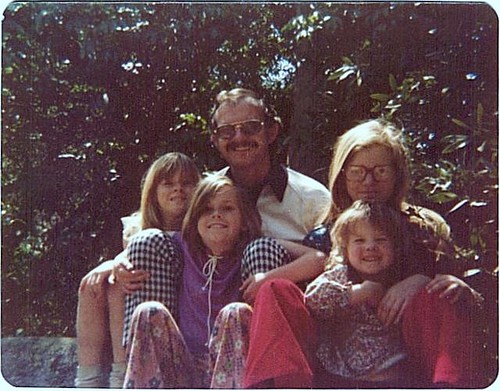
Tonya (8), Melody (10), Holly (3) and Paula (12) with Dan Harrison in southern California, 1976.

SISTERS: A Sacred Contract

A sacred contract between sisters;
My secrets are yours,
yours are mine,
And theirs

are ours together.

Four sisters.
Bound to one another
by secrets.
‘You don’t owe each other,’
my husband said.

Oh, but we do.
For we are survivors of secrets,
together.

by Melody Harrison Hanson, 2005

I’ll never forget how terrified I was when I wrote this.  When I sent it on to my sisters to read I feared their rejection because you see we never talked about dad much, not negatively.  Not until he died because  of his anger.  It just wasn’t worth it.

[Now some of you who knew the gentle, charming character of Dan Harrison will be rising your eyebrows and questioning me now.  Some day, perhaps I will have the energy to remember and write what our childhood was like.  Because we remained until the day he died strangled by his anger.]

You see, when you experience psychological trickery and  mental torment or suffering it creates a level of fear that is insurmountable.  We all suffered physically from this over the years.  I had stomach aches, Holly and my mom had headaches, the others in their own way.  The worry, the knowledge that at any time he might lash into a rage, get stirred up over the smallest thing, I never understood his trigger.  It caused us mental and emotional anguish.  But the very hardest for me was the secret of it.

That’s where this poem comes from.

Haiti – a learning curve indeed.

I’m running a fever and have body aches.  I’m fairly grumpy at this point because I just don’t do sick.  When I was working full-time my modus operandi was pop some pills and get on with it.  But that’s changed over the years.  Being at-home I can’t ignore how I feel, there is not enough to distract me.  So, I feel my pain.  And especially since I’m trying to listen to my body (after this experience).

Anyway, one of the things I do when I am healthy or sick, is read – blogs, articles, anything and everything.  I got to thinking how much amazing stuff I find online and I could let others know about it.

ON HAITI, hopefully soon NGOs are going to get food to the folk in Haiti.

First, one blog I read, from an NGO worker who is not in Haiti said this today:

In the next day or two, non-governmental organizations expect to begin mass food distributions to earthquake survivors in Haiti. They’re planning to do this in conjunction with military support- specifically, the US Marines and the United Nations Mission in Haiti (MINUSTAH).

It’s taken more than two weeks to organize. I’ve explained some of these reasons elsewhere. In short, the logistics of trying to organize food distributions to hundreds of thousands of people simultaneously is an immense undertaking. As well as importing and moving that amount of food (food is heavy stuff), there’s the matter of locating and organizing distribution sites, coordinating dozens of agencies, working through broken infrastructure, communicating the details to the residents of Port-au-Prince, and trying to define the relationship between the military and aid agencies.

I thought his explanation for why things are so damned complicated in Haiti and what the NGOs and the government are doing, are not doing and why was brilliant.  So many in the media are asking questions and criticizing.  This person explained.  It may not be what we want to hear but I feel it was forthright and honest.  And since he’s not on the ground there he doesn’t need to feel defensive.

Secondly, I have found MFAN, Modernizing Modern Assistance Network.

MFAN is a reform coalition composed of international development and foreign policy practitioners, policy advocates and experts, concerned citizens and private sector organizations.  MFAN’s goal is to help build a safer, more prosperous world by strengthening the United States’ ability to alleviate extreme poverty, create opportunities for growth, and secure human dignity in developing countries.

Fantastic!  I’m  totally with them and when they provided a list of articles I realized that many of them I had already read in the last week.  These give you a sense of the discussions going on in and around Haiti about the aid that is and isn’t getting there, how things are organized (or not) and folks criticisms and affirmations.

From MFAN’s website:

Since almost the moment that a devastating earthquake struck Haiti nearly three weeks ago, high-level world leaders, development experts (including MFAN Principals), and others have published pieces with opinions on what went wrong with development in Haiti and what we can do to make things right.

One common feature of the commentary, with the exception of a few pieces (Atwood and Birdsall come to mind), is the fact that they call for a new development approach in Haiti without mentioning that a transformative debate is happening at all levels of government about how to make overall U.S. development and foreign assistance efforts more effective and accountable.  In spite of this omission, the pieces touch on important themes of foreign assistance reform that MFAN has been aggressively advocating for more than a year, and which are now being discussed as part of the White House’s Presidential Study Directive on Development Policy, the State Department’s Quadrennial Diplomacy and Development Review, and Congress’ anticipated efforts to revise the Foreign Assistance Act of 1961.

I hope you will read some of them.  I hope they are as interesting and informative to you as I found them.  I hope you will start talking about the reform that has already been in the works.  Here’s the list of articles again.

Sorry for a less than passionate post.  I am — very much so  — deeply interested.

Just under the weather.

Stay healthy yourself!

Hope for Haiti

I thoroughly enjoyed watching a Hope For Haiti Now fundraiser the other night.  This collaboration between Jay-Z, Rihanna, and Bono jumped out at me.  I loved it because it was innovative, interesting and original.  Am I being redundant?  I loved it.

Taylor Swift was also incredible.

Just don’t want to forget Haiti.  I heard a report on NPR today that some people STILL have only received water as “aid.”  I do not want to criticize people on the ground doing good work.

Rwanda. Haiti. A photographer’s work.

Of the many things that one could do with their photography, this would be my dream. Telling stories that need telling. This photographer is incredibly talented, and tells his stories so well. I discovered him checking who the photographers were on the doctors without borders website report from Haiti. (I think.)

Jonothan Torgovnik is in Haiti right now. Be well, sir, be well. Tell the story that needs to be told.

Intended Consequences by Jonathan Torgovnik

An estimated 20,000 children were born from rapes committed during the 1994 genocide in Rwanda. Intended Consequences chronicles the lives of these women. Their narratives are embodied in portrait photographs, interviews and oral reflections about the daily challenges they face today. See the project at http://mediastorm.org/0024.htm

. I found the photographer’s reflections to be incredibly powerful.