O Jesus! meek and humble of heart, Hear me From the desire of being esteemed, Deliver me, Jesus.
From the desire of being loved, Deliver me, Jesus.
From the desire of being extolled,Deliver me, Jesus.
From the desire of being honored,Deliver me, Jesus.
From the desire of being praised,Deliver me, Jesus.
From the desire of being preferred to others,Deliver me, Jesus.
From the desire of being consulted,Deliver me, Jesus.
From the desire of being approved, Deliver me, Jesus.
From the fear of being humiliated,Deliver me, Jesus.
From the fear of being despised,Deliver me, Jesus.
From the fear of suffering rebukes,Deliver me, Jesus.
From the fear of being calumniated,Deliver me, Jesus.
From the fear of being forgotten,Deliver me, Jesus.
From the fear of being ridiculed, Deliver me, Jesus.
From the fear of being wronged,Deliver me, Jesus.
From the fear of being suspected,Deliver me, Jesus.
That others may be loved more than I, Jesus, grant me the grace to desire it.
That others may be esteemed more than I, Jesus, grant me the grace to desire it.
That, in the opinion of the world, others may increase & I may decrease, Jesus, grant me the grace to desire it.
That others may be chosen & I set aside, Jesus, grant me the grace to desire it.
That others may be praised & I unnoticed,Jesus, grant me the grace to desire it.
That others may be preferred to me in everything,Jesus, grant me the grace to desire it.
That others may become holier than I, provided that I may become as holy as I should,Jesus, grant me the grace to desire it.
(I will admit that I had to look up calumniated which is to “charge falsely or with malicious intent; attack the good name and reputation of someone.”)
Whew, that is incredible to read and let it sink into your heart, mind and soul. This prayer is counter cultural. A couple of those made my pulse race as I faced my fear in a physical way.
Desiring to be consulted has been a lifelong struggle for me.
Wanting to increase in the opinion of the world.
That others may be praised & I unnoticed is only something I can hope for, pray for.
I do believe repetition and practice in prayer is effective and powerful. I am going to pray this every day in Lent.
On Feb 17th, 2011 I decided I was going to stop. Stop contributing to the negativity in our culture. Stop verbalizing my negative thoughts about people. And criticising and not affirming or building up others. And perhaps become a more positive person.
So far, I haven’t made it more than a few days.
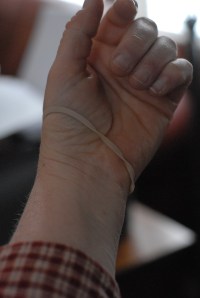
To be honest I haven’t kept track of how long I have gone but I know I have certainly not gone 21 consecutive days. But, the rubber band is still on my wrist. Remember the rubber band was the reminder. Move it to the other wrist when you fail. I said:
“I’m trying to lead by example and not complain about anything or criticize anyone, or gossip, for 21 days, which is how long it takes to form a habit apparently.”
And though I haven’t made it, I can say this.
I am fantastically aware of my mouth.
It’s not that I am an excessively negative person. But I am verbal. And I have been known to intimidate others — insert sinister laughter — and I am well aware of the “power” my words have. I am not consciously (I hope) hurting others at this point in my life. (I started working on giving up sarcasm approx. ten years ago and for the most part I’m doing well on that. But it’s tough.)
But I know how easy, almost habitual, it is to say something critical about another person. I include jibes or sarcasm here because, though (sometimes) funny, they are totally unnecessary and without a doubt do not build others up.
So, no more complaining, criticising and gossiping. I want to try. It’s not the number of days that matters. It’s the effort.
Another thing I’ve learned from this effort is that I DO use “complaining, subtle criticism and jibes” in a passive aggressive way.
When I am annoyed or upset about one thing, I jab at the person about something else. With the adult child or the tweens in my house I see directly how this simply wears down their self-esteem and it reinforces negative when it could be a learning opportunity. So, I am trying to be up front about behaviors that annoy me and let the cracks go. No matter how funny they may be I will bite my tongue!
And as this is the first day of LENT you might consider giving up being a “critical, complaining, or gossiping” person.
I have lofty goals for myself.
(Yes, that was sarcasm. But at my own expense!)
I am going to see if I can go three days without moving the wristband. Three days without saying something unnecessarily critical. Three days without talking about another person when they aren’t there. Three days without cracking a joke at someone’s expense. Some call it being snarky. Or kvetching. And three days feels long. It’s especially hard if you get a lot of your identity from being funny.
But it’s something to think about. It comes down to this: Do you build others up or tear them down?
I don’t want to be known to be a complainer. Or have a reputation for mean sarcasm. Or be remembered for being negative. And this is more than about giving something up. In that way it’s just a discipline. But if our heart is to be changed then we have to truely set that weakness or propensity or sin at the foot of the Cross. Let it go because if you’re totally honest with yourself, like me you want to build others up.
Three days. I know that’s about all I can do — in — a — row. If that!?! And then perhaps another three. Some day 21. Or the lenton 40. Or, forever.
What about you?
-MHH
Some verses, if you read the Bible
Ephesians 4.29 Don’t use foul or abusive language. Let everything you say be good and helpful, so that your words will be an encouragement to those who hear them
Ecclesiastes 10:12 Words from a wise man’s mouth are gracious, but a fool is consumed by his own lips.
Matthew 12:34 You brood of vipers, how can you who are evil say anything good? For out of the overflow of the heart the mouth speaks.
Romans 14:19 Let us therefore make every effort to do what leads to peace and to mutual edification.
Romans 15:2 Each of us should please his neighbor for his good, to build him up.
Ephesians 5:4 Nor should there be obscenity, foolish talk or coarse joking, which are out of place, but rather thanksgiving.
Colossians 3:8 But now you must rid yourselves of all such things as these: anger, rage, malice, slander, and filthy language from your lips.
Colossians 4:6 Let your conversation be always full of grace, seasoned with salt, so that you may know how to answer everyone.
1 Thessalonians 5:11 Therefore encourage one another and build each other up, just as in fact you are doing.
Lent is strange for those that don’t follow the tradition. Or if followed at all it may mean giving up a vice for 40 days, an addiction to technology or caffeine or sugar, but not really knowing why.
That was true for me for many years. If you grew up in an evangelical church like I did, you may not know that much about Lent either.
It is the period of fasting leading up to Easter to remember Jesus’ 40-day fast in the wilderness. Like his fast, it is to be a time of sacrifice and listening. Lent begins on Ash Wednesday and ends right before the evening service of Holy Thursday or Maundy Thursday, depending on your tradition. This year Lent begins on March 9 in the Western Church.
For the longest time I was attracted to the idea of giving up a vice that had persistently bothered me, but I had no theological understanding of the tradition. I think evangelicals are remiss in not teaching about Lent, which can be a beautiful and profoundly meaningful tradition of growing closer to God.
I think we miss out because we give things up but don’t replace them with anything.
The intended purpose of Lent is a season of fasting, penitence, and self-denial, but also of spiritual growth, conversion, receiving from and embracing simplicity.
“Lent, which comes from the Teutonic (Germanic) word for springtime, can be viewed as a spiritual spring cleaning: a time for taking spiritual inventory and then cleaning out those things which hinder our corporate and personal relationships with Jesus Christ and our service to him. Thus it is fitting that the season of Lent begin with a symbol of repentance: placing ashes mixed with oil on one’s head or forehead.
However, we must remember that our Lenten disciplines are supposed to ultimately transform our entire person: body, soul, and spirit. Our Lenten disciplines are supposed to help us become more like Christ. Eastern Christians call this process theosis, which St. Athanasius aptly describes as “becoming by grace what God is by nature.”1
The aim in observing Lenten disciplines is to be changed as a person — body, soul and spirit!
Therefore there is more to it than giving something up, which I’ll admit for the longest time I thought was fairly impressive in and of itself. I don’t do well without caffeine which is something I habitually gave up. Or sweets. Yikes that one is hard.
As one endeavors to grow to be more like Christ and know him better, with the grace of God the tradition says you would be focusing on Fasting, Praying, Almsgiving (Charity or service) and Scripture.
Fasting: The Catholic Church requires its members age 18 to 59 “to fast on Ash Wednesday and Good Friday, unless a physical condition prevents otherwise. This means only one full meal is permitted. The Fridays of Lent are days of required abstinence, meaning meat, and soups or gravies made of meat, are not permitted.” This traditional way of fasting I have have never observed. Giving up meat once a week or only drinking water for the 40 days is a way to remind ourselves of our abundance and to draw our attention to Christ’s sacrifice for us all. And to be more conscious of how much we have.
Prayer:Lent is a good time to develop a discipline of daily prayer if you don’t have it already. Whatever it might be, the idea is to add the discipline of listening and seeking through prayer, whatever that looks like for you.
Almsgiving (Charity): While giving something up you are also to put something positive in its place. They say the best way to remove a vice is to cultivate virtue. What might you do for someone else over Lent?
Scripture Reading: As he faced temptation in the desert, Jesus relied on Scripture to counter the trickery of the devil. Growing up I was encouraged to memorize scripture, but today this rarely occurs in the Church. Memorize a section of scripture like the Beatitudes in Matthew 5. Or if you are thinking of reading a whole book of the Bible promise yourself to read two chapters a day or finish a medium-sized book of the Bible by Easter.
Also, here is a wonderful compilation of books to read, rituals and fasts to consider, and meditations to read from Rachel Held Evans.
When it comes down to it, so often we don’t take the time to ask why we do a certain thing. Why do I need to observe Lent?
I found Evan’s ten questions helpful to ask myself as I prepare for Lent. But I winnowed and edited them down to three simple questions.
Is there a habit or sin in my life that repeatedly gets in the way of my loving God or loving others?
Ask God to get a hold of that habit over the next 40 days and help you have the discipline to give it to him, forever.
Is there anyone in my life with whom I need to pursue forgiveness or reconciliation? This is unlikely to happen in 40 days, but preparing your hearts for it — yes, that can happen if you ask! Here is a poem that I wrote during a time of profound grieving knowing I had done and said what I thought was “unforgiveable.” It is called Longing for Mercy.
Ask God to begin to work in your heart (and in the other person) to ready you both for reconciliation in God’s perfect timing.
What am I willing to give up to carve out extra time for daily contemplation and listening to God? So often we allow life to press in and set our priorities and not decide for ourselves. What is important? Perhaps you need to get up an hour earlier during Lent to be with God? I started doing this in September and I can tell you that my life will never be the same. I find myself craving that time and (most mornings) it is not difficult to get up. You may need to go to bed earlier to do it. I do! Again a sacrifice, but well worth it in my experience.
Ask God to show you what you need to stop doing to have more time with him.
Ultimately we simply strive to live with the attitudes of humility, repentance and thankfulness. I pray that you will be richly met as you seek to know Jesus better.
And if you’re more confused than satisfied with my post, here is a great description of Lent as described by Marcel & Sarah who have a blog named Aggie Catholics and lots of reading material.
Why I don’t like “women’s” ministry, seminars & conferences specifically for women, or special Bibles and studies written only for women.
It is not that I’m against women (or men) gathering together as a tribe, but I have other, deeper concerns.
First of all, fundamentally it comes out of this notion that men and women are so different that you must make categories of resources just for each group. We certainly have our differences, but that sort of thinking divides us. It’s unproductive. It hurts us more than helps as we try to work out our faith with one another.
Secondly, I don’t like them because I don’t think ideas in scripture are necessarily “for women” or “for men.”
Thirdly, and possibly most important to me, because scripture was translated by men, and it was done a long time ago, by committees, and there were no women involved, therefore I think that the language just might possibly be patriarchal and misleading.
Before you burn me at the stake, look at Proverbs 31:10 to see what I mean. It is the classic verses of a virtuous feminine woman. Yes, it is a description of a woman though I never saw until I looked at the original meaning, that it is a description of a spiritually powerful and strong woman!
The Council on Biblical Manhood and Womanhood (a group I’ll say up front I don’t totally agree with) describes a “worthy woman” fairly well as “virtuous, trustworthy, energetic, physically fit, economical, unselfish, honorable, lovable, prepared, prudent, and God-fearing.” That’s all good.
Look at the word virtuous in 31:10 “Who can find a virtuous woman for her price is far above rubies?” (KJV)
The Hebrew word chayil is translated as virtuous or excellent, strength and influence.; a force, an army, able activity in might and power, valiant, full of valor and virtue, and worthy in war.
I’m not making that up. It’s there for anyone to know – to learn. But don’t you think it’s interesting that no one talks about a virtuous woman like that?
I know I have never heard a woman at church described as a warrior — not in all my life and that ‘s a long time of church attending among several denominations. And I had to find it for myself.
Original Word: חָ֫יִל Transliteration: chayil Phonetic Spelling: (khah’-yil) Short Definition: army Definition: strength, efficiency, wealth, army NASB Word Usage: able (5), armies (3), army (82), army* (1), capability (1), capable (3), elite army (1), excellence (1), excellent (2), forces (12), full (1), goods (1), great (1), might (1), mighty (1), nobly (1), power (2), retinue (2), riches (9), strength (10), strong (2), substance (1), troops (2), valiant (41), valiant* (4), valiantly (6), valor (18), very powerful (1), warriors (1), wealth (25), wealthy (1), worthy (1).
A Proverbs 31 Woman:
She is a mighty woman of God.
She is a woman of strength and influence.
She is a woman of force who is able and effective in spiritual warfare, she is full of valor (acts of bravery) and virtue.
“Who can finda virtuous woman for her price is far above rubies.” (KJV)
The Hebrew word for find transliterated matsa,not only means find or acquire‚ but also has the meaning of to come forth, to appear or exist.
Imagine that.
Perhaps these verses are saying:
God is calling mighty and courageous women to come forth, spiritual warriors and champions, who at His command will be a great spiritual force in Jesus name.
Would people be so uncomfortable with this if you inserted “God is calling mighty and courageous MEN, spiritual warriors, champions, forceful and mighty, be a great spiritual force?
So, if as I believe God communicates to us all — straight up, irregardless of our gender — why are we always separating ourselves as women? It just makes me uncomfortable. I think we each benefit as we mix the generations, genders, hipsters and bikers and soccer moms and dads, with boomers, silent gen, under 18 kids, teens or whatever. Single and married, higher education or not, race or ethnicity. The church is the worst at coming across those cultural barriers to worship together. But we are strengthened as people and as a community when we do. Why do we do that? Especially in the church? We lose out. There is so much that we don’t learn. I love that my life is incredibly diverse and I’ll do everything I can to keep it that way.
Tribes. On the other hand, we are all in a tribe, or two or three. We feel connection and solidarity, even strength when we connect from time to time to our tribe. So, I suppose one must find a balance. One of my husband Tom’s Tribes is Musical Geeks and they cross believers and not, women or men, young or old, it matters not at all. They just get together to “geek out” about all sorts of really boring musical minutia. Not my tribe. Not my need. But man does he need and love to be with those folk!
So finding the balance is key.
But, I detest groups “for women.” Bible studies and events just for women. I guess they always will represent to me that women are not yet equal with men in the body of Christ. It’s not an obvious equation, but still that math goes there in my mind and heart.
Sure I’m not your typical evangelical Christian woman. I regularly question every idea in theology. I don’t believe “male headship.” I don’t believe the idea that God’s divine order of things is for me to follow a man. I do believe in order. I do believe in submitting to one another mutually. But right now it feels like there are a million obstacles to women experiencing true equity within the Christian evangelical church.
There’s no way that your typical male is ready for the woman spiritual warrior who is mighty in strength and influence. Uh uh. They’re squirming now in discomfort and ready to thump me over the head with their B I B L E. Oh well.
I can read it for myself. I translated it. I know it is different from some things being taught.
I believe that men and women when utilizing their skills and abilities and spiritual gifts — all given to us by a real and loving God by the way, who chose those skills, abilities and spiritual gifts for us — that creator God is the one that called us. If He made me this way, I should be serving, using my gifts that He gave me.
Because sitting back, watching many capable men do many things in the church is wrong. And only leading in the midst of women is also wrong.
It gets complicated when you don’t know, when you haven’t had your abilities affirmed in the church. But some day, women will come to know themselves capable of being that woman described in Proverbs 31.
God is calling mighty and courageous women to come forth, spiritual warriors and champions, who at His command will be a great spiritual force in Jesus name.
Amen.
——————————
Some things I am reading my way through:
Women’s Bible Commentary by Carol A. Newsom and Sharon H. Ringe, Editors. “… the writers focus on “portions . . . that deal explicitly with female characters and symbols . . . and sections that bear upon the condition of women generally.” Although the contributors share this goal, they take different paths. In addition to the commentary itself, there are helpful essays on feminist hermeneutics and daily life in biblical times. This commentary will raise eyebrows, and it will raise consciousness as well. It will not be well received in all quarters, but it is essential for those who are seriously interested in biblical and feminist studies. Recommended for seminary, university, and public libraries.” – Craig W. Beard, Univ. of Alabama at Birmingham Lib.
“No one will go away from the volume with her or his old assumptions about biblical texts intact…The challenge and pleasure of this work is its tendency to upset expectations about familiar books”. Theology Today
“No mistake was made in heaven when God gave you the gift of leadership or teaching. Every gift you have came from the hand of a loving Father who crafted you.”— Nancy Beach
How I Changed my Mind about Women in Leadership. Compelling stories from Prominent Evangelicals including Stuart and Jill Briscoe, Tony Campolo, Bill and Lynn Hybels, I. Howard Marshall, John and Nancy Ortberg, Cornelius Pantinga.
[I find this website Biblos to be a great resource in my Bible study. It has many commentaries, original translation, many versions of text, and concordance. SO many things that I’ve never used including dictionary, atlas, even bible studies.]
I cannot believe how insidious envy is. As we are in a time of learning about the power of our possessions in our life this is particularly clear to us, to me. We are learning what’s most important and who our money ultimately serves.
As you list out how you spend it is startling to see your priorities. Sad. Even embarrassing at times. Self serving much?
Okay not always. There are admittedly many good things that our money is applied toward — ongoing, frequent requests at church to help those with less, extra scholarship money for public school field trips for the kids that can’t afford, the bonus $5 at the grocery store for whatever cause they are raising money for or the extra bag of food for the shelters. Public Radio. Our church. World Vision child. Compassion International child. There are lots of ways to give in our culture and it feels pretty good.
But still. I envy.
Envy is something innocuous. Invisible. Like a vapor. Of the heart. And the mind. Originating in the soul.
I read an email vacation message yesterday that said: “Someplace warmer.” Envy. I am not there, that someplace warmer.
“Beautiful jacket” I tell my friend. Envy. Mine is from St. Vincent’s is already pilling. And it is not even close to being “this season.”
Vacations. Nicer cars. Newer stuff. Season tickets to whatever.
Things. Activities.
Envy. Envy. Envy.
It’s a constant pull. And, possibly because we’re older and are beginning to make wiser choices apparently so they tell us, our children “suffer” for our wisdom.
We put 15% of our budget into retirement. We haven’t been on a vacation with our kids for three years (since we stopped using our credit cards frankly.) We limit Christmas presents and birthday presents. We no longer (I no longer) shop for entertainment. We haven’t bought furniture in years, though ours is “trashed” by our cats and kids. I have a nice car (Tom’s belongs to work) and still, I look at the car I wanted, seeing it everywhere, wishing I had the sun roof, leather seats, V6 engine, and a GPS. Yes, two years after I bought my beautiful almost new Honda Accord I still wish I had upgraded it to to have those features. Will I ever be content? That is envy. That is it right there in its ugliness.
The insidious cancer of the discontented my pastor called it.
And yet, reading in 1 Corinthians 13 in the New Testament this morning it says (the Mel paraphrase):
Won’t you just do love, it is what is most important. Those “spiritual” things that you act like are so important — they’re not. Devoid of love, they are nothing.
Even more important than faith and hope, love is what I want you to do. Because to love the people in your life is to be patient and kind in your responses to them. Not irritable. If you are loving you are glad when truth wins, whatever that might be. Love never gives up or loses faith. It is always full of hope, and can endure every circumstance.
Love is not JEALOUS. It doesn’t boast. Don’t worry about what others think of you or about what makes you look good!
It is the opposite of self-glorification. It is humble. Love does not demand its own way rudely. Love does not keep a record (even in your head) of being wronged. Love is not happy at injustice.
Love is your highest goal.
Not all that stuff? No. I haven’t achieved that. Thankfully Jesus also said in 2 Corinthians 12:9
“My grace** is enough. My power perfected when you admit you are weak.”
Thankfully I don’t actually do. He does it in me. And he is perfecting me more every day as I wake up to his priorities. His focus. His purpose for us all.
———-
** If you don’t know what GRACE is, you should look it up. It’s pretty amazing. And it is what Jesus gave us as a gift.
The way we experience God every day is in the life, death, and resurrection of Jesus Christ. We can’t help but respond by changing — some call it growing. This is individual. It is personal and it is communal. The Holy Spirit is present, leading us deeper into the wisdom of God through our honesty and openness with one another.
Even if we choose not to reveal ourselves it is evident through our life. Don’t you think?
“A writer is dear and necessary for us only in the measure of which he reveals to us the inner workings of his very soul.“
I believe it. I believe that is what makes writing such a healing and positive thing for me and for those that follow along — the openness. The honesty.
We like to make a distinction between our private and public lives and say, “Whatever I do in my private life is nobody else’s business.” But anyone trying to live a spiritual life will soon discover that the most personal is the most universal, the most hidden is the most public, and the most solitary is the most communal. What we live in the most intimate places of our beings is not just for us but for all people. That is why our inner lives are lives for others. That is why our solitude is a gift to our community, and that is why our most secret thoughts affect our common life.
Jesus says, “No one lights a lamp to put it under a tub; they put it on the lamp-stand where it shines for everyone in the house” (Matthew 5:14-15). The most inner light is a light for the world. Let’s not have “double lives”; let us allow what we live in private to be known in public.
I do believe transparency within (trusted) community is crucial to the spiritual life. Keeping our private lives full of secrets only encourages more secrecy.
I have experienced that transparency pulls me toward God. He longs for us. And by doing so, often it throws me down on my knees. Humbles me. And within a community where there is mutual dependence, it draws others in thus allowing space for their own transformation. That is the miracle. That is it. The moment in which the attributes of God are seen us. That is everything. That is the resurrection and atonement all over again.
Has this been true in your life? You don’t have to tell me of course, but I urge you to tell someone. And if you find it difficult to reveal yourself — your true self — to others ask yourself why? And what are you going to do about it?
I don’t know why that is so important, except that it is — blue — today. And I would have missed it, if I hadn’t looked up.
There are so many days when I don’t. Because it usually looks like this.
How often do we miss out on the amazing beauty in our life because we just don’t look up?
“What if we believed in the deep places, the darkest recesses, that God always provides — and not barely, but abundantly? Wouldn’t we always be at peace — no matter what? What if thanks in all things actually could be easy — because we believe that God always gives us the thing we exactly need? What if gratitude was as natural as breathing, because we knew in our bones that the air we breathe is grace? (… A Holy Experience)”
We are having an ongoing discussion in our house about “Needs vs. Wants.”
Do we need cable? Do I need books of my own or will the library suffice? Does my daughter need rain boots or want them? Why won’t snow boots work in the rain? Do we need Ezekiel 4:9 Organic Sprouted Whole Grain bread or just want it? Are we desperate for fizzy water (what we call mineral water in our house) or can we live without? Does the cat need a new collar when her old one works perfectly well? My daughter is concerned that she (the cat) got her feelings hurt because she received the dead cat’s collar. Hm … Does Tom need seven or eight guitars, even if they are a knock off brands from China? But you see what I mean? And that’s just scratching the surface.
“Your Father knows the things you have need of before you ask Him” (Matt. 6:8).
“My God shall supply all your needs, according to His riches in glory by Christ Jesus” (Phil 4:19).
I think we have many different motivations for making change in our lives. It is smart or prudent or loving or generous or “the adult” thing to do. I’m thinking of money and resources now, all the stuff of life. To begin to make those choices because it is all God’s anyway, well, that’s a whole other league of maturity. Dang, why is it so hard?
What I’m talking about here is complicated.
Our motivations. Why do we think we need all this stuff? Cable. Books. Rain boots. Gourmet food. Stuff for the animals. More than one of anything? Yes, I have money on the brain.
But it is more than that. It’s about being discontent on a deep, cellular level. My pastor called it a cancer and I think it really is.
If you have spent time overseas or simply in a different less abundant and materialistic culture you likely were floored by how great that was. For me, a summer pared down to a forty pound backpack was still more than my Russian students had. I seriously never wanted to come back to America. I felt for the first time an incredible freedom from caring about the things that are so important in America.
I believe. I believe that God will care for me all my life.
Not that good things will always happen to me or that bad things won’t. Rather that in the midst of life and its icky messes God is here and he loves me. I’ve never had the courage to read the book of Job all the way through because I’ve always thought that if I read it God will think I’m ready to live it.
I have never felt persecuted. Even in the midst of my father’s illness and mother’s illness going on at the same time. Even with major depression not receding no matter how much effort and work I spent on it. Even needing medication and finding out I was pregnant. And then losing the baby. Losing my father. Helping my mother get into recovery. Already struggling with my own addictions. Even in the midst of all that — which I found myself recounting to a friend the other day — I believed. Deep down I believed God would care for me.
I’m reading, slowly as it applies, The Women’s Bible Commentary. (see desc. below) As I was reading about the Psalms I read this:
“Those who speak with complete candor in the presence of God, those who articulate their doubts and their pain as well as their trust in God are all included among the faithful in the Psalms. Women who have been taught (like children) to be “seen and not heard” in relation to faith and religion should notice that the very act of putting anger, impatience, and frustration into words often enables the speakers in the Psalms to come to a renewed sense of assurance in God’s continuing care. The confessional stance of the Psalmists (their willingness to articulate feelings of anger and pain as well as joy in the presence of God, their refusal to submit passively to oppressive circumstances, and their confidence in God’s concern for their needs) has had and continues to have a significant influence in shaping the theology, the piety and the lives of many women.”
This has been my experience. I think this is why during all of that which I listed above the one thing I was able to do was cry out to God. Many times by writing but also with friends, and in prayer or through reading Bible, especially the Psalms. My bitterness toward my parents manifested in depression, low self-esteem, alcoholism … My poetry is so real because it came from that core.
When I first wrote it was God cleansing and healing me. A secondary result has been how my words have helped others — perhaps jog a mind or heart to circumstances between themselves and God. That was an unexpected delight.
Do you believe God will care for you, abundantly?
If you aren’t sure cry out to him. He listens. He is good and he is our Shepherd. (John 10) This section of scripture describes the most incredibly loving relationship between Jesus and people. He calls his sheep by name. The sheep know his voice. Jesus is the gate for the sheep. Whoever enters by Jesus will be saved and will come in and go out and will find pasture. The thief comes to steal kill and destroy. “But I came that they may have life and have it abundantly!”
Write thy blessed name, o Lord, upon my heart, there to remain so indelibly engraved, that no prosperity, no adversity shall ever move me from thy love. Be thou to me a strong tower of defense, a comforter in tribulation, a deliverer in distress, a very present help and a guide to heaven through the many temptations and dangers of this life.
— Thomas a Kempis
I want to be content. I want it to be true of me. All I need is my pasture. And the Good Shepherd calling me by name.
Be well, Melody
I highly recommend The Women’s Bible Commentary if you preach or teach, especially if you’re male. It will give you a perspective that you cannot possibly have since you are not a woman.
From the back of The Women’s Bible Commentary — an outstanding groups of women scholars introduced and summarized each book of the Bible and commented on those sections of each book that have particular relevance to women, focusing on female characters, symbols, life situations such as marriage and family, the legal status of women, and religious principles that affect relationships between women and men. (It also has a huge bibliography!)
Yep, that is pretty much the way to communicate these days. Some call it critique (I have) but it is pretty much bad news. And a bad example. And it’s gotten so out of hand with one of my kids that I just snapped recently. “Not another word!” I found myself screaming. I totally understand the old adage which I heard from my father “If you can’t say anything nice, don’t say anything at all!” And when he was mad, just “Shut up” in Tibetan so no one else would know what he was saying.
So I’m trying to lead by example and not complain about anything or criticize anyone, or gossip, for 21 days, which is how long it takes to form a habit apparently.
They offer purple bracelets (you can get free on their website) but I have stuck with a rubber band. Wear it on a wrist and switch it to the other wrist when you catch yourself expressing a complaint, gossiping or criticizing. And begin again. I started on Sunday and I haven’t made it through a day, yet. But I am über conscious of my thoughts and have struggled to not express a lot of complaints, criticism or gossip. The idea is by changing your words you change your thoughts — a constant striving to reformat your mental hard drive. By doing that you change your heart and your life.
And I think Jesus would agree. He talks a lot about kindness, speaking kindly to one another, not slandering one another, not calling names. In Matt 5.22:
Whoever says to his brother raca will be answerable to the Sanhedrin; and whoever says “you fool” will be liable to fiery Gehenna. NIV
But I say to you that if you are angry with a brother or sister,* you will be liable to judgment; and if you insult*[Greek say Raca to an obscure term of abuse] a brother or sister,* you will be liable to the council; and if you say, “You fool”, you will be liable to the hell* of fire. NRSV
Whoah! Bottom line beyond our words: “Be kind.” Watch our tongues, stop putting others down, or gossiping. Perhaps I’m just on about this because I have two middle-schoolers and they are often catty and snarky and I find myself also guilty. It’s such a common part of our culture that we don’t even realize it, often.
So, build into your life a practice of treating others with respect, giving people the benefit of the doubt, stopping your tongue, and be kind!
This could easily become a fix-it gimmick, but if you look at this in spiritual terms I believe it could change you forever. Irrevocably.
Speaking positively about others is a simple thing, but it is so hard to do. Trust me, I shout out loud at the “idiots” on the road. I talk about people who I don’t understand (e.g. gossip). I called the Governor of Wisconsin a bad name yesterday. When you have kids all of a sudden you have a mirror in front of you or in the case of yelling obscenities at the dog-sh*t on the floor, you have a tape recorder in the memory of your children. Yikes!
Jesus tells us in no uncertain terms: Shut Your Mouth! Don’t be a fool. Be kind.
Listen to him and I believe it will change you.
—————————————————–
[“Ephphatha” Be opened] First in a series on responding to Jesus’ words
“I went to the woods because I wished to live deliberately, to front only the essential facts of life, and see if I could not learn what it had to teach, and not, when I came to die, discover that I had not lived.”
— Henry David Thoreau
For many years now Tom and I have felt like we’re playing the Game of the American Dream.
Although it looks perfectly delightful on the outside, the conspicuous consumption of our lives keeps us awake at night. It’s no secret that we must make pretty good money, since I don’t have to work but we’re not even very careful with our money. We know we are lucky to have a such a good income and we have our retirement funds, and because of his business we’re insured up to our eye balls. But at the same time have no short-term savings and live month-to-month. And we’ve gotten ourselves in trouble a few times wanting a vacation or bedroom furniture or to build out a studio and putting it on credit because we don’t save for those eventualities.
I shop compulsively — like I do so many things — with more than twenty years of bad spending choices and not living deliberately. I confess to my own addictive spending habits which have taken years to reform and I must say I am not fully there. It has been an area where I have had a two-fisted grip on that “need” to have things and this is something God has slowly wrestled away from me one finger at a time.
In 2008 we decided enough was enough and with the help of a family member stopped spending on credit (for good we hope) by getting a personal loan to end the endless high interest chase of debt. And we are paying that off at low-interest over several years. So far, as it comes to credit, we are reformed.
But we are continuously asking how do we live more deliberately?
We have begun to ask each other hard questions about cultural expectations, the influence of media on our world view and our children’s minds and souls, asking what is “life-giving, important, and meaningful?” and how should that change the way we spend our money. A recent series at church on Generosity (aptly titled Let’s Get Fiscal) has also had interesting timing for us. And right in the midst of this sermon series and our personal discussion and prayer about fiscal irresponsibility and generosity we had someone in our life that really needs our financial help. We have to face that we don’t have money on hand to help. Because of our financial irresponsibility we cannot help someone that we love and whom we want to help. That hurts and convicts and fits right in to what God’s doing. The timing is striking and as we have sought to listen to God, because he is clearly speaking to us. The sermon series told us startlingly that 3.6 billion people in the world live on $2 or less a day. (Passing the Plate, by Smith, Emerson and Snell) And I heard recently on NPR that more than half of the Egyptians now protesting for a better life live on $2 a day.
As Jesus was starting out on his way to Jerusalem, a man came running up to him, knelt down, and asked, “Good Teacher, what must I do to inherit eternal life?” “Why do you call me good?” Jesus asked. “Only God is truly good. But to answer your question, you know the commandments: ‘You must not murder. You must not commit adultery. You must not steal. You must not testify falsely. You must not cheat anyone. Honor your father and mother.’e” “Teacher,” the man replied, “I’ve obeyed all these commandments since I was young.” Looking at the man, Jesus felt genuine love for him. “There is still one thing you haven’t done,” he told him. “Go and sell all your possessions and give the money to the poor, and you will have treasure in heaven. Then come, follow me.” At this the man’s face fell, and he went away sad, for he had many possessions. Jesus looked around and said to his disciples, “How hard it is for the rich to enter the Kingdom of God!”This amazed them. But Jesus said again, “Dear children, it is very hardf to enter the Kingdom of God. In fact, it is easier for a camel to go through the eye of a needle than for a rich person to enter the Kingdom of God!” The disciples were astounded. “Then who in the world can be saved?” they asked. Jesus looked at them intently and said, “Humanly speaking, it is impossible. But not with God. Everything is possible with God.” Then Peter began to speak up. “We’ve given up everything to follow you,” he said. “Yes,” Jesus replied, “and I assure you that everyone who has given up house or brothers or sisters or mother or father or children or property, for my sake and for the Good News, will receive now in return a hundred times as many houses, brothers, sisters, mothers, children, and property—along with persecution. And in the world to come that person will have eternal life. But many who are the greatest now will be least important then, and those who seem least important now will be the greatest then.g” (Mark 10, New Living Translation)
Now more than ever, we are thinking about living intentionally and thinking it through carefully. What we do and how we do it impacts, or should, how we spend, how generous we are, how we are able to make choices deliberately and carefully. A recently blog entry by Rachel Held Evans talked about our purpose and essential living in this way:
“It seems to me that there are all of these voices telling me that I need certain things—privacy, boundaries, a 3-bedroom house, a two-car garage, clean neighbors, cool friends, fashionable clothes, TV, junk food, exercise equipment, a plan, a religion, a career, certainty, approval, stacks and stacks of books, and lotion that gives my skin a healthy-looking glow. Rarely do I stop, take stock of how I spend my money and my time, and ask myself—Do I really need this? Is this really essential? What is its purpose?
The ambitions we have will become the stories we live. If you want to know what a person’s story is about, just ask them what they want. If we don’t want anything, we are living boring stories, and if we want a Roomba vacuüm cleaner, we are living stupid stories. If it won’t work in a story, it won’t work in life.
Why do I write about this? I believe it is a defining sin — conspicuous consumption and the love of money. It is a lack of contentment — my pastor calls it a “cancer of discontentment.” He also reminded us of the prayer of Agur in Proverbs 30. It says:
Surely I am more stupid than any man, And I do not have the understanding of a man. Neither have I learned wisdom, Nor do I have the knowledge of the Holy One. Who has ascended into heaven and descended? Who has gathered the wind in His fists? Who has wrapped the waters in His garment? Who has established all the ends of the earth? What is His name or His son’s name? Surely you know! Every word of God is tested; He is a shield to those who take refuge in Him. Do not add to His words Or He will reprove you, and you will be proved a liar.
Two things I asked of You, Do not refuse me before I die: Keep deception and lies far from me, Give me neither poverty nor riches; Feed me with the food that is my portion, That I not be full and deny You and say, “Who is the LORD?” Or that I not be in want and steal, And profane the name of my God.
Tom and I begin a journey tonight, taking a Financial Peace University by Dave Ramsey. I don’t know where it will lead. I don’t know what God is doing. But I invite you to follow along, because surely, I believe, we are not alone. I am tired of this heavy and oppressive way of life.
Are you too suffocating from the weight of the “American Dream?” Are you burdened by consumption without knowing what to do about it?
I invite you to follow along and see what we learn.
At times I cannot imagine that I am raising children in the world today. Nor can I imagine expecting them to live in the world we are creating for them. I can only respond with the discipline of faith, hope and love to this world full of suffering, poverty and injustice — genocide, food crises, unjust and expensive wars, oil dependency and overpopulation. And I’m just getting started. It is all devastating.
On a blog this morning I read the termpost-evangelical1 so I went to the web to figure out what he meant. After reading just a bit my knee jerk reaction I must admit is that I am a post-evangelical too.
But looking at it more closely I think the term is stupid — ill named. Evangelical means “gospel” or “good news.”
I am a believer in the gospel. What I do not believe in are the many people who call themselves Christians but they are truly fringe, fundamentalists — I believe some in the media call them ironically “the religious right.” I think the term post-evangelical came out of a reaction to fundamentalists. And out of the desire to distance themselves, get as far away as one can from being identified like one. I can relate! I feel like I am constantly denying that I am a “FOX News Christian…”
I used to call myself a recovering evangelicalbecause I felt those sort of Christians tarnish the witness of Christ and are frankly embarrassing. So as much as I want to remove myself from the label and image of evangelical Christian I cannot say I am a post-evangelical. I’m still an evangelical.
I cannot get away from the truth that I attend a 75% white mega-church in middle-class America. It’s of the EFCA denomination which I mostly know nothing about. But I have chosen not become a member officially because they don’t ordain women or allow them, — er– us, to be considered for eldership. But, for better or worse I am a part of “evangelicalism” because I attend, give and take part in an evangelical Christian church.
But the world is changing around the evangelical church and I believe there are areas that we must be responsive to the culture.
We must find ways to talk about these things within the Church without it creating partisan or contentious quarreling. Without being perceived as a trouble maker.
We must forcefully adhere to the Word of God. But study it first and foremost ourselves and not base our assumptions on what others tell us!
We must understand the cultural times we’re living in... Loaded words I know…
I feel strongly that these three things are incredibly important for the future of the Church and the future of our witness, yes us, evangelical Christians. And with that in mind there are real barriers to people feeling welcome in our churches.
These are the things that I think are wrong with (many) evangelical churches. The reasons that Christianity is so distasteful to many people outside of the church. These are the barriers as I see them.
Excessive focus on personal psychological growth and individualism
Lack of theological depth coming from lack of personal study, understanding or wish to know the scripture individually
Narrow and/or partisan political viewswhich are unsubstantiated by scripture
Lack of engagement in the culture: art, media, and society and/or a withdrawal from society and culture.
Lives caught up in the pursuit of materialism and consumerism
Insensitivity toward and lack of love for people who areLGBT or Q
Lack of engagement of the role of women in leadership of the church.
Ignoring social justice within the church.
Ignorance as it relates to white power and male power and how that impacts minority groups and women within the Church.
(I got this originally off Wikipedia amazingly. I rewrote it to better express my views. )
I have no therefore.
I simply think that this list is worth mulling over.
As Christ has made himself real to me — through a growing understanding and awareness of the incarnation and God’s grace in my life — I have had to face that God wants something from me. Do I have any idea what this looks like long-term? No. And it is a constant heartache not knowing exactly how to respond to Him. Yes, faith is a mystery and to wrestle with the what, and the who, and to respond has become the most challenging call in my life to date.
I continue to pray for peace, hope and love in my choices and actions and attitudes. For that is our challenge and lifelong discipline to figure out how to do that daily. Forif we lose hope of receiving from Jesus soon will come despair. We must be steadfast in our unconditional love of others and today do peace. Do hope. Do love. For in the end thatisthe Church of Christ. Isn’t it?
MHH
1″The term evangelical has its etymological roots in the Greek word for “gospel” or “good news”: ευαγγελιον (evangelion), from eu- “good” and angelion “message.” In that sense, to be evangelical would mean to be a believer in the gospel, that is the message of Jesus Christ.”
that I don’t deserve this gift that you gave me.
Though I haven’t e a r n e d a n y t h i n g.
Knowing
that I am broken. This heart inside of me is corrupt.
Aware
that my flesh is stronger than my will.
Flawed
I live with a certainty that I will choose the things that dishonor you.
You came to die. You came to love.
You alone are God. And I am your beloved child.
Of course
it is no longer about me. I must ask
How can I die? Who must I love?
January 17, 2011
“The Christian gospel is that I am so flawed that Jesus had to die for me, yet I am so loved and valued that Jesus was glad to die for me. This leads to deep humility and deep confidence at the same time. It undermines both swaggering and sniveling. I cannot feel superior to anyone, and yet I have nothing to prove to anyone. I do not think more of myself nor less of myself. Instead, I think of myself less.” — Tim Keller, The Reason For God
“Faith is different from theology because theology is reasoned, systematic, and orderly, whereas faith is disorderly, intermittent, and full of surprises … Faith is homesickness. Faith is a lump in the throat. Faith is less a position on than a movement toward, less a sure thing than a hunch. Faith is waiting.” — Frederick Buechner
It’s the new year. Which means nothing really except a calendar roll over. It provides an opportunity to reconsider our focus and intentions. The children continue with their job of school. Husband continues with work and musical passions. He started a shoe-gaze type rock band in 2010 and that will continue to be his focus outside of work. We each continue with the opportunities before us. At church we are taught to love where we live; that’s my challenge in 2011, as I seek clarity about …well, me.
What I’m Learning.
I’ve thought hard over the past few years and realized that I am stuck in a way. As God has done this incredible work in my heart, mind and soul and then put me back together into the person of his making, rather than being confident in the transformation, I have grown afraid. Fearing the hell of depression returning I’ve grown cautious and careful, reluctant to take risks of any kind or to believe in the possibilities of my future. I have forgotten how to believe that I have a future and a hope. Sounds strange and odd to me as I write it down but as I sat at coffee this week with a new friend, we talked about our areas of brokenness and healing. I expressed my worry that my “mess” is impacting my children in negative ways. I was expressing the worry I have over my complicity.
I realized in a flash of insight that I have carried an awful load on my back. A load of fear. And in many ways of doubt and lack of faith! Doubt that God has plans to use me … any more. Doubt that I have something unique to give … to the global plan of God or even local Madison. Doubt — nagging at my soul, tearing at my heart, filling my mind, even consuming my hope.
If I could sum up what I feel God has led me to and through in the last few years, it is found in the lyrics of the song Holiness by Sonicflood.
Holiness, holiness is what I long for, Holiness is what I need. Holiness, holiness is what You want from me.
So, take my heart and form it. Take my mind and transform it. Take my will and conform it. To Yours, to Yours, oh, Lord.
Faithfulness, faithfulness is what I long for. Faithfulness is what I need. Faithfulness, faithfulness is what You want from me.
Brokenness, brokenness is what I long for. Brokenness is what I need. Brokenness, brokenness is what You want from me.
This path and my story over the last few years has been about the metamorphosis of my person. A reshaping. A tempering. An internal spiritual revolution if you can forgive the dramatic way of expressing it. But it has been nothing less! Healing implies God is finished, which is untrue. But He allowed me to fall apart and he put me back together again. And I learned a few things from those years of pain.
… I know God has given me the spiritual gift of Mercy. I have never been more sure of anything. Painfully sure, to a point that I question His care because it hurts so. But I am learning what to do with that. There is so much more I need to know about this and what to do with it.
… I know God has given me a Voice through writing and my photography — a way of speaking that people listen to. A way of telling the truth. I am learning to hone it. And learning to listen to Him. I seek more quiet spaces in order to listen well. I find the noise of life to be debilitating and soul sucking! My ability to listen to God and to listen to my heart, mind and soul and believe in my ideas is also progressing.
… I know God has put in me a thirst, a hunger, a hollowed-out cavern of unsatisfied need for the WORD of God which I cannot live without satisfying. I want to know what to do with it? And so I wait.
... I know that God has given me “eyes and ears” for the Ancient Tears of Women through out the history of the Church and perhaps this is a part of the heart of mercy. I do not know why, but I do hear them crying. And I know something must be done, said, understood, written so that future women & girls do not have that same spiritual pain. I live in it, breath it in and out. Their tears and cries echo in my soul becoming my tear, my cry for justice, mercy and hope for women in the Church. As I said, I don’t know why. I don’t know what I am to do with it yet. And so I wait.
… I am impatient to see and understand why I have these gifts and why I hear these voices with an equal measure of apprehension and anticipation.
… I confess that I have not trusted God or believed that I have a good future ahead of me. In my years of being broken down, losing e v e r y t h i n g that I knew to be true and solid, God has taken the shards of what I once was, swept them up and formed me into something else — someone other than who I once was. I just haven’t believed that this someone could be useful to God.
You see in those years, I was driven. And insecure. Hungry for authority and power, for significance. Passionate,zealous and perfectionistic. Continuously pushing myself. Never satisfied with my work. Rarely satisfied with others and overly judgmental, critical and irritated. I became lonely, sad, and most importantly spiritually lacking a true faith. I was bereft and lost as up until a few years ago I did not comprehend that Jesus died for me — yes, if I were the only one here on earth Jesus would have given his life for me — my life, my sin. Me. I could not accept that. I didn’t not understand G R A C E.
And then God began to work. And though painful it is beautiful.
But I still don’t want to live a small life.
“I live a small life. Well, valuable but small. And sometimes I wonder, do I do it because I like it or because I haven’t been brave?” — Meg Ryan’s character in You’ve Got Mail.
I fear insignificance and I fear my need for the opposite. The search for significance has run deep in me. As long as I can remember I believed that God had “saved” my life for a reason. As a toddler I choked on a peanut and through a series of dangerous events came close to a predicted death (This was in Papua New Guinea and Australia in 1968) but God intervened; At least that is what I have always believed — that He saved me for a reason and I have been searching for that reason my entire life.
I have been Searching.
Do you believe this? I think I do.
“When God created humankind in the divine image, the highest expression of that image is the power to be a decision maker. In this sense, one is never complete, but is always being formed by the decisions we make. If this be true, God casts the responsibility on us to choose that which is best for us. These choices come inevitably from the judgments we make about what reflects our highest selves. Each one of us is a unique person, with gifts, abilities and desires that give us the opportunities for creativity. To discover who we are and what those deep desires of our hearts mean gives us the clue to making decisions about what we do with our lives. If we choose wisely, we will experience the joy of growing a self and offering it as a source of strength to others. This does not mean that God is not with us in the critical moments of decision-making. Through prayer and meditation, we have access into the divine Presence that provides guidance and inspiration. God is never so pleased as when we stand up and make a moral decision that reflects our desire to live at the highest and most useful level attainable.” —The Rev. Dr. Brooks Ramsey
To end where I began, with Beuchner, I am reminded that “faith is disorderly, intermittent, and full of surprises…. Faith is homesickness. Faith is a lump in the throat. Faith is less a position on than a movement toward, less a sure thing than a hunch. Faith is waiting.”
Yes, I am waiting with a lump in my throat. I’ve learned some things. I anticipate the new year with hope and joy.












![[respect]](https://i0.wp.com/farm5.static.flickr.com/4039/4334588077_f5bca1b77d.jpg)




 Logic & Imagination