Featured

Lent Diary: The Mundane, A Holy Awareness, Our body, and Jesus

1-DSC_0038-001

My first Lenten post is here.

These are the indiscriminate observations from days one and two. 

Often, I allow dailiness of life to flood in, the tyranny of the urgent family agenda turning me half brain-dead.  Just do the next thing, if grumpily.

In The Sign of Jonas, Merton says:

 “I ought to know, by now, that God uses everything that happens as means to lead me into solitude. Every creature that enters my life, every instant of my days, will be designed to wound me with the realization of the world’s insufficiency, until I become so detached that I will be able to find God alone in everything. Only then will all things bring me joy.”

1. I SAW MY SHRINK.

The last time I saw her, a month ago, I was so down that she expressed concern. Meanwhile, until late last week I couldn’t even pick up the phone to set up an appointment. Yesterday I was floating; my brain was uncluttered and clear.  I was articulate and full of a strong sense of myself. I had a little extra energy and my spirits weren’t clouded by anxiety and depression. Is this a result of the medication change? I have no idea.

I often get an emotional bump from HOPE.  I have seen this time and again over the years.  There were so many incredible observations with my shrink.  I left knowing that I wanted to write them down the got stuck in the snow filled parking lot at Pier 1.  By the time I was out of that mess, I didn’t want to see if they had a round table-cloth and in a fit of anger huffily drove home.
1-DSC_0003

2. THE MUNDANE.

My days at home are full of the mundane.  Every keeper of a home knows that most things are never finished.  The laundry is never done.  Bathrooms always need cleaning.  The kitchen needs sweeping or wet mopping.  You wash the dishes so that you can have room to cook dinner and do it all over again. That’s why I love snow blowing or mowing depending on the season.  Jobs that make me feel good—it is finished.

When I got home, I plowed out two driveways (we borrow from a neighbor and it was my turn).  My car got stuck again, this time in an icy snow patch in the street in front of my house. I lost almost an hour trying to get myself out and then the generous city employer helped.

Sadly, I blew out my shoulders doing that, more stupid than sad. I’ve had weak shoulders for twenty years.  If they get inflamed, they burn and ache all day long, with one special place that I have come to fondly call The Rod. I had to lie immobile or sit for the rest of the afternoon.

3. TIME COUNTS.

Rather than take advantage of the downtime, to read or study or write, I nosed about on Twitter and Instagram, alternating. I do read linked articles but reading on my phone gives me squinting, tired eyes. And my (self-diagnosed) ADD makes it so that I have eighty things open at once. I follow too many writers.  I don’t finish things. I’m twittering away my life – pun intended.

4. AWARENESS

Regular readers know that I appreciate the writer, international teacher and Benedictine nun Joan Chittister. She has written more than 30 books including The Liturgical Year.  In chapter 17 titled Lent: A Symphony in Three Parts she says:

“Having conquered our impulses for the immediate, having tamed our desires for the physical, perhaps we will be able to bring ourselves to rise above the GREED that consumes us. Maybe we will be able to control the ANGER that is a veil between us and the face of God. Perhaps we will have a reason now to forswear the PRIDE that is a barrier to growth. Possibly we will learn to forswear the LUST that denies us the freeing grace of simplicity. Maybe we will even find the energy to fight the SLOTH that deters us from making spiritual progress, the GLUTTONY that ties us to our bellies, and the ENVY that makes it impossible for us to be joyful givers of the life we have been given.

Lent is the period in which, learning to abstain from adoring at the shrine of the self, we come to see beyond the divinity we have made of ourselves to the divine will for all the world.” (pp. 113)

5. RISE ABOVE.

“There is no way under the sun to make a man worthy of love except by loving him. As soon as he realizes himself loved–if he is not so weak that he can no longer bear to be loved–he will feel himself instantly becoming worthy of love. He will respond by drawing a mysterious spiritual value out of his own depths, a new identity called into being by the love that is addressed to him.” — from “The Power and Meaning of Love” Merton

I’m conscious today of how easily I resent people, especially social circles where I may be forgotten; as much as I am embarrassed1-DSC_0036 by those “high school” type feelings, don’t we all simply want connection? Social media feeds that anger and pride and envy in me.

I’m not sure what kind of distinction I dream about for my writing, nothing specific.  As I said my goals are unclear.  There’s a chance that I’ll need to go to work outside the home. This came up late last week. And this shook me.  I became frustratingly aware of what I had to lose.  These twelve years of privilege, I do not have to work for money.  I saw my writing life suddenly threatened and had to ask myself how badly I want this.  Do I want it enough to get up early or stay up late for it; to sacrifice evenings or weekends to write if I had to work a 9-5 job? Right now my writing is very one offish. I respond to requests, take very little risks, never query, don’t have a writing group, don’t ask others to edit (except Tom.)  Haven’t taken further classes to improve. How serious am I?  I think I am but I haven’t been behaving that way. If I want to write for certain publications then I have to query and write and send.  As if I’m going to be “discovered” sitting here in my den, in Wisconsin.

I am my own worst enemy. Recently, a writer who blogs on Patheos.com asked me if I’d like her to check into their interest in my writing for them.  I’m the one that put the question out there but when she took the bait I got scared.  I haven’t written her to say one way or another.  I’m afraid.

“Our deepest calling is to grow into our own authentic self-hood, whether or not it conforms to some image of which we ought to be. As we do so, we will not only find the joy that every human being seeks–we will also find our path of authentic service in the world.” ― Parker J. Palmer

6. MY BODY.

Another Lenten awareness is that I’m eating an Orthodox fast for Lent, this is my first time.  That means no meat (except fish), no dairy or things made of fat from animals.  (Additionally no white sugar because why not?  It’s a brain drain I learned yesterday.) I don’t eat gluten but I’ve cheated on that.  I’m eager to return to the discipline of no wheat, to be honest gluten makes me depressed, foggy headed, and lethargic. At first, I was sure I’d feel deprived.  So far I’m not that hungry.  I’m aware of a cleansing of body and spirit.  I look forward to other observations.

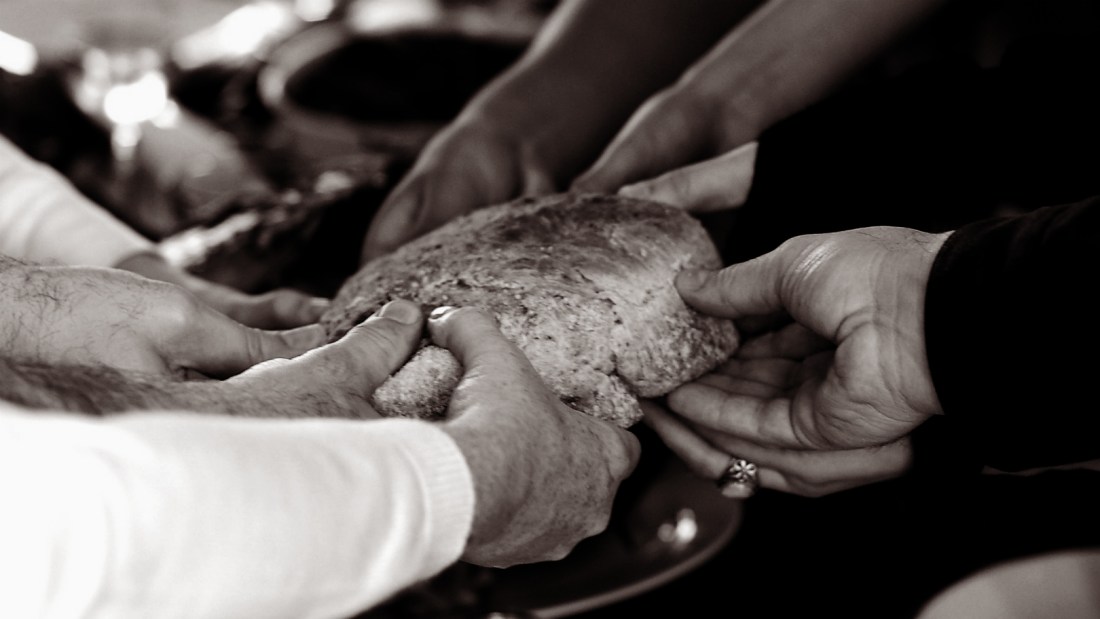
From Isaiah: “If you bestow your bread on the hungry and satisfy the afflicted; Then light shall rise for you in the darkness, and the gloom shall become for you like midday.”
hands breaking bread

7. MY SPIRIT.

I’m reading the four Gospels through over the forty days of lent. The Gospels tell the story of Jesus and that is what I want to know more about.  I think my (lack of) prayer life would be changed by truly knowing Jesus.  Prayer is communication in a relationship after all.

“Everyone was trying to touch him because the power came out of him that cured their ills.” Luke 6:19-26

I’ve got some ills that need curing.

8. SO FAR.

On this path of slowing down for Lent, so far I’ve seen I’m terrible at it. I’m self-consciously aware that I read my Twitter feed all day long. I dive quickly into FB and out again, because FB makes me feel bad. I post images on Instagram and wonder why I am not liked.  I want to sort out why does social media like Facebook make me feel bad about myself? I need to sit with my discomfort. Face it.  Own it.  Get over it. Do I think I’m a worthwhile person? Do I think I’m a worthwhile writer or photographer? Why seek other’s validation?

The word AWARENESS is sticking with me, nudging and prodding in all the right places.

I read these words somewhere today and jotted them in the front of my prayer-book.

Desire God, make space for God, and remember God does all the work.

Amen.

What about you? What practice are you taking on for Lent.  What are you observing as you slow down your days? (One day thus far.)  You don’t have to tell me here, just something to be thinking about.

Life Begins Again and Again: Seeing the Good in Depression

“The words spirit and inspire both derive from the Latin word spirare which literally means to breathe. These emotional highs and lows that we experience are just the natural breathing process of our spirits.” 

The Rev. Marcy Ellen, author of The Soul Truth: Reflections for the Waking Soul

Yesterday I wrote about what depression feels like and how much I hate it.  I’ve done that a lot perhaps even dwelling too long on the negatives, pain and grief.

Today, I’m reflecting on that. I found myself telling Tom, when he asked, “Yes, when I smile I’m forcing it, if not technically faking.  Fake it till you feel it,” I answered in a text.  Even he was surprised by my statements. And that got me thinking.  What about a positive post?

So this is about how one accepts the positive outcomes of depression. What are they? How do we grow from this pain? Six ideas.

We must face the things that might have made us depressed.

When you are clinically depressed, it is difficult to process reality well or consider clearly what might come of being sick. Surely there aren’t positive outcomes?  It’s likely you’re not thinking about how you might become a stronger person through the experience.  But I have learned that if you are willing to continue the hard work of therapy good things do eventually come.  I can attest to this in my life time and again.

For me, two good outcomes of depression and therapy are the growth that comes from self-discovery and  forgiveness. This only happens by facing your pain squarely and accepting your past, then working toward forgiving yourself or others.

It is only by looking at yourself very directly as if in a mirror and seeing in your own pain—your history and the toll it has taken on your weary face and in your tired eyes—that you can begin to move forward.

My depression often returns (the really bad stuff) when I start thinking that I’m responsible for things, that I’m in total control of the outcomes of my life, my family, my past and my future. Ironically these are things that are usually quite out of my control.  My perfectionism, my rigid thinking, and my acting like I am god all stems from a false belief that it is all within my control.

  • If I were a stronger, healthier or better role model and mother, “less depressed,” then my children somehow would not struggle.
  • If I had been a stronger child, more resilient and confident, I would not still be fraught with the outcomes of my father’s raging and abuse.
  • If I’d been less weak, sad and lonely, then I would not have become dependent on alcohol.

And on it goes, with wrong thinking about situations that were for the most part outside of my human control.

In my right mind, of course, I know that this is ridiculous thinking.  But depression does not allow the right mind to prevail, causing maudlin, senseless, sloppy and wrong thinking to rise to the surface and muddy the waters.

I’m so grateful to have been paired in life with a partner that is a frequent encourager, confident in his own ideas enough to sit me down, time and time again, and tell me squarely: That’s wrong thinking.

Through reflection, stillness and rest healing comes. 

I often guiltily spend time in stillness and reflection.  My life as a SAHM allows for this choice we have made for our family.  But my heartache and self-doubts make me wonder if I should be doing something more. True “work”—earning an income, being a breadwinner, and modeling work outside the home as a woman, something I believe in strongly.

I had to accept that a part of the reason I don’t “work outside home” at this point is that I need spaces of stillness in order to continue to heal.  My psyche is bruised. Spiritually I’m still dysfunctional.  I need space to heal, to pray, to listen, to become aware of and open to the Spirit.  I still wrestle with “Why me and not others? Why do I struggle so with depression?  Why am I privileged enough to not have to work?” My brain always asks.  For now, all I can do is accept how fortunate I am to have a partner who can provide for our needs.

Take the wide open spaces, as a Season to Heal.

When I worked full-time I was driven by fear of failure, insecurity and a need to build my own domain of responsibility.  The more I accomplished, the more they threw at me and I ate it up, loving the affirmation and the challenge.  If I’m honest I was motivated by conquest and power more than anything else.

Stepping away from that was not a choice to be a SAHM it was a choice to not work there any longer.  Over the years, as I have lost that part of my identity, as you can imagine it’s been hard.  I have always needed and wanted work—to fill me, even fulfill me.  

A part of the healing has been accepting that I’m okay without that part of my identity.  Yes, I write, and enjoy the expression of my soul and mind through photography but it’s not a paying full-time job. I have always written it off as lesser importance.  Finally, okay not finally but for the most part, I accept myself and that means that I can face those monsters of purpose and identity.

I’m not there yet, fully healthy.  My identity in Christ, my value in the kingdom, my desire for accolades, and attention, and applause, still live inside me.  I can say that things are headed in the right direction.

We can heal by asking why we were led into this spiritual recession.

Marcy Ellen suggested the question.  And this sort of question is helpful to me. I’ve never considered my depression as a spiritual recession and it’s a challenging idea.  It reminds me of the spiritual seasons of the book of EcclesiastesSp Chapter 3.

For everything there is a season, and a time for every matter under heaven:

a time to be born, and a time to die;
a time to plant, and a time to pluck up what is planted;
a time to kill, and a time to heal;
a time to break down, and a time to build up;
a time to weep, and a time to laugh;
a time to mourn, and a time to dance;
a time to throw away stones, and a time to gather stones together;
a time to embrace, and a time to refrain from embracing;
a time to seek, and a time to lose;
a time to keep, and a time to throw away;
a time to tear, and a time to sew;
a time to keep silence, and a time to speak;
a time to love, and a time to hate;
a time for war, and a time for peace.

ECCLESIASTES 3:1-8

[hope]

By accepting the seasons of living, we can be comforted. Especially when some seasons contain suffering and pain, we can know that it leads naturally to a season of healing and growth.  If we do more than simply endure it and fully accept, we can appreciate the ups and downs, leading to a deepened time yet to come.

Life can be outrageously difficult, “A wild and mesmerizing melody,” says author and Benedictine sister Joan Chittister, one of my spiritual mothers, in her book For Everything A Season. “We can go with the flow (of life) or we can resist it all the way to the bitter end. We can learn from it or reject it completely…Life is a relentless teacher.” p. 154.

The truth of this life is that sometimes we’ll struggle and at other times we’ll thrive, even dance!  This is hard to believe when you’re depressed.  But the thought fills me with hope.

And I believe hope is what eventually heals the depressed, if it is not total healing at least something good. Whether it is through God’s healing or a therapist’s genius. Perhaps it is a husband’s quiet truth spoken over two decades or a friend’s frequent kindness. Or other forms of healing.

Hope spoken aloud and believed is the path to healing, and it is the way forward to a season of laughter and dancing.

I believe these seasons of grief, with tears searing warm salty pathways in my soul, will lead to building up and healing, to days other than this.  As Chittister says, there is no such thing as a meaningless moment.  It is all important, teaching us, molding us, chiseling our souls, shaping us into a person of compassion and joy.  “Who is the happy person? Those who have survived each of the elements and found themselves to be more human, more wise, more kindly, more just, more flexible, more integrated because of having lived through that period of time, that moment of definition, that phase of survival, that streak of chastening awareness.” p. 156, For Everything A Season.

Awareness and acceptance are all. 

Accept your lot, even while you strive through self-care, perhaps medicine and spiritual guides, and time, to heal.  As we stop fighting our life, we become aware that each season is meant to teach and force us to grow and grow up.

This season of depression is an opportunity for me, if I am willing to be still and listen.  I will sit in the quiet of this moment and lean in, for there life begins, again.