I’ve never really cared to prove that God exists — before today. My son looked at me with his huge blue eyes the color of warm ocean and cried:
“If God is real, why doesn’t he stop all the bad stuff? Why Mom? Why?”
I felt as if I’d been slapped hard across the face by the innocence of his question. It is something that I try not to think about. I try not to dwell on that now as I sit here enjoying my expensive coffee, in my warm house, in my comfortable chair. As I sit at my computer which is connected 24/7 to the world, I try not to think. Or feel how much that stuff hurts. It makes my comfortable life not — so — comfortable when I turn on the radio and they tell me of people being beheaded. Or a woman who had acid poured into her face. Or that going for firewood in some places in the world will get you raped. Or that girls are still unwanted in many places in the world.
I try not to feel how bad that makes me feel. I try to not be in that moment because it hurts. It hurts me! There I said it.
It makes my stomach hurt when over and over, I have to tell my kids to eat their dinner and be grateful. How very lucky they are that they have something to eat and a glass of milk to wash it down. And when they complain that there is no desert, I try not to feel bad that I didn’t indulge them. And won’t remind them, again, of how much they have. I makes me hurt when my smart, but bored kids bring home reports of below average work, when they complain about homework, I try not scream at them of their lost opportunities. And remind them of the children in many parts of the world that will never go to school. Or children in our country who cannot safely walk home from school in their own neighborhood. I try not to scream. I do. I try not to, but we have so much. It makes my stomach hurt and I try not to compare.
Why could a good God make life so easy for you my son and so hard for so many? We are the 1% and we have no idea how lucky we are. Is it luck? Random stupid luck that made my kids healthy, and smart, and born into a well to do home? I cannot answer. I have — no– answer for my son when he asks me to prove God exists, because I agree! What kind of God would set things up like that?
My son was born into a white, middle class home full of privilege and opportunity, without the violence and cruelty so many children face. He was given for no reason of his own doing good health, and wealth, and I believe God intends that he does something with it for others. My son, along with you and I, we prove God exists by seeing the pain that others suffer from and hearing the cries of those born with less. We prove God actually loves the world. We are his love. We are his hands and feet. We the one percent are a part of the his answer. No, not just me. Not my son, only.
another life, and that in turn another, until who knows
where the trembling stops
or in what far place my touch will be felt
Frederick Buechner
——————————————
(Carl) Frederick Buechner is an American writer and theologian. Born July 11, 1926 in New York City, he is an ordained Presbyterianminister and the author of more than thirty published books thus far.[1] His work encompasses different genres, including fiction, autobiography, essays and sermons, and his career has spanned six decades.
Last night, my ten year old son said he wanted to stay up until midnight — insisting that he had to do it. — But why? I asked slightly bewildered.
“If I do, I will have not cracked my knuckles for a whole day!” he told me in all seriousness. He has a nervous habit. It makes him self-conscious but I had no idea how much. He came up with this promise to himself. I reassured him that he could “not crack his knuckles in his sleep and that would still count.”
But it strikes me and stays with me today. That little self-improvement goal seemed so simple to me and yet it was such a challenge for him as he made a promise to himself and kept it. It made me wonder how many times I promise God something and don’t do it. Does he, like a mother feel admiration for me that I even try? Or is he disappointed when I fail?
Blessings & Curses.
I wonder. Does God withhold blessings from us if there was something that God has wanted us to learn and we knew it full well but resisted. Or ignored God? Pretend we don’t hear, like child who acts like they can’t hear their mother calling from the next room.
Sermons are like that sometimes. Most of the time not offending seems to be the order of the day and sermons become nothing more than a gentle reminder. Not exactly optional, but full of choices and options … How many of those softball sermons have I ignored or just not allowed them to change me? Or when they challenge do I consider it “optional?”
Yes I do that. I ignore God regularly. Stubbornly. Foolishly, knowing fully that God has my best interest in mind and yet I can’t gather up the willpower to obey. To stop cracking my (spiritual) knuckles.
What? You don’t? I don’t believe you.
And do we miss out on blessings, on a level of happiness or contentment because certain challenges from God seem too hard? Not that serious. Life goes on.
Of that we can be sure.
Floodgate of Social Media.
I cannot seem to deal lately with the torrent of information coming into my life through the media. A friend, who is a Scientist at the university, said he thought perhaps evolutionarily (is that the right way to say that? what is the word I’m searching for?) we are not capable of taking it all in. Our minds and hearts just can’t absorb it.
Some days I feel my heart cracking open reading about suffering in Japan and Christ Church,NZ, ongoing efforts in Haiti and areas of Africa, our nearly decade long wars in Iraq and Afghanistan, cholera outbreak in Ghana, ethnic minority Christians facing religious persecution in Vietnam, unrest in Yemen promoting Somali refugees to flee there, political unrest in Nigeria, drought in Niger, measles epidemic in Kenya, even AIDS being still the number one killer was brought up on the Colbert Report last night. Can’t even escape the pain in humor.
We cannot get away from it. How would God have us respond? It’s too much. I cannot bear it. I need to know what God would have us do to respond.
Justice.
My understanding of the gospel is becoming enriched by the truth of a recent sermon series at Blackhawk on Justice. And reading Timothy Keller’s book, Generous Justice. God’s justice is not a distraction from the gospel but a centering on its fullness. Whenever anyone argued with Amy Carmichael that the gospel was only a proclamation and didn’t include acts of mercy and social justice, she emphatically said to her critics: “God didn’t make you all mouth.” Ha. I love that.
And Bishop J.C. Boyle, a nineteenth-century British evangelical, said: “Let the diligence of Christ be an example to all Christians… Like Him, let us labor to do good in our day and generation, and to leave the world a better world than we found it….Let us awake to a sense of our individual responsibility.”
My Church & Women: The ongoing Crusade.
I’ve decided to acknowledge to myself that I am on a crusade. It may be small. It may be ineffective. But I am. In my reading this week I read that if you truly disagree with the premises of your church on women in ministry or ordination of women you will eventually leave that church. People just do. For the most part churches don’t change — especially those connected to a denomination. People give up. Lose hope. And leave.
While that was devastating on one level, because I love my church dearly. It also made me accept the truth that I am on a crusade to change it.
One can’t simply learn the truth and sit on it.
Truth not only changes how we see ourselves, it changes what we do and how we live.
— Carolyn Custis James, Half the Church.
What I know. Jesus loved women. He consistently reinforced human equity. He mobilized and recruited and listened to and even hang out with those who were on the margins. He valued women and they served with him and spoke for him, gave witness faithfully in the Bible, which seems to me to be a story of redemption for marginal people. And there are leaders in my church who do too. They believe, they agree, they are willing to concede. But moving a church is as I’ve said like moving the Titanic. It won’t happen any time soon. I will be the quiet, prayerful voice of change.
More on this in the future, but for now…
Authorities at my church have decided to phase out the Bibles that are on hand every week, calling it a Bible Revolution. They want people to use their own personal Bible. Yay. The best thing that will come of this, besides the obvious, is that they won’t be tied to the New International Version any longer and can perhaps use an inclusive translation like the New Revised Standard Version that speaks to women as well as men. That one uses language that is more welcoming to women.
Halle — fricken — lujah!
“Is the gospel truly good news for women who live in entrenched patriarchal cultures?” — Carolyn Custis James
The Titanic didn’t move this week, but the iceberg it is stuck in melted a little. Viva La Revolution!
Winter seems to be lingering here in the Midwest. I dug out an old poem from October, 2009.
No matter how long I postpone trying on last year’s coats, hats and gloves,
even still winter comes. If I leave the hose out until it’s frozen stiff, snaking through the yard,
still winter comes. The pots and the plants they crack and curl from the cold. Winter, comes.
Winter comes in the cold,
dark mornings heralding sad thoughts and memories.
I lost my father to the winter. I discovered, accepted and revealed a family’s ancient addiction.
I miscarried. I fell down. I fell apart. Always winter comes.
Winter means waking early with darkness bringing in the day.
Though I try to overcome, the anxious thoughts settle in.
Remember the cold. Remember, remember. I am always falling, in winter.
Good things are lost, so do not hold too tight
to what you desire most. You will lose them to winter.
Love hurts more in winter, dries up and becomes need.
Love becomes memory. I am falling. In winter.
And at the moment when the winter once again threatens to overcome, I end my slumber.
On that icy morning I wake early. Snuggle in.
Sipping coffee, by the fire. And I think of Spring.
As you, I am thinking of spring!
Feeling grateful during the season of Lent, as I process how much God has done to redeem me from the pit where my life was. I must never forget. Ever. I cannot. Reading Henri Nouwen and he speaks to this:
“In our lives there are moments when we realize that, even if we may have done everything to destroy ourselves, we have never lost our true identity as beloved daughters or sons. That identity is never taken away. And that moment of realization is a very, very important moment.
“But take care what you do and be on your guard. Do not forget the things your eyes have seen, nor let them slip from your heart all the days of your life…” (Deut. 4)
Amy Wilson Carmichael was a Protestant Christian missionary in India, who opened an orphanage and founded a mission in Dohnavur. She served in India for 55 years without furlough and wrote many books about the missionary work there. While serving in India, Amy received a letter from a young lady who was considering life as a missionary. She asked Amy, “What is missionary life like?” Amy wrote back saying simply, “Missionary life is simply a chance to die.”
Carmichael’s work also extended to the printed page. She was a prolific writer, producing thirty-five published books including Things as They Are: Mission Work in Southern India (1903), His Thoughts Said . . . His Father Said (1951), If (1953), Edges of His Ways (1955) and God’s Missionary (1957). In 1931, Carmichael was badly injured in a fall, which left her bedridden much of the time until her death. She died in India in 1951 at the age of 83. She asked that no stone be put over her grave; instead, the children she had cared for put a bird bath over it with the single inscription “Amma”, which means mother in the Tamil. Her biography quotes her as saying: “One can give without loving, but one cannot love without giving.”
I don’t think about my father very often — any more. After he died, there was a time when my relationship with him clouded everything I did, or thought, or believed. Before he died, I had no real understanding of how much he made me who I am. He and my mother. Every choice I made, sadly was in some way a reaction to his control over my mind and my heart. I don’t think he meant to have that kind of power over me, nor would he have wanted it. But it happened that way because I was so afraid of him. I so wanted his approval. And longed for more from him and my mother.
I talk a lot about the mind and heart in my writing because though two different organs they are connected psychologically to — what makes us — human. I believe they make us who we are and it is through our choices (by making up our mind) that we grow into different people (transforming our heart.)
It’s strange to think back. I had no idea how unwell my parents were — as a child I thought they were just being parents. Thought all parents were like mind. I had no notion that there was a good or bad way to be a parent. Nor could I conceive that I might one day stand in some sort of judgment over them and I am still very uncomfortable being perceived that way.
[I feel when I write about my mom and dad, I have to give this caveat every time: I know my parents did the best they could with what they had. I figured that out through lots of therapy. I do accept it now.]
Listening to a radio interview yesterday of Anne Sexton’s daughter, Linda Gray Sexton, I was struck once again by how very dysfunctional my home life was growing up. If you don’t know, Anne Sexton was a poet, known for her confessional verse who won a Pulitzer Prize for her poetry in 1967, a year after I was born. She suffered through out her life with clinical depression and after many attempts, killed herself when she was 45 and her daughter Linda was 21.
While I listened to Linda talk about her relationship with her mother as a love/hate and like/dislike, oh how much I related as it is unpleasantly close to what I experience today with my mother.
I love my mother dearly, but I can’t figure out a very good way to be with her. I want to be in her life. And I try, sometimes. And at other times not very hard at all. I know that I must be a better daughter. And that she is a widow. And I have all that weight on my shoulders which I want to live up to. But often we hardly see one another and she lives ten minutes away.
Certain things she does hurts me, over and over again. And no matter how much I have learned to not take it personally it is hard not to do so. For example, it is not personal that she does not show up to things that are important to me because she got sick or is not “up to” it or is genuinely in some physical pain. She’s done that my whole life and it feels personal! But it’s not. I think she just shuts down sometimes. I believe it is because of my father’s treatment all those years — her brain blitzes out and she just can’t “do” life. It comes and goes. Sometimes she’s all over me. And then she’s gone.
I simply want to escape the pain of not being able to understand my parents and how they treat me.
For Linda, growing up it was taboo for her to talk about her mother’s suicide attempts. For us it was forbidden to talk about my father’s rage, my mother’s illnesses, and later the drinking. There were so many secrets. I wrote about that in a poem to my sisters titled A Sacred Contract and that’s what it was.
Linda Sexton said how much her mother’s depression and suicide attempts hurt her. I’ll say it. These are the things that broke my heart early on in life and God is beginning to repair. My father’s rages. My mother’s obvious misery. My father’s belittling and constant picking at her and us. My mother’s frequent sinking into illness to “get away” from him. My father’s work and frequent travel with subsequent fatigue. My mother’s constant “support” and appalling attempts to build him up when he was in one of his Funks of insecurity and fear of failure. I think because if he fell apart the whole thing — our lives — would fall apart also. At least that was the threat. That was the fear. That tsunami was constantly just off the coast for years.
Relationships with parents are difficult and complicated. On the one hand we know how we are so like our parents in their dysfunction and we castigate ourselves for it. There is a level of shame involved that must be overcome.
Forgiving your parents for being who they were. And forgiving ourselves for being so like them or for choosing not to be like them any longer which also somehow becomes a betrayal as well.
No Boundaries.
Linda went on to say, as she put in her book Half in Love, another dilemma of living with such parents is that there are no boundaries appropriately set up by the adult. And so the child feels unsafe — life feels precarious all the time. My father’s rage was so unpredictable. Even while it was on some level expected, it came at unexpected times. If you cannot count on or predict the bad, on some level you cannot believe in the affirmation and love. I don’t know why. You just can’t.
And yet I worshiped my father. There I said it. And it is true. Just as others did, I did.
And that was also my betrayal. I worshiped my father and came to unfairly loath my mother. It’s twisted. She suffered from his rages more than anyone. She endured. She protected us by holding that fragile matchstick house together all those years. But I saw her as the betrayer of us after all those years. Thinking somehow she should have left him. And what would have become of us if she had walked out on him after one of his thousands of verbal beatings over the years? All I know is now. Now without him we are a fractured family. We don’t know how to be with each other. We are all alone in our lives together.
Parenting by free fall.
As a mother, after all these years I see how this way of growing up gave me “no map for how to be a mother” as Linda Sexton put it so well yesterday in her interview.
I have struggled so much with the confusion of that reality. At times, saying I should never have become a mother. What was I thinking, thinking I could be a Mother? Sure, I can do the driving, and wipe away tears, help with the homework (not math!) and in the classrooms. My mother was a great homemaker. She cooked exceptionally well. I’ve gotten than from her but kids can survive without it. And she loved to garden as do i. She was a terrible cleaner, as am I. It is not that I cannot clean, I just do not.
But shouldn’t home be “a self-sustaining world unto itself. And mothers world-makers?” as David Griffith says in his essay Homemaker about his mother.
The fact of the matter is that I feel about as able to be a parent as a Mime.
I copy other people. I try to mimic Mothers that I admire. But I am mute. And a fake. I continuously hit some strange, solid and impenetrable internal wall. I cannot break through it to discover what it would mean to be a “normal” or “good” parent. A good mother. I have not found the answers in parenting books either. They are not the answer.
It’s something deeper. I don’t trust myself. And beyond that I do not even have words for it because I have never experienced it. There are missing pieces of my soul, my experiences, my character and person.
How can I ever hope to be a healer? Because that is one word I do have for motherhood.
Mothers are meant to be healers.
I am left with the knowledge that my only hope is that The Healer will infuse me with the Spirit of God. Then and only then, there and only there something good will come. I have to trust in that.
I have to set all my hope in that. Because left to my own devices there is only fear, insecurity, depression, addiction, rage, and broken hearts. There is only an inability to love, to connect, to nurture, to receive, to cohabitate — to be human. I am not being overly dramatic although it sounds so. When all you knew was rage you are unable to be normal.
I wrote this poem i 2004 after my father died. It felt like a betrayal then, when the words came out of me they were as much of a shock to me as to others I think. But now I see that they were s t e p s toward my own healing.
Good Dad. Bad Dad.
I shed no tears today
for the warrior who has fallen.
Taken down by Cancer’s sword.
My heart is full of memories,
good and bad.
Good Dad. Bad Dad.
Constant worry.
Constant change.
Who could have foreseen
the Cancer overtaking his mind;
that became my liberation
in five short months.
The danger –
of loving too much;
needing tenderness,
and all the things Daddy’s are supposed to be.
PAIN. FEAR.
Emotions jangling around inside me
like some kind of white noise;
pushing their way into my conscious thoughts.
Invaders, threatening to undo
the weak hold I’ve found on The Good Life.
So many memories
good and bad,
bad and good.
Who was he? Why was he MY dad?
MY tormentor.
MY warrior;
Finally broken,
beaten by the Cancer
that was to become my friend.
Betrayal, these thoughts which plague me.
Broken; the unspoken promise
to keep our secrets to the end.
How do I remember?
How do I stay true and honest,
when the Truth causes an ache
too strong to feel,
to face,
to bear.
Good Dad. Bad Dad.
Who was he in the end?
A Demon? A Saint?
Now simply a Muse?
Remembered, but no longer feared?
Thought of in furtive,
anxious moments?
Good Dad. Bad Dad.
Who is he to me now?
A man driven to despair
Living a chaotic, frantic life.
Not the Good Life I choose,
Not the legacy I will repeat.
Good Girl. Bad Girl.
Who will I listen to?
Who will I believe?
I am the woman I choose to become
today, tomorrow.
These are the Good Days
that I can change.
Yesterday is dead.
Burned in the funeral pyre.
Vapors.
Mist.
Dust settling around me.
Good Girl. Bad Girl.
Good.
Bad.
Good.
I certainly don’t know what it means to be a Mother. A Daughter. A Sister. A Wife. A Friend.
I
just
don’t
know.
But I can only take this life one day at a time and hope in God.
None of us can rewrite our history. Nor should we try. It makes us who we are today. And for me, it makes me strong enough to write tomorrow.
Every once in a while someone talks to me about my blog. They read it! Someone stopped me at church to say so and I want to thank him and you. This is unimaginably rewarding. I know that people are reading, because WordPress gives me stats that show how many view my blog each day. But when a real live person takes the time to tell me that what I write means something to them — well, that is priceless to me. Thank you Eric! What flows from my heart is what I write here and it is a part of me. It is my discoveries, my pain, my growth and better understanding of the world. Thank you for reading.
I love new discoveries. So, you may think I am stuck under an intellectual rock but I just discovered Miroslav Volf tonight and I’m loving his brain. I spent about a 1/2 hour watching him on YouTube. I’m hooked.
“The proper distance from a culture does not take Christians out of that culture. Christians are not the insiders who have taken flight to a new “Christian culture” and become outsiders to their own culture; rather when they have responded to the call of the Gospel they have stepped, as it were, with …one foot outside their own culture while the other remaining firmly planted in it. They are distant, and yet they belong . . . distance born out of allegiance to God and God’s future. . . . Both distance and belonging are essential. Belonging without distance destroys . . . but distance without belonging isolates.”
— Miroslav Volf, Exclusion and Embrace
And then there is this. I have no idea who John Stuart Mill is (again the uneducated rock) but this quote knocked me off my seat.
Ask yourself whether you are happy, and you cease to be so. . . . Those only are happy who have their minds fixed on some object other than their own happiness; on the happiness of others, on the improvement of mankind, even on some art of pursuit, followed not as a means, but as itself an ideal end. Aiming thus at something else, they find happiness by the way.
— John Stuart Mill
On the topic of women and equality this is the quote that stuck out to me in my reading this week.
“Life will not be less than, when women are truly equal with men. Life will be richer, and greater, and men will be more than they are now, when women are no longer considered less than they really are.” — discombobula
And I’ll leave you with a quote from the author of one of my favorite books, The Secret Life of Bees.
In that curious and exotic way that an “unteacher” appears only when the student is ready, the Magritte painting appeared and opened several revelations to me. First, our lives as women are not always as self-created as we might assume. And second, once we are caught in the pattern of creating ourselves from cultural blueprints, it becomes a primary way of receiving validation. We become unknowingly bound up in a need to please the cultural father – the man holding the brush – and live up to his image of what a woman should be and do. We’re rewarded when we do; life gets difficult when we don’t.
I have to run. I’ve been ignoring my kids since 5:00 pm!
Good Night, dear friends.
MH
——————————————————————————-
Miroslav Volf (born 1956) is an influential Christiantheologian and currently the Henry B. Wright Professor of Theology at Yale University Divinity School and Director of the Yale Center for Faith and Culture, which focuses in part on Workplace spirituality . He has been a member in both the Episcopal Church (USA) and the Evangelical Church in Croatia. He is widely known for his works on systematic theology, ethics, conflict resolution, and peace-making. Recently he contributed the essay, “Forgiveness, Reconciliation and Justice” to a new text on the atonement, Stricken by God? Nonviolent Identification and the Victory of Christ.
What is your prison? What deprives you of freedom? To what fear do you fall prey?
Please, oh please would you take away the endless, maddening worry over words.
The words I love as I endlessly twist and turn
them. Allowing the words to loll about on my tongue.
I cannot get them out loud. Not well enough.
And it makes me boil with fury. Powerless because in my brain it is all
so clear. On paper every word concise and even brilliant, a time or two.
But out loud I am a clown.
If I could buy any talent in the world I ask
would you give me the ability to actually say what I think?
The persuasive magic of breaking down walls of misunderstanding?
Of bringing people together toward an idea, a prayer, a prophetic word, an affirmation that needs saying.
Oh the words, the intent, the message in my heart I just want it out. Out of my head.
In the interview, I spoke of comfort speaking publicly, but it is so much more.
It
comes
down
to the
w o r d s
CrowdingInMyHead.
Please, oh please
take away the endless, maddening worry over w o r d s turning
“Silence in the face of evil is itself evil: GOD will not hold us innocent. Not to speak is to speak. Not to act is to act.”— Bonhoeffer
NOT TO SPEAK IS TO SPEAK : VOLUME 2
This is my attempt to consolidate some of the things I find on the web. Of course this is a drop in the bucket of what I read all week, but you have to focus sometimes.
Image via CrunchBase
Several things on the UCLA Student’s recent YouTube Video.
A white student rants about Asians and it goes viral, drawing accusations of racism.
“Sadly, what she expressed isn’t that different from what a lot of Americans think, even if we’re not posting it on YouTube … In many ways this blonde-haired, exposed push-up bra wearing college student, embodies the popular and prolific image of entitled, image driven, individualistic “Americanness.””
You can read the rest here and see the video it its entirety there. You should watch it if you are white. If you’re not white, you’ve likely seen or heard of it already. If you are white, I think you have a responsibility to SEE things like this. Before you go there, thinking I’m “over reacting” I’ll acknowledge that I need to spend some time considering all this and being prayerful before God. But in the meantime, I can call racism what it is — wrong.
My initial thought is this. Although I feel ashamed of being white, many many times. Today, more than any day in a long time, while I watched this young lady’s strange, egocentric, racist, stupid and ignorant rant about the “hordes of Asians” at her university I was mortified for all of us.
“Ching chong? Hordes of Asians? American manners?” A friend I have made because of the internet responds to the student’s video as a Mom and an American and one of the Asians that the young lady at UCLA refers to in her video. In A Mother’s Rant About Racism & ReconciliationKathy Khang shares a personal response. I love her heart and learn so much from her every time she writes.
And still on the topic, here are some things White People with Power should consider. That would be me.
“However difficult it is for many White Americans to hear, examples like this video clearly show that many (as in a large number, but certainly not all) Whites implicitly think there’s nothing wrong with invoking cultural stereotypes to portray an entire group of color. I have written about this dynamic many times before, but needless to say, this is certainly not the first time that Whites have tried to “make fun” of Asian Americans or other groups of color on college campuses and elsewhere in society…”
Lastly, an incredible response by the InterVarsity’s Asian Staff director, James Choung. He is godly, kind and wise. Once again, I learned a lot. These are things that privileged white people need to hear.
A glimpse into the heart of an incarcerated father.
Dear Son: A Letter from an Incarcerated Father on how a believer behind bars might pass on his faith.
Statistical studies tell us that roughly 90 percent of incarcerated parents are fathers. Their offspring, approximately 2 million strong, represent the textbook definition of “at risk” children. According to the Princeton University’s Center for Research on Child Wellbeing, the absence of a father—particularly due to incarceration—correlates with a plethora of family dysfunctions, including elevated rates of juvenile crime and incarceration.
Politics.
Congress Making Themselves and Friends Richer, While Everyone Else Struggles to Make Ends Meet. If you don’t read Jim Hightower you are missing out.
The great majority of Americans make about $30K a year. Incoming lawmakers, however? Extensive personal investments in Wall St. banks, oil giants and drug makers.Change is not the same thing as progress. In fact, change can be the exact opposite. It can be regressive, as we’re now learning from — where else? — Congress.
Feminist Reading.
100 Young Adult Books for the Feminist Reader. Whether you’re already knee-deep in young adult literature or looking to reacquaint yourself with an old favorite we’ve put together a whopping 100 of our favorite young adult novels, featuring kick-ass teens and inspiring feminist themes. These stories will empower teenage and adult readers alike.
[I’m not recommending all of these books because I haven’t read them all. Simply passing on the list. Make your own wise choices.]
The Environment.
You have to watch this video by Allan Savory, a Zimbabwean biologist, farmer, soldier, exile, environmentalist.
Winner of the Banksia International Award 2003 and winner of the Buckminster Fuller Award 2010. He is the originator of the Holistic Management concept that turn deserts into thriving grasslands, restores biodiversity, brings streams and rivers back to life, increases food production and security and stores carbon in ever deeper and healthier soils – all of this while reversing global climate change.
He won a TED award and that’s how I found him. I’m in love. So sweet. So passionate. So smart!
Next time perhaps.
Rob Bell. What I’m learning from reading on feminism and women in the church. And Libya, going to war? … and my current theological thoughts on Justice.
A friend sent me this article in Christianity Today, because of what I wrote yesterday, mentioning Rob Bell. Upfront, it asked:
“Do you think it is wrong for Rob Bell to question traditional views of heaven and hell? Answer: I don’t care. Do you think it is wrong for traditionalist writers to label Rob Bell a universalist? Answer: I don’t care.
Do you think it is wrong for every Christian with an iPhone to tweet their answers to the above questions from restaurant bathrooms and then go home and blog about it? Answer: Now there’s an interesting question.
Of course, we care about the doctrines of heaven and hell. As Bell reminds when I heard him interviewed on Good Morning America what we think about heaven and hell informs what we believe about God and how we understand what it means to respond to the suffering around us, here and now. Informs how we live out heaven and hell right now. And it informs what to think about injustice here and now. And that I agree with.
Oh, a controversy was stirred and it will sell a bunch of books and Rob Bell will survive to preach another Sunday. But I don’t really care. In How social media changed theological debate, the author John Dyer goes on to say something MORE IMPORTANT. In fact the more I think about it, it is critical to this conversation.
But my response is different than Dyer’s.
Dyer says:
“Throughout the history of public theological debate, there was one constant—those debates only took place between a few select people—Moses, Plato, Augustine, Aquinas, and so on—who gained respect through a lifetime of scholarship….In pre-2004 Christianity (that is, Christianity before Facebook was invented), only a small group of Christian leaders and teachers had access to the printing press—but today everyone has WordPress. In pre-2004 Christianity it was difficult to become a published author, but today everyone is surrounded by dozens of “Publish” buttons.”
He is gravely concerned with the quality of the debate. The quality of the conversation, teaching and writing on-line because with the advent of WordPress any ol’ person can express themselves. And I would never argue against a need for quality conversation or scholarship! But that doesn’t answer a more important question of who is writing and teaching?
The culture is changing rapidly. Books are becoming less relevant, though I for one will always buy and read books printed on paper. Even so, yesterday I found myself longing for a Kindle because there was a book I wanted to read immediately! The church needs to catch up to the immediacy of our culture and how it communicates.
Many pastors still do not Tweet or have a Facebook account. Mine does not and I am sure it is not just because it is too hot — unpredictable — with much opportunity for people to misinterpret. It’s also time consuming. And mentally degrading to clarity of thought. If you are working all week to compose your thoughts on a particular topic for a sermon, it can’t be helpful to constantly be distracted by multiple media. And yet, hipster pastors are online frequently and do these things. As do many of the younger pastors in my church. I am sure they spend much more time and energy than they would like thinking about what’s wise to say or not say.
The fact is one thing hasn’t changed, even as the culture does, our need to use restraint, to respond with maturity and self-control . These are things that one would wish Piper and others had, even when tweeting. Our words still matter! Our heart, mind and soul — even more so than in the pre-Facebook age — is out there for the world to scour over!
Here’s what is most important to me about this conversation.
This new social media gives power to people of color and women — to those that have traditionally had less access to theological education, opportunities for preaching, teaching, and writing and getting published. (Even the homeless.)
So while I applaud Dyer’s thoughts about who should speak, teach and write in the specific situation, one must remember that not everyone is a white, male with all access to publishers, to power and to influence. Yes, everyone needs to exercise restraint when it comes to social media. But the new social frontier gives a voice to those of us who have traditionally been kept out of the conversation, the board room, seminaries, and these voices and viewpoints need to be heard in these critical times.
Why is it that each book suggested at church for extra reading in the last year was written by a white man? Or that almost every song sung on Christian radio, and thus in churches, has a man singing or writing it? Or that all the elders at my church are men? And the teaching team is all men? Why are conferences full of Godly Christian men, with perhaps one female or person of color, MAYBE? Why?
So, my response to John Dyer is “You may knock blogs because the level of thinking isn’t on the level of Moses and Plato, Augustine, Aquinas, and so on … well, have patience!
Until the brick and mortar institutions change for women and people of color, we need places like the internet in order to be heard.
Until you or I can name a Latino or Latina or African-American or female theologian or two, as quickly as you can think of NT Wright or J.I. Packer or John Piper we need the internet in order to be heard.
Until my pastor can name an up and coming female pastor or theologian, as readily as whatever man is on the tip of his lips, we still need this medium to bring change
I believe until it is just as commonplace to hear the perspective of a woman or a person of color in your lifewe need the internet in order to bring change. It is messy, and imperfect, but it gives access.
I would not have my story published if it were not for connections made on-line.
In Defense of Women. This was interesting and not just because he mentioned me. It relates to not having women’s voices as a part of “the conversation.
I think I’ve got March madness, and it isn’t about basketball.
It’s been such a strange week already. I feel exhausted and I can’t identify exactly why. It cannot simply be the time loss or the season changing. It’s March and so for Wisconsin that means lots of sunshine. Lots of slush. There is an anticipation in the air but there is still snow on the ground. I went for a walk earlier today in shorts and snow boots!
The highs and lows of late are stunning and I do not mean the weather. It’s international woman’s week and I was going to write about that. Perhaps I still will. I’ve stopped and started several posts. Taken lots of photographs. Thought, prayed and dreamed about the future.
Here are few things I’ve been thinking about — being an artist & a Christian, politics in Madison, Rob Bell and what that has to do with the future of women in ministry in the evangelical church, my baby turning ten, and getting a job. And lent.
Artist Showcase @ Blackhawk
Tom and I thoroughly enjoyed participating in a showcase of artists at our church. We, along with more than fifty other artists, expressed how we love and are loved in the context of the community of Blackhawk Church and beyond into our Madison community. It was so rich with the many expressions of God at work in people’s lives in song, spoken word and visual art including a dance! It was a very powerful time for me. I’m glad artists have a platform in the body of Christ for their gifts to be used. I think many times artists do not know exactly what our place in the church is or might be.
Politics in Madison
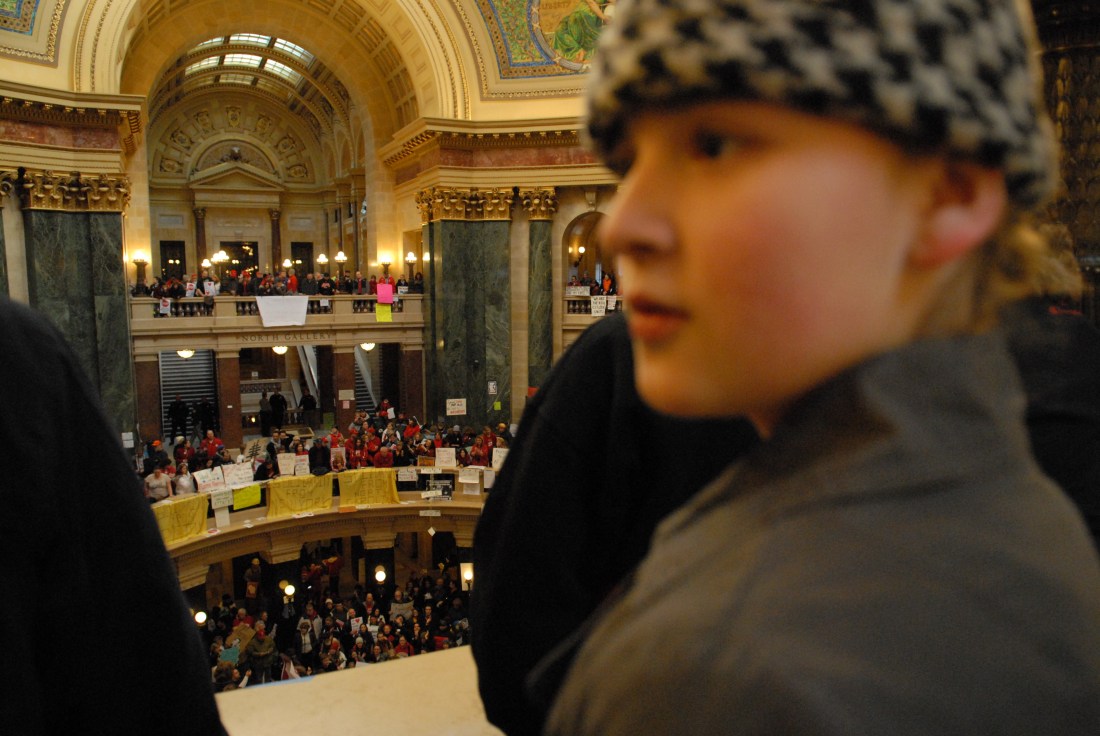
The whole political shenanigans in Wisconsin is exhausting. So many folk are pitted against one another, the national media is saying strange and untruthful things. The demonstrations have been peaceful while the rhetoric is grinding and vitriolic. It’s troubling. Hard to know how to be loving in the midst of what feels like grave injustice and oppression of the poor. I have a lot of images here.
I want to lead a book group at my church for people interested reading and talking about women’s roles in ministry, but I was turned down.
I understand. How can you read books about women in ministry without it becoming theological? And well, as I don’t speak for my church and this isn’t something they want to get into “right now.” So therefore, I can’t do the group. I was choosing the wrong format for what I wanted to do anyway which though Tom says is “nurture a small revolution” that is not completely true. Yes and no. But yes, kind of.
So Iwill keep praying about how to move the titanic of conservative belief along.
I’ve started to think there’s little hope for women to preach, teach and lead within evangelical church denominations.
This last week it was as I learned about the controversy with Rob Bell. If you don’t know about him, and I didn’t until a few months ago, he’s what the New York Timescalls “one of the country’s most influential evangelical pastors” and he comes highly recommended by a few people in my church. He pastors Mars Hill Bible Church in Grand Rapids, Mich., with 10,000 members. If he sounds like a Christian celebrity, it’s because he is. I watched him online. He is a hipster with groovy dark glasses and a lanky look. They say hundreds of thousands follow him online.
Anyway. Bell’s new book, Love Wins, looks at the doctrines of salvation, heaven and hell. He may have said something about Gandhi and hell inferring that a loving God wouldn’t send Gandhi to hell, or something. Prominent Christians that you would know by name have denounced him with the double criticism of universalist and unbiblical. Here’s the crazy part — no one had read the book. It came out on Monday. And yet conservative authorities like John Piper, wrote, “Farewell Rob Bell.” on Twitter.
“These knee-jerk reactions, at least to my mind, are unhelpful and reveal just how narrow many people’s understanding of Christianity really is. It is amazing to me that people will hold so tenaciously to their own particular Christian tradition of understanding that when they encounter ideas that fall outside it they are viewed as non-Christian or threatening. The truth is that Christian “tradition” is a much wider river than many people are willing to acknowledge they are swimming in.” (Emphasis mine.)
There are so many variety of Christians. I know, the word of God says what it does. But we all read it within a context, coming from different cultures and well, he goes on.
“Are you a mystic? Try reading John’s gospel, the book of Ephesians, Julian of Norwich, Meister Eckhart or Bernard of Clairvaux’s commentary on the Song of Solomon. Are you concerned with social justice? Try Isaiah, Jeremiah, Malachi, Luke’s gospel, John Chrysostom, Martin Luther King Jr., or Mother Theresa. Do you have a penchant for ritual and structure? Look at the book of Hebrews, the Didache, the letters of Ignatius of Antioch, and large portions of the Orthodox and Catholic traditions. Are you philosophically minded? So were Paul, Irenaeus, Justin Martyr, Gregory of Nyssa, Thomas Aquinas, and Alvin Plantinga (to name a few). Do you have existentialist leanings? Try Kierkegaard, Dostoyevsky and maybe even Augustine. Do you struggle with the concept of hell? So did the early Christian writers Origen and Evagrius (among others up to the present). Are you a pacifist? So was Menno Simons…and Jesus. All of these writers and thinkers considered themselves Christians. All of them were “biblical” insofar as they read the Bible and used it as the foundation for their theology, philosophy and lives. All of them came to different conclusions on many issues.”
Okay Jesus and Paul didn’t read the Bible, but the greater point I’ve thought is, if a Christian celebrity and pastor, clear leader of a new generation of believers, can’t express his thoughts on a controversial topic without being branded unbiblical, what hope is there for women?
For Christian feminist thinkers. For theologins who are outside the mainstream? Who is speaking, teaching, studying, influencing, changing minds about women in such a way that mainstream evangelicalism responds? Just wondering.
If you wonder what I’m talking about? See this from John Piper on women. It’s stunning in its subtlety about the role of women in the church.
I applied for a job today.
And after ten years out of the workplace that’s revolutionary on many levels no matter if I get it or not. It is with a Christian organization so I was asked to share my faith journey and this is what I wrote.
“My parents were missionaries with Wycliffe Bible Translators and later with InterVarsity. As Christ followers they raised me with Christian values and as much as I understood it, I committed my life to Christ in high school and was baptized. In my twenties and thirties I was doing and serving – willingly and happily – but it was not until my forties that I faced that I had not received God’s grace fully nor allowed it to transform me.
This may be because my home life was extremely dysfunctional with a rigid, angry, controlling father. A series of things converged including hard work in therapy, my father dying, leaving full-time ministry and the recovery work of alcohol addiction. Over a period of ten years God pried open my heart and began to teach me about his incredible life altering grace. It was through these experiences, as difficult and mortifying as they were, that I have come to recognize that I had to face my disappointment with my parents — and forgive. Gratefully, I can say that all of this, including the addiction to alcohol drove me to my knees, to the cross. At one time, I was puffed up with my own importance but through this learned and gained a real understanding Christ’s broken body.
I believe we must trust while serving, not knowing the future. Trust that we have a contribution to make. Today I am grateful and full of hope that I am becoming a person useful to God again. I am humbled by how my story and my experiences sometimes minister to others, as I am willing to be open.
Today, my faith is grounded in the grace of God. I do have daily disciplines of study, prayer, and constant seeking, but I rest in the knowledge of Jesus and what he did for me — Yes giving his life so that I may also live. I am no longer a slave to doing, but rather serve out of joy and passion for telling others what Christ has done for me.
Moving into the Lenten season it is good to remember what’s truly important. What was it again? Kidding. Read the prayer I sent out a few days ago. That’ll prioritize your heart, and mine.
Other things in March. My baby turned ten.
A few misc. images from March.
Be well,
Melody
“Your words were found and I ate them, And your word was to me the joy and rejoicing of my heart; For I am called by Your name,O Lord God of hosts.”
On Feb 17th, 2011 I decided I was going to stop. Stop contributing to the negativity in our culture. Stop verbalizing my negative thoughts about people. And criticising and not affirming or building up others. And perhaps become a more positive person.
So far, I haven’t made it more than a few days.
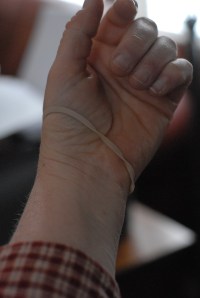
To be honest I haven’t kept track of how long I have gone but I know I have certainly not gone 21 consecutive days. But, the rubber band is still on my wrist. Remember the rubber band was the reminder. Move it to the other wrist when you fail. I said:
“I’m trying to lead by example and not complain about anything or criticize anyone, or gossip, for 21 days, which is how long it takes to form a habit apparently.”
And though I haven’t made it, I can say this.
I am fantastically aware of my mouth.
It’s not that I am an excessively negative person. But I am verbal. And I have been known to intimidate others — insert sinister laughter — and I am well aware of the “power” my words have. I am not consciously (I hope) hurting others at this point in my life. (I started working on giving up sarcasm approx. ten years ago and for the most part I’m doing well on that. But it’s tough.)
But I know how easy, almost habitual, it is to say something critical about another person. I include jibes or sarcasm here because, though (sometimes) funny, they are totally unnecessary and without a doubt do not build others up.
So, no more complaining, criticising and gossiping. I want to try. It’s not the number of days that matters. It’s the effort.
Another thing I’ve learned from this effort is that I DO use “complaining, subtle criticism and jibes” in a passive aggressive way.
When I am annoyed or upset about one thing, I jab at the person about something else. With the adult child or the tweens in my house I see directly how this simply wears down their self-esteem and it reinforces negative when it could be a learning opportunity. So, I am trying to be up front about behaviors that annoy me and let the cracks go. No matter how funny they may be I will bite my tongue!
And as this is the first day of LENT you might consider giving up being a “critical, complaining, or gossiping” person.
I have lofty goals for myself.
(Yes, that was sarcasm. But at my own expense!)
I am going to see if I can go three days without moving the wristband. Three days without saying something unnecessarily critical. Three days without talking about another person when they aren’t there. Three days without cracking a joke at someone’s expense. Some call it being snarky. Or kvetching. And three days feels long. It’s especially hard if you get a lot of your identity from being funny.
But it’s something to think about. It comes down to this: Do you build others up or tear them down?
I don’t want to be known to be a complainer. Or have a reputation for mean sarcasm. Or be remembered for being negative. And this is more than about giving something up. In that way it’s just a discipline. But if our heart is to be changed then we have to truely set that weakness or propensity or sin at the foot of the Cross. Let it go because if you’re totally honest with yourself, like me you want to build others up.
Three days. I know that’s about all I can do — in — a — row. If that!?! And then perhaps another three. Some day 21. Or the lenton 40. Or, forever.
What about you?
-MHH
Some verses, if you read the Bible
Ephesians 4.29 Don’t use foul or abusive language. Let everything you say be good and helpful, so that your words will be an encouragement to those who hear them
Ecclesiastes 10:12 Words from a wise man’s mouth are gracious, but a fool is consumed by his own lips.
Matthew 12:34 You brood of vipers, how can you who are evil say anything good? For out of the overflow of the heart the mouth speaks.
Romans 14:19 Let us therefore make every effort to do what leads to peace and to mutual edification.
Romans 15:2 Each of us should please his neighbor for his good, to build him up.
Ephesians 5:4 Nor should there be obscenity, foolish talk or coarse joking, which are out of place, but rather thanksgiving.
Colossians 3:8 But now you must rid yourselves of all such things as these: anger, rage, malice, slander, and filthy language from your lips.
Colossians 4:6 Let your conversation be always full of grace, seasoned with salt, so that you may know how to answer everyone.
1 Thessalonians 5:11 Therefore encourage one another and build each other up, just as in fact you are doing.
Why I don’t like “women’s” ministry, seminars & conferences specifically for women, or special Bibles and studies written only for women.
It is not that I’m against women (or men) gathering together as a tribe, but I have other, deeper concerns.
First of all, fundamentally it comes out of this notion that men and women are so different that you must make categories of resources just for each group. We certainly have our differences, but that sort of thinking divides us. It’s unproductive. It hurts us more than helps as we try to work out our faith with one another.
Secondly, I don’t like them because I don’t think ideas in scripture are necessarily “for women” or “for men.”
Thirdly, and possibly most important to me, because scripture was translated by men, and it was done a long time ago, by committees, and there were no women involved, therefore I think that the language just might possibly be patriarchal and misleading.
Before you burn me at the stake, look at Proverbs 31:10 to see what I mean. It is the classic verses of a virtuous feminine woman. Yes, it is a description of a woman though I never saw until I looked at the original meaning, that it is a description of a spiritually powerful and strong woman!
The Council on Biblical Manhood and Womanhood (a group I’ll say up front I don’t totally agree with) describes a “worthy woman” fairly well as “virtuous, trustworthy, energetic, physically fit, economical, unselfish, honorable, lovable, prepared, prudent, and God-fearing.” That’s all good.
Look at the word virtuous in 31:10 “Who can find a virtuous woman for her price is far above rubies?” (KJV)
The Hebrew word chayil is translated as virtuous or excellent, strength and influence.; a force, an army, able activity in might and power, valiant, full of valor and virtue, and worthy in war.
I’m not making that up. It’s there for anyone to know – to learn. But don’t you think it’s interesting that no one talks about a virtuous woman like that?
I know I have never heard a woman at church described as a warrior — not in all my life and that ‘s a long time of church attending among several denominations. And I had to find it for myself.
Original Word: חָ֫יִל Transliteration: chayil Phonetic Spelling: (khah’-yil) Short Definition: army Definition: strength, efficiency, wealth, army NASB Word Usage: able (5), armies (3), army (82), army* (1), capability (1), capable (3), elite army (1), excellence (1), excellent (2), forces (12), full (1), goods (1), great (1), might (1), mighty (1), nobly (1), power (2), retinue (2), riches (9), strength (10), strong (2), substance (1), troops (2), valiant (41), valiant* (4), valiantly (6), valor (18), very powerful (1), warriors (1), wealth (25), wealthy (1), worthy (1).
A Proverbs 31 Woman:
She is a mighty woman of God.
She is a woman of strength and influence.
She is a woman of force who is able and effective in spiritual warfare, she is full of valor (acts of bravery) and virtue.
“Who can finda virtuous woman for her price is far above rubies.” (KJV)
The Hebrew word for find transliterated matsa,not only means find or acquire‚ but also has the meaning of to come forth, to appear or exist.
Imagine that.
Perhaps these verses are saying:
God is calling mighty and courageous women to come forth, spiritual warriors and champions, who at His command will be a great spiritual force in Jesus name.
Would people be so uncomfortable with this if you inserted “God is calling mighty and courageous MEN, spiritual warriors, champions, forceful and mighty, be a great spiritual force?
So, if as I believe God communicates to us all — straight up, irregardless of our gender — why are we always separating ourselves as women? It just makes me uncomfortable. I think we each benefit as we mix the generations, genders, hipsters and bikers and soccer moms and dads, with boomers, silent gen, under 18 kids, teens or whatever. Single and married, higher education or not, race or ethnicity. The church is the worst at coming across those cultural barriers to worship together. But we are strengthened as people and as a community when we do. Why do we do that? Especially in the church? We lose out. There is so much that we don’t learn. I love that my life is incredibly diverse and I’ll do everything I can to keep it that way.
Tribes. On the other hand, we are all in a tribe, or two or three. We feel connection and solidarity, even strength when we connect from time to time to our tribe. So, I suppose one must find a balance. One of my husband Tom’s Tribes is Musical Geeks and they cross believers and not, women or men, young or old, it matters not at all. They just get together to “geek out” about all sorts of really boring musical minutia. Not my tribe. Not my need. But man does he need and love to be with those folk!
So finding the balance is key.
But, I detest groups “for women.” Bible studies and events just for women. I guess they always will represent to me that women are not yet equal with men in the body of Christ. It’s not an obvious equation, but still that math goes there in my mind and heart.
Sure I’m not your typical evangelical Christian woman. I regularly question every idea in theology. I don’t believe “male headship.” I don’t believe the idea that God’s divine order of things is for me to follow a man. I do believe in order. I do believe in submitting to one another mutually. But right now it feels like there are a million obstacles to women experiencing true equity within the Christian evangelical church.
There’s no way that your typical male is ready for the woman spiritual warrior who is mighty in strength and influence. Uh uh. They’re squirming now in discomfort and ready to thump me over the head with their B I B L E. Oh well.
I can read it for myself. I translated it. I know it is different from some things being taught.
I believe that men and women when utilizing their skills and abilities and spiritual gifts — all given to us by a real and loving God by the way, who chose those skills, abilities and spiritual gifts for us — that creator God is the one that called us. If He made me this way, I should be serving, using my gifts that He gave me.
Because sitting back, watching many capable men do many things in the church is wrong. And only leading in the midst of women is also wrong.
It gets complicated when you don’t know, when you haven’t had your abilities affirmed in the church. But some day, women will come to know themselves capable of being that woman described in Proverbs 31.
God is calling mighty and courageous women to come forth, spiritual warriors and champions, who at His command will be a great spiritual force in Jesus name.
Amen.
——————————
Some things I am reading my way through:
Women’s Bible Commentary by Carol A. Newsom and Sharon H. Ringe, Editors. “… the writers focus on “portions . . . that deal explicitly with female characters and symbols . . . and sections that bear upon the condition of women generally.” Although the contributors share this goal, they take different paths. In addition to the commentary itself, there are helpful essays on feminist hermeneutics and daily life in biblical times. This commentary will raise eyebrows, and it will raise consciousness as well. It will not be well received in all quarters, but it is essential for those who are seriously interested in biblical and feminist studies. Recommended for seminary, university, and public libraries.” – Craig W. Beard, Univ. of Alabama at Birmingham Lib.
“No one will go away from the volume with her or his old assumptions about biblical texts intact…The challenge and pleasure of this work is its tendency to upset expectations about familiar books”. Theology Today
“No mistake was made in heaven when God gave you the gift of leadership or teaching. Every gift you have came from the hand of a loving Father who crafted you.”— Nancy Beach
How I Changed my Mind about Women in Leadership. Compelling stories from Prominent Evangelicals including Stuart and Jill Briscoe, Tony Campolo, Bill and Lynn Hybels, I. Howard Marshall, John and Nancy Ortberg, Cornelius Pantinga.
[I find this website Biblos to be a great resource in my Bible study. It has many commentaries, original translation, many versions of text, and concordance. SO many things that I’ve never used including dictionary, atlas, even bible studies.]