Not To Speak is to Speak: Volume 2

“Silence in the face of evil is itself evil: GOD will not hold us innocent. Not to speak is to speak. Not to act is to act.”— Bonhoeffer

NOT TO SPEAK IS TO SPEAK :  VOLUME 2

This is my attempt to consolidate some of the things I find on the web.  Of course this is a drop in the bucket of what I read all week, but you have to focus sometimes.

Image representing YouTube as depicted in Crun...
Image via CrunchBase

Several things on the UCLA Student’s recent YouTube Video.

A white student rants about Asians and it goes viral, drawing accusations of racism.

“Sadly, what she expressed isn’t that different from what a lot of Americans think, even if we’re not posting it on YouTube  …  In many ways this blonde-haired, exposed push-up bra wearing college student, embodies the popular and prolific image of entitled, image driven, individualistic “Americanness.””

You can read the rest here and see the video it its entirety there.  You should watch it if you are white.  If you’re not white, you’ve likely seen or heard of it already.  If you are white, I think you have a responsibility to SEE things like this.  Before you go there, thinking I’m “over reacting” I’ll acknowledge that I need to spend some time considering all this and being prayerful before God. But in the meantime, I can call racism what it is — wrong.

My initial thought is this.  Although I feel ashamed of being white, many many times.  Today, more than any day in a long time, while I watched this young lady’s strange, egocentric, racist, stupid and ignorant rant about the “hordes of Asians” at her university I was mortified for all of us.

Ching chong? Hordes of Asians? American manners?” A friend I have made because of the internet responds to the student’s video as a Mom and an American and one of the Asians that the young lady at UCLA refers to in her video.  In A Mother’s Rant About Racism & Reconciliation Kathy Khang shares a personal response.   I love her heart and learn so much from her every time she writes.

And still on the topic, here are some things White People with Power should consider.  That would be me.

“However difficult it is for many White Americans to hear, examples like this video clearly show that many (as in a large number, but certainly not all) Whites implicitly think there’s nothing wrong with invoking cultural stereotypes to portray an entire group of color. I have written about this dynamic many times before, but needless to say, this is certainly not the first time that Whites have tried to “make fun” of Asian Americans or other groups of color on college campuses and elsewhere in society…”

Lastly, an incredible response by the InterVarsity’s Asian Staff director, James Choung.  He is godly, kind and wise.  Once again, I learned a lot.  These are things that privileged white people need to hear.

A glimpse into the heart of an incarcerated father.

Dear Son: A Letter from an Incarcerated Father on how a believer behind bars might pass on his faith.  

Statistical studies tell us that roughly 90 percent of incarcerated parents are fathers. Their offspring, approximately 2 million strong, represent the textbook definition of “at risk” children. According to the Princeton University’s Center for Research on Child Wellbeing, the absence of a father—particularly due to incarceration—correlates with a plethora of family dysfunctions, including elevated rates of juvenile crime and incarceration.

Politics.

Congress Making Themselves and Friends Richer, While Everyone Else Struggles to Make Ends MeetIf you don’t read Jim Hightower you are missing out.

The great majority of Americans make about $30K a year. Incoming lawmakers, however? Extensive personal investments in Wall St. banks, oil giants and drug makers.Change is not the same thing as progress. In fact, change can be the exact opposite. It can be regressive, as we’re now learning from — where else? — Congress.

Feminist Reading.

100 Young Adult Books for the Feminist Reader . Whether you’re already knee-deep in young adult literature or looking to reacquaint yourself with an old favorite we’ve put together a whopping 100 of our favorite young adult novels, featuring kick-ass teens and inspiring feminist themes. These stories will empower teenage and adult readers alike.

[I’m not recommending all of these books because I haven’t read them all.  Simply passing on the list.  Make your own wise choices.]

The Environment.

You have to watch this video by Allan Savory, a Zimbabwean biologist, farmer, soldier, exile, environmentalist.

Winner of the Banksia International Award 2003 and winner of the Buckminster Fuller Award 2010.  He is the originator of the Holistic Management concept that turn deserts into thriving grasslands, restores biodiversity, brings streams and rivers back to life, increases food production and security and stores carbon in ever deeper and healthier soils – all of this while reversing global climate change.

He won a TED award and that’s how I found him.  I’m in love. So sweet. So passionate.  So smart!

Next time perhaps.

Rob Bell.  What I’m learning from reading on feminism and women in the church.  And Libya, going to war? … and my current theological thoughts on Justice.

Here’s the last issue of Not to Speak is to Speak in case you missed it.

Sometimes Life is Stunning


Sometimes

life is stunning. if you stop

and look.


forget the heavy stuff you carry on your shoulders

(perhaps) set it aside for a minute.


look down

and be filled with wonder,

sometimes.

Do you have Soul Wounds?

Five wounds of Christ
Image by Nick in exsilio via Flickr

It is a beautiful thought, my children, that we have a sacrament that heals the wounds of our souls! – Saint John Vianney

Do you  have soul wounds?

For me this depends on day-to-day realities.  It is a discipline (see Nouwen on discipline below) not to allow things like bitterness, anger, envy, or conceit to enter in, quickly overtaking what I know to be true and beautiful.  A harsh rude word is spoken or written.  I resent another’s success. Or my day-to-day life practices add up to selfish spending  or no time for others, which bring an inability to be generous with either.

Love is patient and kind; love does not envy or boast; it is not arrogant or rude. It does not insist on its own way; it is not irritable or resentful; it does not rejoice at wrongdoing, but rejoices with the truth. Love bears all things, believes all things, hopes all things, endures all things.

Choices, choices, choices.  Choices discipline us and bring order in and of themselves.  Knowing Christ also did that for me.  Knowing that I am the one he loved enough to die for —  that his body was broken, the nails cut into his hands and feet as he slowly strangled, gasping for air.  All that was for me.  For you.

And more than the human part of that death — which was physically painful and devastating — he cried out to God, his father, to rescue him from my sin!

And then, all the petty and selfish choices I make day-to-day feel even more petty, selfish, and sickening.

But wait.  The pure beauty of the sacrament is the washing away.

The cleansing of our heart, soul and mind that had been corrupted by the entangling of day-to-day.

Henri Nouwen said this:

“When God took on flesh in Jesus Christ, the uncreated and the created, the eternal and the temporal, the divine and the human became united. This unity meant that all that is mortal now points to the immortal, all that is finite now points to the infinite. In and through Jesus all creation has become like a splendid veil, through which the face of God is revealed to us. This is called the sacramental quality of the created order. All that is is sacred because all that is speaks of God’s redeeming love. Seas and winds, mountains and trees, sun, moon, and stars, and all the animals and people have become sacred windows offering us glimpses of God.”

If truly understood, this is a profound, life changing truth. If you are feeling wounded. If you inflicted those bloody wounds on your own soul, remember.  He took on flesh pain and soul pain for you.  He took on our sin and we are now joined to him.

And now our lives point others to the immortal, through the confession of our sin and the washing away. Through the cleansing Jesus offers.

Tell him where your soul is wounded.  Let him take it from you today.

Amen.

________________________________________

Discipline is the other side of discipleship. Discipleship without discipline is like waiting to run in the marathon without ever practicing. Discipline without discipleship is like always practicing for the marathon but never participating. It is important, however, to realize that discipline in the spiritual life is not the same as discipline in sports. Discipline in sports is the concentrated effort to master the body so that it can obey the mind better. Discipline in the spiritual life is the concentrated effort to create the space and time where God can become our master and where we can respond freely to God’s guidance.


Thus, discipline is the creation of boundaries that keep time and space open for God. Solitude requires discipline, worship requires discipline, caring for others requires discipline. They all ask us to set apart a time and a place where God’s gracious presence can be acknowledged and responded to.
These reflections are taken from Henri J.M. Nouwen’s Bread for the Journey.

Not everyone is a white male, with all access!

A friend sent me this article in Christianity Today, because of what I wrote yesterday, mentioning Rob Bell.  Upfront, it asked:

“Do you think it is wrong for Rob Bell to question traditional views of heaven and hell? Answer: I don’t care. Do you think it is wrong for traditionalist writers to label Rob Bell a universalist? Answer: I don’t care.
Do you think it is wrong for every Christian with an iPhone to tweet their answers to the above questions from restaurant bathrooms and then go home and blog about it? Answer: Now there’s an interesting question.

Of course, we care about the doctrines of heaven and hell.  As Bell reminds when I heard him interviewed on Good Morning America what we think about heaven and hell informs what we believe about God and how we understand what it means to respond to the suffering around us, here and now.  Informs how we live out heaven and hell right now.  And it informs what to think about injustice here and now.  And that I agree with.

Oh, a controversy was stirred and it will sell a bunch of books and Rob Bell will survive to preach another Sunday.  But I don’t really care.  In How social media changed theological debate, the author John Dyer goes on to say something MORE IMPORTANT.   In fact the more I think about it, it is critical to this conversation.

But my response is different than Dyer’s.

Dyer says:

“Throughout the history of public theological debate, there was one constant—those debates only took place between a few select people—Moses, Plato, Augustine, Aquinas, and so on—who gained respect through a lifetime of scholarship….In pre-2004 Christianity (that is, Christianity before Facebook was invented), only a small group of Christian leaders and teachers had access to the printing press—but today everyone has WordPress. In pre-2004 Christianity it was difficult to become a published author, but today everyone is surrounded by dozens of “Publish” buttons.”

He is gravely concerned with the quality of the debate.  The quality of the conversation, teaching and writing on-line because with the advent of WordPress any ol’ person can express themselves.  And I would never argue against a need for quality conversation or scholarship! But that doesn’t answer a more important question of who is writing and teaching?

The culture is changing rapidly.  Books are becoming less relevant, though I for one will always buy and read books printed on paper.  Even so, yesterday I found myself longing for a Kindle because there was a book I wanted to read immediately!  The church needs to catch up to the immediacy of our culture and how it communicates.

Many pastors still do not Tweet or have a Facebook account.  Mine does not and I am sure it is not just because it is too hot — unpredictable — with much opportunity for people to misinterpret.  It’s also time consuming.  And mentally degrading to clarity of thought. If you are working all week to compose your thoughts on a particular topic for a sermon, it can’t be helpful to constantly be distracted by multiple media.  And yet, hipster pastors are online frequently and do these things.  As do many of the younger pastors in my church.  I am sure they spend much more time and energy than they would like thinking about what’s wise to say or not say.

The fact is one thing hasn’t changed, even as the culture does, our need to use restraint, to respond with maturity and self-control .  These are things that one would wish Piper and others had, even when tweeting.  Our words still matter!  Our heart, mind and soul — even more so than in the pre-Facebook age — is out there for the world to scour over!

Here’s what is most important to me about this conversation.

This new social media gives power to people of color and women — to those that have traditionally had less access to theological education, opportunities for preaching, teaching, and writing and getting published. (Even the homeless.)

So while I applaud Dyer’s thoughts about who should speak, teach and write in the specific situation, one must remember that not everyone is a white, male with all access to publishers, to power and to influence.  Yes, everyone needs to exercise restraint when it comes to social media.  But the new social frontier gives a voice to those of us who have traditionally been kept out of the conversation, the board room, seminaries, and these voices and viewpoints need to be heard in these critical times.

Why is it that each book suggested at church for extra reading in the last year was written by a white man?  Or that almost every song sung on Christian radio, and thus in churches, has a man singing or writing it?  Or that all the elders at my church are men?  And the teaching team is all men? Why are conferences full of Godly Christian men, with perhaps one female or person of color, MAYBE?  Why?

So, my response to John Dyer is “You may knock blogs because the level of thinking isn’t on the level of Moses and Plato, Augustine, Aquinas, and so on … well, have patience!

  • Until the brick and mortar institutions change for women and people of color, we need places like the internet in order to be heard.
  • Until you or I can name a Latino or Latina or African-American or female theologian or two, as quickly as you can think of NT Wright or J.I. Packer or John Piper we need the internet in order to be heard.
  • Until my pastor can name an up and coming female pastor or theologian, as readily as whatever man is on the tip of his lips, we still need this medium to bring change
  • I believe until it is just as commonplace to hear the perspective of a woman or a person of color in your life we need the internet in order to bring change. It is messy, and imperfect, but it gives access. 
I would not have my story published if it were not for connections made on-line. 

Shalom!

Melody

Here’s what I said yesterday.

—————–

In Defense of Women.  This was interesting and not just because he mentioned me.  It relates to not having women’s voices as a part of “the conversation.

I think I’ve got March Madness!

I think I’ve got March madness, and it isn’t about basketball.

It’s been such a strange week already.  I feel exhausted and I can’t identify exactly why.  It cannot simply be the time loss or the season changing.  It’s March and so for Wisconsin that means lots of sunshine.  Lots of slush.  There is an anticipation in the air but there is still snow on the ground.   I went for a walk earlier today in shorts and snow boots!

The highs and lows of late are stunning and I do not mean the weather.  It’s international woman’s week and I was going to write about that.  Perhaps I still will.  I’ve stopped and started several posts.  Taken lots of photographs.  Thought, prayed and dreamed about the future.

Here are few things I’ve been thinking about — being an artist & a Christian, politics in Madison, Rob Bell and what that has to do with the future of women in ministry in the evangelical church, my baby turning ten, and getting a job.  And lent.

Artist Showcase @ Blackhawk

Tom and I thoroughly enjoyed participating in a showcase of artists at our church. We, along with more than fifty other artists,  expressed how we love and are loved in the context of the community of Blackhawk Church and beyond into our Madison community.  It was so rich with the many expressions of God at work in people’s lives in song, spoken word and visual art including a dance!  It was a very powerful time for me.  I’m glad artists have a platform in the body of Christ for their gifts to be used.   I think many times artists do not know exactly what our place in the church is or might be.

by Kortney Kaiser

Politics in Madison

The whole political shenanigans in Wisconsin is exhausting.  So many folk are pitted against one another, the national media is saying strange and untruthful things.  The demonstrations have been peaceful while the rhetoric is grinding and vitriolic.  It’s troubling.  Hard to know how to be loving in the midst of what feels like grave injustice and oppression of the poor.  I have a lot of images here.

I want to lead a book group at my church for people interested reading and talking about women’s roles in ministry, but I was turned down.

I understand.  How can you read books about women in ministry without it becoming theological?  And well, as I don’t speak for my church and this isn’t something they want to get into “right now.”  So therefore, I can’t do the group.   I was choosing the wrong format for what I wanted to do anyway which though Tom says is “nurture a small revolution” that is not completely true.  Yes and no.  But yes, kind of.

So Iwill keep praying about how to move the titanic of conservative belief along.

I’ve started to think there’s little hope for women to preach, teach and lead within evangelical church denominations.

This last week it was as I learned about the controversy with Rob Bell. If you don’t know about him, and I didn’t until a few months ago, he’s what the New York Times calls “one of the country’s most influential evangelical pastors” and he comes highly recommended by a few people in my church.  He pastors Mars Hill Bible Church in Grand Rapids, Mich., with 10,000 members.  If he sounds like a Christian celebrity, it’s because he is.  I watched him online.  He is a hipster with groovy dark glasses and a lanky look.  They say hundreds of thousands follow him online.

Anyway. Bell’s new book, Love Wins, looks at the doctrines of salvation, heaven and hell.  He may have said something about Gandhi and hell inferring that a loving God wouldn’t send Gandhi to hell, or something.  Prominent Christians that you would know by name have denounced him with the double criticism of universalist and unbiblical. Here’s the crazy part — no one had read the book.  It came out on Monday.   And yet conservative authorities like John Piper, wrote, “Farewell Rob Bell.” on Twitter.

As one blogger said:

“These knee-jerk reactions, at least to my mind, are unhelpful and reveal just how narrow many people’s understanding of Christianity really is. It is amazing to me that people will hold so tenaciously to their own particular Christian tradition of understanding that when they encounter ideas that fall outside it they are viewed as non-Christian or threatening. The truth is that Christian “tradition” is a much wider river than many people are willing to acknowledge they are swimming in.”  (Emphasis mine.)

There are so many variety of Christians.  I know, the word of God says what it does.  But we all read it within a context, coming from different cultures and well, he goes on.

Are you a mystic?  Try reading John’s gospel, the book of Ephesians, Julian of Norwich,  Meister Eckhart or Bernard of Clairvaux’s commentary on the Song of Solomon.  Are you concerned with social justice?  Try Isaiah, Jeremiah, Malachi, Luke’s gospel, John Chrysostom, Martin Luther King Jr., or Mother Theresa.  Do you have a penchant for ritual and structure? Look at the book of Hebrews, the Didache, the letters of Ignatius of Antioch, and large portions of the Orthodox and Catholic traditions.  Are you philosophically minded?  So were Paul, Irenaeus, Justin Martyr, Gregory of Nyssa, Thomas Aquinas, and Alvin Plantinga (to name a few).  Do you have existentialist leanings?  Try Kierkegaard, Dostoyevsky and maybe even Augustine.  Do you struggle with the concept of hell?  So did the early Christian writers Origen and Evagrius (among others up to the present).  Are you a pacifist?  So was Menno Simons…and Jesus.  All of these writers and thinkers considered themselves Christians. All of them were “biblical” insofar as they read the Bible and used it as the foundation for their theology, philosophy and lives. All of them came to different conclusions on many issues.”

Okay Jesus and Paul didn’t read the Bible, but the greater point I’ve thought is, if a Christian celebrity and pastor, clear leader of a new generation of believers, can’t express his thoughts on a controversial topic without being branded unbiblical, what hope is there for women?

For Christian feminist thinkers.  For theologins who are outside the mainstream? Who is speaking, teaching, studying, influencing, changing minds about women in such a way that mainstream evangelicalism responds?  Just wondering.

If you wonder what I’m talking about?  See this from John Piper on women.  It’s stunning in its subtlety about the role of women in the church.

I applied for a job today.

And after ten years out of the workplace that’s revolutionary on many levels no matter if I get it or not.   It is with a Christian organization so I was asked to share my faith journey and this is what I wrote.

“My parents were missionaries with Wycliffe Bible Translators and later with InterVarsity.  As Christ followers they raised me with Christian values and as much as I understood it, I committed my life to Christ in high school and was baptized.   In my twenties and thirties I was doing and serving – willingly and happily – but it was not until my forties that I faced that I had not received God’s grace fully nor allowed it to transform me.

This may be because my home life was extremely dysfunctional with a rigid, angry, controlling father.  A series of things converged including hard work in therapy, my father dying, leaving full-time ministry and the recovery work of alcohol addiction.  Over a period of ten years God pried open my heart and began to teach me about his incredible life altering grace.  It was through these experiences, as difficult and mortifying as they were, that I have come to recognize that I had to face my disappointment with my parents — and forgive.  Gratefully, I can say that all of this, including the addiction to alcohol drove me to my knees, to the cross.  At one time, I was puffed up with my own importance but through this learned and gained a real understanding Christ’s broken body.

I believe we must trust while serving, not knowing the future.  Trust that we have a contribution to make.  Today I am grateful and full of hope that I am becoming a person useful to God again.  I am humbled by how my story and my experiences sometimes minister to others, as I am willing to be open.

Today, my faith is grounded in the grace of God.  I do have daily disciplines of study, prayer, and constant seeking, but I rest in the knowledge of Jesus and what he did for me — Yes giving his life so that I may also live.  I am no longer a slave to doing, but rather serve out of joy and passion for telling others what Christ has done for me.

Moving into the Lenten season it is good to remember what’s truly important.  What was it again?  Kidding.  Read the prayer I sent out a few days ago.  That’ll prioritize your heart, and mine.

Other things in March.  My baby turned ten. 

A few misc. images from March.


Be well,

Melody

“Your words were found and I ate them,
And your word was to me the joy and rejoicing of my heart;
For I am called by Your name, O Lord God of hosts.”

Jeremiah 15:16

Kathleen Falsani in the Huff Post on Rob Bell.

“Litany of Humility” or “from My Desires & My Fears, Jesus Help Me!”

This blew me away when I read it, aloud.  You should try it.

Litany of Humility

O Jesus! meek and humble of heart, Hear me
From the desire of being esteemed, Deliver me, Jesus.
From the desire of being loved, Deliver me, Jesus.
From the desire of being extolled, Deliver me, Jesus.
From the desire of being honored, Deliver me, Jesus.
From the desire of being praised, Deliver me, Jesus.
From the desire of being preferred to others, Deliver me, Jesus.
From the desire of being consulted, Deliver me, Jesus.
From the desire of being approved, Deliver me, Jesus.
From the fear of being humiliated, Deliver me, Jesus.
From the fear of being despised, Deliver me, Jesus.
From the fear of suffering rebukes, Deliver me, Jesus.
From the fear of being calumniated, Deliver me, Jesus.
From the fear of being forgotten, Deliver me, Jesus.
From the fear of being ridiculed, Deliver me, Jesus.
From the fear of being wronged, Deliver me, Jesus.
From the fear of being suspected, Deliver me, Jesus.

That others may be loved more than I, Jesus, grant me the grace to desire it.
That others may be esteemed more than I, Jesus, grant me the grace to desire it.
That, in the opinion of the world, others may increase & I may decrease, Jesus, grant me the grace to desire it.
That others may be chosen
& I set aside, Jesus, grant me the grace to desire it.
That others may be praised
& I unnoticed, Jesus, grant me the grace to desire it.
That others may be preferred to me in everything, Jesus, grant me the grace to desire it.
That others may become holier than I, provided that I may become as holy as I should, Jesus, grant me the grace to desire it.

(I will admit that I had to look up calumniated which is to “charge falsely or with malicious intent; attack the good name and reputation of someone.”)

Whew, that is incredible to read and let it sink into your heart, mind and soul. This prayer is counter cultural.   A couple of those made my pulse race as I faced my fear in a physical way.

  • Desiring to be consulted has been a lifelong struggle for me.
  • Wanting to increase in the opinion of the world.
  • That others may be praised & I unnoticed is only something I can hope for, pray for.

I do believe repetition and practice in prayer is effective and powerful.  I am going to pray this every day in Lent.

Will you join me?

MHH

———————————————————————————————

Read the Lenten Series:

1)  What is Lent Anyway, Besides Strange?


This prayer was composed by Rafael Cardinal Merry del Val (1865-1930), Cardinal Secretary of State of the Holy See under Pope Saint Pius X.

From Wikipedia, the free encyclopedia

On Complaining and Criticizing, Part 2

[This is a follow-up to On Complaining and Criticizing, part 1.]

On Feb 17th, 2011 I decided I was going to stop.  Stop contributing to the negativity in our culture.  Stop verbalizing my negative thoughts about people. And criticising and not affirming or building up others.  And perhaps become a more positive person.

So far, I haven’t made it more than a few days.

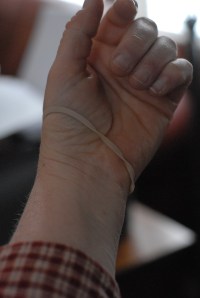
To be honest I haven’t kept track of how long I have gone but I know I have certainly not gone 21 consecutive days.  But, the rubber band is still on my wrist. Remember the rubber band was the reminder.  Move it to the other wrist when you fail.  I said:

“I’m trying to lead by example and not complain about anything or criticize anyone, or gossip, for 21 days, which is how long it takes to form a habit apparently.”

And though I haven’t made it, I can say this.

I am fantastically aware of my mouth.

It’s not that I am an excessively negative person.  But I am verbal.  And I have been known to intimidate others — insert sinister laughter — and I am well aware of the “power” my words have.  I am not consciously (I hope) hurting others at this point in my life.  (I started working on giving up sarcasm approx. ten years ago and for the most part I’m doing well on that.  But it’s tough.)

But I know how easy, almost habitual, it is to say something critical about another person.  I include jibes or sarcasm here because, though (sometimes) funny, they are totally unnecessary and without a doubt do not build others up.

So, no more complaining, criticising and gossiping.  I want to try.  It’s not the number of days that matters.  It’s the effort.

Another thing I’ve learned from this effort is that I DO use “complaining, subtle criticism and jibes” in a passive aggressive way.

When I am annoyed or upset about one thing, I jab at the person about something else.  With the adult child or the tweens in my house I see directly how this simply wears down their self-esteem and it reinforces negative when it could be a learning opportunity.  So, I am trying to be up front about behaviors that annoy me and let the cracks go.  No matter how funny they may be I will bite my tongue!

And as this is the first day of LENT you might consider giving up being a “critical, complaining, or gossiping” person.

I have lofty goals for myself.

(Yes, that was sarcasm. But at my own expense!)

I am going to see if I can go three days without moving the wristband.  Three days without saying something unnecessarily critical.  Three days without talking about another person when they aren’t there.  Three days without cracking a joke at someone’s expense.  Some call it being snarky. Or kvetching.  And three days feels long. It’s especially hard if  you get a lot of your identity from being funny.

But it’s something to think about.  It comes down to this:  Do you build others up or tear them down?

I don’t want to be known to be a complainer.  Or have a reputation for mean sarcasm.  Or be remembered for being negative.  And this is more than about giving something up.  In that way it’s just a discipline.  But if our heart is to be changed then we have to truely set that weakness or propensity or sin at the foot of the Cross.  Let it go because if you’re totally honest with yourself, like me you want to build others up.

Three days.  I know that’s about all I can do — in — a — row. If that!?!  And then perhaps another three.  Some day 21.  Or the lenton 40.  Or, forever.

What about you?

-MHH

Some verses, if you read the Bible

  • Ephesians 4.29 Don’t use foul or abusive language. Let everything you say be good and helpful, so that your words will be an encouragement to those who hear them
  • Ecclesiastes 10:12 Words from a wise man’s mouth are gracious, but a fool is consumed by his own lips.
  • Matthew 12:34 You brood of vipers, how can you who are evil say anything good? For out of the overflow of the heart the mouth speaks.
  • Romans 14:19 Let us therefore make every effort to do what leads to peace and to mutual edification.
  • Romans 15:2 Each of us should please his neighbor for his good, to build him up.
  • Ephesians 5:4 Nor should there be obscenity, foolish talk or coarse joking, which are out of place, but rather thanksgiving.
  • Colossians 3:8 But now you must rid yourselves of all such things as these: anger, rage, malice, slander, and filthy language from your lips.
  • Colossians 4:6 Let your conversation be always full of grace, seasoned with salt, so that you may know how to answer everyone.
  • 1 Thessalonians 5:11 Therefore encourage one another and build each other up, just as in fact you are doing.

Related Articles

What is Lent Anyway, Besides Strange?

Ashes imposed on the forehead of a Christian o...
Image via Wikipedia

Lent is strange for those that don’t follow the tradition.  Or if followed at all it may mean giving up a vice for 40 days, an addiction to technology or caffeine or sugar, but not really knowing why.

That was true for me for many years.  If you grew up in an evangelical church like I did, you may not know that much about Lent either.

It is the period of fasting leading up to Easter to remember Jesus’ 40-day fast in the wilderness.  Like his fast, it is to be a time of sacrifice and listening.  Lent begins on Ash Wednesday and ends right before the evening service of Holy Thursday or Maundy Thursday, depending on your tradition.  This year Lent begins on March 9 in the Western Church.

For the longest time I was attracted to the idea of giving up a vice that had persistently bothered me, but I had no theological understanding of the tradition.  I think evangelicals are remiss in not teaching about Lent, which can be a beautiful and profoundly meaningful tradition of growing closer to God.

I think we miss out because we give things up but don’t replace them with anything.

The intended purpose of Lent is a season of fasting, penitence, and self-denial, but also of spiritual growth, conversion, receiving from and embracing simplicity.

“Lent, which comes from the Teutonic (Germanic) word for springtime, can be viewed as a spiritual spring cleaning: a time for taking spiritual inventory and then cleaning out those things which hinder our corporate and personal relationships with Jesus Christ and our service to him. Thus it is fitting that the season of Lent begin with a symbol of repentance: placing ashes mixed with oil on one’s head or forehead.

However, we must remember that our Lenten disciplines are supposed to ultimately transform our entire person: body, soul, and spirit. Our Lenten disciplines are supposed to help us become more like Christ. Eastern Christians call this process theosis, which St. Athanasius aptly describes as “becoming by grace what God is by nature.”1

The aim in observing Lenten disciplines is to be changed as a person — body, soul and spirit!

Therefore there is more to it than giving something up, which I’ll admit for the longest time I thought was fairly impressive in and of itself.  I don’t do well without caffeine which is something I habitually gave up. Or sweets.  Yikes that one is hard.

As one endeavors to grow to be more like Christ and know him better, with the grace of God the tradition says you would be focusing on Fasting, Praying, Almsgiving (Charity or service) and Scripture.

  • Fasting: The Catholic Church requires its members age 18 to 59 “to fast on Ash Wednesday and Good Friday, unless a physical condition prevents otherwise. This means only one full meal is permitted. The Fridays of Lent are days of required abstinence, meaning meat, and soups or gravies made of meat, are not permitted.”  This traditional way of fasting I have have never observed.  Giving up meat once a week or only drinking water for the 40 days is a way to remind ourselves of our abundance and to draw our attention to Christ’s sacrifice for us all.  And to be more conscious of how much we have.
  • Prayer: Lent is a good time to develop a discipline of daily prayer if you don’t have it already. Whatever it might be, the idea is to add the discipline of listening and seeking through prayer, whatever that looks like for you.
  • Almsgiving (Charity): While giving something up you are also to put something positive in its place. They say the best way to remove a vice is to cultivate virtue.  What might you do for someone else over Lent?
  • Scripture Reading: As he faced temptation in the desert, Jesus relied on Scripture to counter the trickery of the devil.  Growing up I was encouraged to memorize scripture, but today this rarely occurs in the Church. Memorize a section of scripture like the Beatitudes in Matthew 5.   Or if you are thinking of reading a whole book of the Bible promise yourself to read two chapters a day or finish a medium-sized book of the Bible by Easter.

Also, here is a wonderful compilation of books to read, rituals and fasts to consider, and meditations to read from Rachel Held Evans.

When it comes down to it, so often we don’t take the time to ask why we do a certain thing.  Why do I need to observe Lent?

I found Evan’s ten questions helpful to ask myself as I prepare for Lent.  But I winnowed and edited them down to three simple questions.

  • Is there a habit or sin in my life that repeatedly gets in the way of my loving God or loving others?

Ask God to get a hold of that habit over the next 40 days and help you have the discipline to give it to him, forever.

  • Is there anyone in my life with whom I need to pursue forgiveness or reconciliation? This is unlikely to happen in 40 days, but preparing your hearts for it — yes, that can happen if you ask!  Here is a poem that I wrote during a time of profound grieving knowing I had done and said what I thought was “unforgiveable.”  It is called Longing for Mercy.


Ask God to begin to work in your heart (and in the other person) to ready you both for reconciliation in God’s perfect timing.

  • What am I willing to give up to carve out extra time for daily contemplation and listening to God?  So often we allow life to press in and set our priorities and not decide for ourselves.  What is important?  Perhaps you need to get up an hour earlier during Lent to be with God? I started doing this in September and I can tell you that my life will never be the same.  I find myself craving that time and (most mornings) it is not difficult to get up.  You may need to go to bed earlier to do it.  I do!  Again a sacrifice, but well worth it in my experience.

Ask God to show you what you need to stop doing to have more time with him.

Ultimately we simply strive to live with the attitudes of humility, repentance and thankfulness.  I pray that you will be richly met as you seek to know Jesus better.

-mhh

A few things I wrote last year about Lent.

And if you’re more confused than satisfied with my post, here is a great description of Lent as described by Marcel & Sarah who have a blog named Aggie Catholics and lots of reading material.

————————————————————–

Other sources I used.

http://www.churchyear.net/lent.html

2 http://rachelheldevans.com/40-ideas-for-lent-2011

http://niv.scripturetext.com/matthew/5.htm

Why “For Women” is not “For Me”

Matthew 25 (1) of The Holy Bible, King James v...
Image via Wikipedia

Why I don’t like “women’s” ministry, seminars & conferences specifically for women, or special Bibles and studies written only for women.

It  is not that I’m against women (or men) gathering together as a tribe, but I have other, deeper concerns.

  • First of all, fundamentally it comes out of this notion that men and women are so different that you must make categories of resources just for each group.   We certainly have our differences, but that sort of thinking divides us.  It’s unproductive. It hurts us more than helps as we try to work out our faith with one another.
  • Secondly, I don’t like them because I don’t think ideas in scripture are necessarily “for women” or “for men.”
  • Thirdly, and possibly most important to me, because scripture was translated by men, and it was done a long time ago, by committees, and there were no women involved, therefore I think that the language just might possibly be patriarchal and misleading.

Before you burn me at the stake, look at Proverbs 31:10 to see what I mean.  It is the classic verses of a virtuous feminine woman.  Yes, it is a description of a woman though I never saw until I looked at the original meaning, that it is a description of a spiritually powerful and strong woman!

The Council on Biblical Manhood and Womanhood (a group I’ll say up front I don’t totally agree with) describes a “worthy woman” fairly well as “virtuous, trustworthy, energetic, physically fit, economical, unselfish, honorable, lovable, prepared, prudent, and God-fearing.”  That’s all good.

Look at the word virtuous in 31:10 “Who can find a virtuous woman for her price is far above rubies?” (KJV)

The Hebrew word chayil is translated as virtuous or excellent, strength and influence.; a force, an army, able activity in might and power, valiant, full of valor and virtue, and worthy in war.

I’m not making that up.  It’s there for anyone to know – to learn.  But don’t you think it’s interesting that no one talks about a virtuous woman like that?

I know I have never heard a woman at church described as a warrior — not in all my life and that ‘s a long time of church attending among several denominations.  And I had to find it for myself.

Original Word: חָ֫יִל
Transliteration: chayil Phonetic Spelling: (khah’-yil)
Short Definition: army
Definition: strength, efficiency, wealth, army
NASB Word Usage: able (5), armies (3), army (82), army* (1), capability (1), capable (3), elite army (1), excellence (1), excellent (2), forces (12), full (1), goods (1), great (1), might (1), mighty (1), nobly (1), power (2), retinue (2), riches (9), strength (10), strong (2), substance (1), troops (2), valiant (41), valiant* (4), valiantly (6), valor (18), very powerful (1), warriors (1), wealth (25), wealthy (1), worthy (1).

A Proverbs 31 Woman:

  • She is a mighty woman of God.
  • She is a woman of strength and influence.
  • She is a woman of force who is able and effective in spiritual warfare, she is full of valor (acts of bravery) and virtue.

Who can find a virtuous woman for her price is far above rubies.” (KJV)

The Hebrew word for find transliterated matsa, not only means find or acquire‚  but also has the meaning of  to come forth, to appear or exist.

Imagine that.

Perhaps these verses are saying:

God is calling mighty and courageous women to come forth, spiritual warriors and champions, who at His command will be a great spiritual force in Jesus name.

Would people be so uncomfortable with this if you inserted “God is calling mighty and courageous MEN, spiritual warriors, champions, forceful and mighty, be a great spiritual force?

So, if as I believe God communicates to us all — straight up, irregardless of our gender — why are we always separating ourselves as women? It just makes me uncomfortable.  I think we each benefit as we mix the generations, genders, hipsters and bikers and soccer moms and dads, with boomers, silent gen, under 18 kids, teens or whatever.  Single and married, higher education or not, race or ethnicity.  The church is the worst at coming across those cultural barriers to worship together.  But we are strengthened as people and as a community when we do.  Why do we do that?  Especially in the church?  We lose out.  There is so much that we don’t learn.  I love that my life is incredibly diverse and I’ll do everything I can to keep it that way.

Tribes. On the other hand, we are all in a tribe, or two or three.  We feel connection and solidarity, even strength when we connect from time to time to our tribe.  So, I suppose one must find a balance. One of my husband Tom’s Tribes is Musical Geeks and they cross believers and not, women or men, young or old, it matters not at all.  They just get together to “geek out” about all sorts of really boring musical minutia.  Not my tribe.  Not my need.  But man does he need and love to be with those folk!

So finding the balance is key.

But, I detest groups “for women.”  Bible studies and events just for women.  I guess they always will represent to me that women are not yet equal with men in the body of Christ. It’s not an obvious equation, but still that math goes there in my mind and heart.

Sure I’m not your typical evangelical Christian woman.   I regularly question every idea in theology.  I don’t believe “male headship.”  I don’t believe the idea that God’s divine order of things is for me to follow a man.  I do believe in order.  I do believe in submitting to one another mutually.  But right now it feels like there are a million obstacles to women experiencing  true equity within the Christian evangelical church.

There’s no way that your typical male is ready for the woman spiritual warrior who is mighty in strength and influence.  Uh uh.  They’re squirming now in discomfort and ready to thump me over the head with their  B I B L E.  Oh well.

I can read it for myself.  I translated it.  I know it is different from some things being taught.

I believe that men and women when utilizing their skills and abilities and spiritual gifts — all given to us by a real and loving God by the way, who chose those skills, abilities and spiritual gifts for usthat creator God is the one that called us. If He made me this way, I should be serving, using my gifts that He gave me.

Because sitting back, watching many capable men do many things in the church is wrong.  And only leading in the midst of women is also wrong.

It gets complicated when you don’t know, when you haven’t had your abilities affirmed in the church.  But some day, women will come to know themselves capable of being that woman described in Proverbs 31.

God is calling mighty and courageous women to come forth, spiritual warriors and champions, who at His command will be a great spiritual force in Jesus name.

Amen.


——————————

Some things I am reading my way through:

Women’s Bible Commentary by Carol A. Newsom and Sharon H. Ringe, Editors.  “… the writers focus on “portions . . . that deal explicitly with female characters and symbols . . . and sections that bear upon the condition of women generally.” Although the contributors share this goal, they take different paths. In addition to the commentary itself, there are helpful essays on feminist hermeneutics and daily life in biblical times. This commentary will raise eyebrows, and it will raise consciousness as well. It will not be well received in all quarters, but it is essential for those who are seriously interested in biblical and feminist studies. Recommended for seminary, university, and public libraries.”  – Craig W. Beard, Univ. of Alabama at Birmingham Lib.

“No one will go away from the volume with her or his old assumptions about biblical texts intact…The challenge and pleasure of this work is its tendency to upset expectations about familiar books”. Theology Today

Christians for Biblical Equality

Equality Central

Gifted to Lead: The ARt of Leading as a Woman in the Church by Nancy Beach, Willow Creek Church.

“No mistake was made in heaven when God gave you the gift of leadership or teaching. Every gift you have came from the hand of a loving Father who crafted you.”— Nancy Beach

Beyond Sex Roles: What the Bible Says about a Woman’s Place in Church and Family by Gilbert Bilezikian. A first-rate biblical and theological study that affirms full equality of the sexes in church and family.

How I Changed my Mind about Women in Leadership. Compelling stories from Prominent Evangelicals including Stuart and Jill Briscoe, Tony Campolo, Bill and Lynn Hybels, I. Howard Marshall, John and Nancy Ortberg, Cornelius Pantinga.

[I find this website Biblos to be a great resource in my Bible study.  It has many commentaries, original translation, many versions of text, and concordance.  SO many things that I’ve never used including  dictionary, atlas, even bible studies.]

Envy

I cannot believe how insidious envy is.  As we are in a time of learning about the power of our possessions in our life this is particularly clear to us, to me.  We are learning what’s most important and who our money ultimately serves.

As you list out how you spend it is startling to see your priorities.  Sad. Even embarrassing at times.  Self serving  much?

Okay not always.  There are admittedly many good things that our money is applied toward — ongoing, frequent requests at church to help those with less, extra scholarship money for public school field trips for the kids that can’t afford, the bonus $5 at the grocery store for whatever cause they are raising money for or the extra bag of food for the shelters.  Public Radio.  Our church.  World Vision child.  Compassion International child.  There are lots of ways to give in our culture and it feels pretty good.

But still.  I envy.

Envy is something innocuous.  Invisible.  Like a vapor.  Of the heart.  And the mind.  Originating in the soul.

I read an email vacation message yesterday that said:  “Someplace warmer.”  Envy.  I am not there, that someplace warmer.

“Beautiful jacket” I tell my friend.  Envy.  Mine is from St. Vincent’s is already pilling.  And it is not even close to being “this season.”

Vacations.  Nicer cars.  Newer stuff.  Season tickets to whatever.

Things.  Activities.

Envy. Envy. Envy.

It’s a constant pull. And, possibly because we’re older and are beginning to make wiser choices apparently so they tell us, our children “suffer” for our wisdom.

We put 15% of our budget into retirement.  We haven’t been on a vacation with our kids for three years (since we stopped using our credit cards frankly.)  We limit Christmas presents and birthday presents.  We no longer (I no longer) shop for entertainment.  We haven’t bought furniture in years, though ours is “trashed” by our cats and kids.  I have a nice car (Tom’s belongs to work) and still, I look at the car I wanted, seeing it everywhere, wishing I had the sun roof, leather seats, V6 engine, and a GPS.  Yes, two years after I bought my beautiful almost new Honda Accord I still wish I had upgraded it to to have those features. Will I ever be content?  That is envy.  That is it right there in its ugliness.

The insidious cancer of the discontented my pastor called it.

And yet, reading in 1 Corinthians 13 in the New Testament this morning it says (the Mel paraphrase):

Won’t you just do love, it is what is most important.  Those “spiritual” things that you act like are so important  — they’re not.  Devoid of love, they are nothing.

Even more important than faith and hope, love is what I want you to do.  Because to love the people in your life is to be patient and kind in your responses to them.  Not irritable.  If you are loving you are glad when truth wins, whatever that might be.  Love never gives up or loses faith.  It is always full of hope, and can endure every circumstance.

Love is not JEALOUS. It doesn’t boast.  Don’t worry about what others think of you or about what makes you look good!

It is the opposite of self-glorification.  It is humble.   Love does not demand its own way rudely.   Love does not keep a record (even in your head) of being wronged.  Love is not happy at injustice.

Love is your highest goal.

Not all that stuff?  No.  I haven’t achieved that.  Thankfully Jesus also said in 2 Corinthians 12:9

“My grace** is enough.  My power perfected when you admit you are weak.”

Thankfully I don’t actually do.   He does it in me. And he is perfecting me more every day as I wake up to his priorities.  His focus.  His purpose for us all.

———-

** If you don’t know what GRACE is, you should look it up.  It’s pretty amazing.  And it is what Jesus gave us as a gift.

I am clutter.

I am clutter.  I am stuff.  I collect things.

I feel good when I see a trinket that my mom and dad brought me, back in 1970-whatever from some place they were visiting.  They have travelled all over the world and brought something back for us girls each time.   I look at these things on my bookshelf and feel warm goodness.

I don’t see the dirt collecting around it or the way the books are pushed back against the wall because of it.  I just feel my parents there with me for a moment and feel loved.

I like to have things around me that remind me of the past.  It happens that we moved a bit growing up – dozens of times.  So somehow things connect all those memories together for me.  They are a thread.  Whispers of the past come back for just a moment.

Stuff, there’s that word again. Too many pens and pencils shoved together into a drawer from a past project and end of year desk cleaning at school. Pencil runts with great erasers or fully unused one with no erasers.  Extra large school erasers, so many  that they get included in the plastic army man battle in the bath!

Now, that stuff should be saved and more importantly used.  When the kids come home saying they need another binder or spiral notebook, it is all too easy to stop over at Walgreens and pick one up.  I suppose I could walk upstairs and filter through a bunch of old spirals, tear the perhaps thirty pages of used math problems out, and hand it over.

Yeah, I realize how lazy and stupid I sound. But I would do that.  I have done that.  There are a lot of moments when I think “I might have one of those here — somewhere” but I actually have no idea where it is.  I think it would take less time (and effort) to “Just Buy One.”

Just Buy One.

The antithesis of simplicity and I must repent of (as in change) this way of thinking.

Today the sun is shining and all week I’ve refused to wear a coat.  Sure, it’s still 30 degrees outside but the sun is shining people!  You have no idea how great that is unless you’ve lived a winter in the Midwest.

Spring will be here any day now.  I believe!!!!  I could easily let myself get giddy about the promise of fresh air, the anticipation of opening up the windows and seeing blooms poking up through the snow.  Oh, just the word “bloom” makes me happy after what felt like a really cold winter.

An opportunity to get things in order!

I will be decluttering, cleaning, and organizing.

[Tom is euphoric right now somewhere at work and he doesn’t even know why.  Just the possibility of me working on decluttering makes him happy.]

So, because this is how I stay motivated, I’m checking this book out of the library (Uh huh, I said that.  I will not buy it!)  Organized Simplicity, and joining something called Project: Simplify.” I’ll be sure to take before and after pictures — No matter how humiliating it feels and keep you posted.

——–

www.Simple Mom.net

What Is Most Personal Reveals What is Real: transparency pulls me toward God

The way we experience God every day is in the life, death, and resurrection of Jesus Christ.  We can’t help but respond by changing — some call it growing.  This is individual.  It is personal and it is communal.  The Holy Spirit is present, leading us deeper into the wisdom of God through our honesty and openness with one another.

Even if we choose not to reveal ourselves it is evident through our life.     Don’t you think?

One of my favorite quotes is by Lev Tolstoy is

“A writer is dear and necessary for us only in the measure of which he reveals to us the inner workings of his very soul.

I believe it.  I believe that is what makes writing such a healing and positive thing for me and for those that follow along — the openness.  The honesty.

Henri Nouwen put it this way in Bread for the Journey:

We like to make a distinction between our private and public lives and say, “Whatever I do in my private life is nobody else’s business.”  But anyone trying to live a spiritual life will soon discover that the most personal is the most universal, the most hidden is the most public, and the most solitary is the most communal.  What we live in the most intimate places of our beings is not just for us but for all people. That is why our inner lives are lives for others. That is why our solitude is a gift to our community, and that is why our most secret thoughts affect our common life.

Jesus says, “No one lights a lamp to put it under a tub; they put it on the lamp-stand where it shines for everyone in the house” (Matthew 5:14-15). The most inner light is a light for the world. Let’s not have “double lives”; let us allow what we live in private to be known in public.

I do believe transparency within (trusted) community is crucial to the spiritual life.  Keeping our private lives full of secrets only encourages more secrecy.

I have experienced that transparency pulls me toward God. He longs for us.  And by doing so, often it throws me down on my knees.  Humbles me. And within a community where there is mutual dependence, it draws others in thus allowing space for their own transformation.  That is the miracle.  That is it.  The moment in which the attributes of God are seen us.  That is everything.  That is the resurrection and atonement all over again.

Has this been true in your life?  You don’t have to tell me of course, but I urge you to tell someone. And if you find it difficult to reveal yourself — your true self — to others ask yourself why?  And what are you going to do about it?

Be well friends.