Why not love if you have the option between that and hate? Why does hate come so easily? Why judge? Or condemn? Why is it that Christians so often are known for how they judge others?
Jesus said blessed are the peacemakers.
But we don’t bring peace. We rejoice in someone’s suffering. Bin Laden is dead!
We wish for more for us which means less for them, who ever they are.
We can only think of our own needs. We groan about the price of gas and our grocery bill, when others have to take public transport and go to bed hungry. Often living with fear and financial insecurity. Have no home. Have nothing.
Why can’t we love more tenderly? I dare you. I dare you to love today. Be a peacemaker. Hold your tongue.
The world is waiting for us to love, in Jesus’ name.
The ultimate weakness of violence is that it is a descending spiral,begetting the very thing it seeks to destroy.Instead of diminishing evil, it multiplies it. Through violence you may murder the liar, but you cannot murder the lie,nor establish the truth.Through violence you murder the hater, but you do not murder hate.In fact, violence merely increases hate….Returning violence for violence multiples violence, adding deeper darkness to a night already devoid of stars.Darkness cannot drive out darkness; only light can do that.Hate cannot drive out hate; only love can do that.
MARTIN LUTHER KING, JR., Where Do We Go from Here: Chaos or Community?
I’ve never really cared to prove that God exists — before today. My son looked at me with his huge blue eyes the color of warm ocean and cried:
“If God is real, why doesn’t he stop all the bad stuff? Why Mom? Why?”
I felt as if I’d been slapped hard across the face by the innocence of his question. It is something that I try not to think about. I try not to dwell on that now as I sit here enjoying my expensive coffee, in my warm house, in my comfortable chair. As I sit at my computer which is connected 24/7 to the world, I try not to think. Or feel how much that stuff hurts. It makes my comfortable life not — so — comfortable when I turn on the radio and they tell me of people being beheaded. Or a woman who had acid poured into her face. Or that going for firewood in some places in the world will get you raped. Or that girls are still unwanted in many places in the world.
I try not to feel how bad that makes me feel. I try to not be in that moment because it hurts. It hurts me! There I said it.
It makes my stomach hurt when over and over, I have to tell my kids to eat their dinner and be grateful. How very lucky they are that they have something to eat and a glass of milk to wash it down. And when they complain that there is no desert, I try not to feel bad that I didn’t indulge them. And won’t remind them, again, of how much they have. I makes me hurt when my smart, but bored kids bring home reports of below average work, when they complain about homework, I try not scream at them of their lost opportunities. And remind them of the children in many parts of the world that will never go to school. Or children in our country who cannot safely walk home from school in their own neighborhood. I try not to scream. I do. I try not to, but we have so much. It makes my stomach hurt and I try not to compare.
Why could a good God make life so easy for you my son and so hard for so many? We are the 1% and we have no idea how lucky we are. Is it luck? Random stupid luck that made my kids healthy, and smart, and born into a well to do home? I cannot answer. I have — no– answer for my son when he asks me to prove God exists, because I agree! What kind of God would set things up like that?
My son was born into a white, middle class home full of privilege and opportunity, without the violence and cruelty so many children face. He was given for no reason of his own doing good health, and wealth, and I believe God intends that he does something with it for others. My son, along with you and I, we prove God exists by seeing the pain that others suffer from and hearing the cries of those born with less. We prove God actually loves the world. We are his love. We are his hands and feet. We the one percent are a part of the his answer. No, not just me. Not my son, only.
Last night, my ten year old son said he wanted to stay up until midnight — insisting that he had to do it. — But why? I asked slightly bewildered.
“If I do, I will have not cracked my knuckles for a whole day!” he told me in all seriousness. He has a nervous habit. It makes him self-conscious but I had no idea how much. He came up with this promise to himself. I reassured him that he could “not crack his knuckles in his sleep and that would still count.”
But it strikes me and stays with me today. That little self-improvement goal seemed so simple to me and yet it was such a challenge for him as he made a promise to himself and kept it. It made me wonder how many times I promise God something and don’t do it. Does he, like a mother feel admiration for me that I even try? Or is he disappointed when I fail?
Blessings & Curses.
I wonder. Does God withhold blessings from us if there was something that God has wanted us to learn and we knew it full well but resisted. Or ignored God? Pretend we don’t hear, like child who acts like they can’t hear their mother calling from the next room.
Sermons are like that sometimes. Most of the time not offending seems to be the order of the day and sermons become nothing more than a gentle reminder. Not exactly optional, but full of choices and options … How many of those softball sermons have I ignored or just not allowed them to change me? Or when they challenge do I consider it “optional?”
Yes I do that. I ignore God regularly. Stubbornly. Foolishly, knowing fully that God has my best interest in mind and yet I can’t gather up the willpower to obey. To stop cracking my (spiritual) knuckles.
What? You don’t? I don’t believe you.
And do we miss out on blessings, on a level of happiness or contentment because certain challenges from God seem too hard? Not that serious. Life goes on.
Of that we can be sure.
Floodgate of Social Media.
I cannot seem to deal lately with the torrent of information coming into my life through the media. A friend, who is a Scientist at the university, said he thought perhaps evolutionarily (is that the right way to say that? what is the word I’m searching for?) we are not capable of taking it all in. Our minds and hearts just can’t absorb it.
Some days I feel my heart cracking open reading about suffering in Japan and Christ Church,NZ, ongoing efforts in Haiti and areas of Africa, our nearly decade long wars in Iraq and Afghanistan, cholera outbreak in Ghana, ethnic minority Christians facing religious persecution in Vietnam, unrest in Yemen promoting Somali refugees to flee there, political unrest in Nigeria, drought in Niger, measles epidemic in Kenya, even AIDS being still the number one killer was brought up on the Colbert Report last night. Can’t even escape the pain in humor.
We cannot get away from it. How would God have us respond? It’s too much. I cannot bear it. I need to know what God would have us do to respond.
Justice.
My understanding of the gospel is becoming enriched by the truth of a recent sermon series at Blackhawk on Justice. And reading Timothy Keller’s book, Generous Justice. God’s justice is not a distraction from the gospel but a centering on its fullness. Whenever anyone argued with Amy Carmichael that the gospel was only a proclamation and didn’t include acts of mercy and social justice, she emphatically said to her critics: “God didn’t make you all mouth.” Ha. I love that.
And Bishop J.C. Boyle, a nineteenth-century British evangelical, said: “Let the diligence of Christ be an example to all Christians… Like Him, let us labor to do good in our day and generation, and to leave the world a better world than we found it….Let us awake to a sense of our individual responsibility.”
My Church & Women: The ongoing Crusade.
I’ve decided to acknowledge to myself that I am on a crusade. It may be small. It may be ineffective. But I am. In my reading this week I read that if you truly disagree with the premises of your church on women in ministry or ordination of women you will eventually leave that church. People just do. For the most part churches don’t change — especially those connected to a denomination. People give up. Lose hope. And leave.
While that was devastating on one level, because I love my church dearly. It also made me accept the truth that I am on a crusade to change it.
One can’t simply learn the truth and sit on it.
Truth not only changes how we see ourselves, it changes what we do and how we live.
— Carolyn Custis James, Half the Church.
What I know. Jesus loved women. He consistently reinforced human equity. He mobilized and recruited and listened to and even hang out with those who were on the margins. He valued women and they served with him and spoke for him, gave witness faithfully in the Bible, which seems to me to be a story of redemption for marginal people. And there are leaders in my church who do too. They believe, they agree, they are willing to concede. But moving a church is as I’ve said like moving the Titanic. It won’t happen any time soon. I will be the quiet, prayerful voice of change.
More on this in the future, but for now…
Authorities at my church have decided to phase out the Bibles that are on hand every week, calling it a Bible Revolution. They want people to use their own personal Bible. Yay. The best thing that will come of this, besides the obvious, is that they won’t be tied to the New International Version any longer and can perhaps use an inclusive translation like the New Revised Standard Version that speaks to women as well as men. That one uses language that is more welcoming to women.
Halle — fricken — lujah!
“Is the gospel truly good news for women who live in entrenched patriarchal cultures?” — Carolyn Custis James
The Titanic didn’t move this week, but the iceberg it is stuck in melted a little. Viva La Revolution!
Winter seems to be lingering here in the Midwest. I dug out an old poem from October, 2009.
No matter how long I postpone trying on last year’s coats, hats and gloves,
even still winter comes. If I leave the hose out until it’s frozen stiff, snaking through the yard,
still winter comes. The pots and the plants they crack and curl from the cold. Winter, comes.
Winter comes in the cold,
dark mornings heralding sad thoughts and memories.
I lost my father to the winter. I discovered, accepted and revealed a family’s ancient addiction.
I miscarried. I fell down. I fell apart. Always winter comes.
Winter means waking early with darkness bringing in the day.
Though I try to overcome, the anxious thoughts settle in.
Remember the cold. Remember, remember. I am always falling, in winter.
Good things are lost, so do not hold too tight
to what you desire most. You will lose them to winter.
Love hurts more in winter, dries up and becomes need.
Love becomes memory. I am falling. In winter.
And at the moment when the winter once again threatens to overcome, I end my slumber.
On that icy morning I wake early. Snuggle in.
Sipping coffee, by the fire. And I think of Spring.
As you, I am thinking of spring!
Feeling grateful during the season of Lent, as I process how much God has done to redeem me from the pit where my life was. I must never forget. Ever. I cannot. Reading Henri Nouwen and he speaks to this:
“In our lives there are moments when we realize that, even if we may have done everything to destroy ourselves, we have never lost our true identity as beloved daughters or sons. That identity is never taken away. And that moment of realization is a very, very important moment.
“But take care what you do and be on your guard. Do not forget the things your eyes have seen, nor let them slip from your heart all the days of your life…” (Deut. 4)
Amy Wilson Carmichael was a Protestant Christian missionary in India, who opened an orphanage and founded a mission in Dohnavur. She served in India for 55 years without furlough and wrote many books about the missionary work there. While serving in India, Amy received a letter from a young lady who was considering life as a missionary. She asked Amy, “What is missionary life like?” Amy wrote back saying simply, “Missionary life is simply a chance to die.”
Carmichael’s work also extended to the printed page. She was a prolific writer, producing thirty-five published books including Things as They Are: Mission Work in Southern India (1903), His Thoughts Said . . . His Father Said (1951), If (1953), Edges of His Ways (1955) and God’s Missionary (1957). In 1931, Carmichael was badly injured in a fall, which left her bedridden much of the time until her death. She died in India in 1951 at the age of 83. She asked that no stone be put over her grave; instead, the children she had cared for put a bird bath over it with the single inscription “Amma”, which means mother in the Tamil. Her biography quotes her as saying: “One can give without loving, but one cannot love without giving.”
On Feb 17th, 2011 I decided I was going to stop. Stop contributing to the negativity in our culture. Stop verbalizing my negative thoughts about people. And criticising and not affirming or building up others. And perhaps become a more positive person.
So far, I haven’t made it more than a few days.
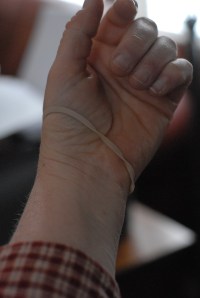
To be honest I haven’t kept track of how long I have gone but I know I have certainly not gone 21 consecutive days. But, the rubber band is still on my wrist. Remember the rubber band was the reminder. Move it to the other wrist when you fail. I said:
“I’m trying to lead by example and not complain about anything or criticize anyone, or gossip, for 21 days, which is how long it takes to form a habit apparently.”
And though I haven’t made it, I can say this.
I am fantastically aware of my mouth.
It’s not that I am an excessively negative person. But I am verbal. And I have been known to intimidate others — insert sinister laughter — and I am well aware of the “power” my words have. I am not consciously (I hope) hurting others at this point in my life. (I started working on giving up sarcasm approx. ten years ago and for the most part I’m doing well on that. But it’s tough.)
But I know how easy, almost habitual, it is to say something critical about another person. I include jibes or sarcasm here because, though (sometimes) funny, they are totally unnecessary and without a doubt do not build others up.
So, no more complaining, criticising and gossiping. I want to try. It’s not the number of days that matters. It’s the effort.
Another thing I’ve learned from this effort is that I DO use “complaining, subtle criticism and jibes” in a passive aggressive way.
When I am annoyed or upset about one thing, I jab at the person about something else. With the adult child or the tweens in my house I see directly how this simply wears down their self-esteem and it reinforces negative when it could be a learning opportunity. So, I am trying to be up front about behaviors that annoy me and let the cracks go. No matter how funny they may be I will bite my tongue!
And as this is the first day of LENT you might consider giving up being a “critical, complaining, or gossiping” person.
I have lofty goals for myself.
(Yes, that was sarcasm. But at my own expense!)
I am going to see if I can go three days without moving the wristband. Three days without saying something unnecessarily critical. Three days without talking about another person when they aren’t there. Three days without cracking a joke at someone’s expense. Some call it being snarky. Or kvetching. And three days feels long. It’s especially hard if you get a lot of your identity from being funny.
But it’s something to think about. It comes down to this: Do you build others up or tear them down?
I don’t want to be known to be a complainer. Or have a reputation for mean sarcasm. Or be remembered for being negative. And this is more than about giving something up. In that way it’s just a discipline. But if our heart is to be changed then we have to truely set that weakness or propensity or sin at the foot of the Cross. Let it go because if you’re totally honest with yourself, like me you want to build others up.
Three days. I know that’s about all I can do — in — a — row. If that!?! And then perhaps another three. Some day 21. Or the lenton 40. Or, forever.
What about you?
-MHH
Some verses, if you read the Bible
Ephesians 4.29 Don’t use foul or abusive language. Let everything you say be good and helpful, so that your words will be an encouragement to those who hear them
Ecclesiastes 10:12 Words from a wise man’s mouth are gracious, but a fool is consumed by his own lips.
Matthew 12:34 You brood of vipers, how can you who are evil say anything good? For out of the overflow of the heart the mouth speaks.
Romans 14:19 Let us therefore make every effort to do what leads to peace and to mutual edification.
Romans 15:2 Each of us should please his neighbor for his good, to build him up.
Ephesians 5:4 Nor should there be obscenity, foolish talk or coarse joking, which are out of place, but rather thanksgiving.
Colossians 3:8 But now you must rid yourselves of all such things as these: anger, rage, malice, slander, and filthy language from your lips.
Colossians 4:6 Let your conversation be always full of grace, seasoned with salt, so that you may know how to answer everyone.
1 Thessalonians 5:11 Therefore encourage one another and build each other up, just as in fact you are doing.
Why I don’t like “women’s” ministry, seminars & conferences specifically for women, or special Bibles and studies written only for women.
It is not that I’m against women (or men) gathering together as a tribe, but I have other, deeper concerns.
First of all, fundamentally it comes out of this notion that men and women are so different that you must make categories of resources just for each group. We certainly have our differences, but that sort of thinking divides us. It’s unproductive. It hurts us more than helps as we try to work out our faith with one another.
Secondly, I don’t like them because I don’t think ideas in scripture are necessarily “for women” or “for men.”
Thirdly, and possibly most important to me, because scripture was translated by men, and it was done a long time ago, by committees, and there were no women involved, therefore I think that the language just might possibly be patriarchal and misleading.
Before you burn me at the stake, look at Proverbs 31:10 to see what I mean. It is the classic verses of a virtuous feminine woman. Yes, it is a description of a woman though I never saw until I looked at the original meaning, that it is a description of a spiritually powerful and strong woman!
The Council on Biblical Manhood and Womanhood (a group I’ll say up front I don’t totally agree with) describes a “worthy woman” fairly well as “virtuous, trustworthy, energetic, physically fit, economical, unselfish, honorable, lovable, prepared, prudent, and God-fearing.” That’s all good.
Look at the word virtuous in 31:10 “Who can find a virtuous woman for her price is far above rubies?” (KJV)
The Hebrew word chayil is translated as virtuous or excellent, strength and influence.; a force, an army, able activity in might and power, valiant, full of valor and virtue, and worthy in war.
I’m not making that up. It’s there for anyone to know – to learn. But don’t you think it’s interesting that no one talks about a virtuous woman like that?
I know I have never heard a woman at church described as a warrior — not in all my life and that ‘s a long time of church attending among several denominations. And I had to find it for myself.
Original Word: חָ֫יִל Transliteration: chayil Phonetic Spelling: (khah’-yil) Short Definition: army Definition: strength, efficiency, wealth, army NASB Word Usage: able (5), armies (3), army (82), army* (1), capability (1), capable (3), elite army (1), excellence (1), excellent (2), forces (12), full (1), goods (1), great (1), might (1), mighty (1), nobly (1), power (2), retinue (2), riches (9), strength (10), strong (2), substance (1), troops (2), valiant (41), valiant* (4), valiantly (6), valor (18), very powerful (1), warriors (1), wealth (25), wealthy (1), worthy (1).
A Proverbs 31 Woman:
She is a mighty woman of God.
She is a woman of strength and influence.
She is a woman of force who is able and effective in spiritual warfare, she is full of valor (acts of bravery) and virtue.
“Who can finda virtuous woman for her price is far above rubies.” (KJV)
The Hebrew word for find transliterated matsa,not only means find or acquire‚ but also has the meaning of to come forth, to appear or exist.
Imagine that.
Perhaps these verses are saying:
God is calling mighty and courageous women to come forth, spiritual warriors and champions, who at His command will be a great spiritual force in Jesus name.
Would people be so uncomfortable with this if you inserted “God is calling mighty and courageous MEN, spiritual warriors, champions, forceful and mighty, be a great spiritual force?
So, if as I believe God communicates to us all — straight up, irregardless of our gender — why are we always separating ourselves as women? It just makes me uncomfortable. I think we each benefit as we mix the generations, genders, hipsters and bikers and soccer moms and dads, with boomers, silent gen, under 18 kids, teens or whatever. Single and married, higher education or not, race or ethnicity. The church is the worst at coming across those cultural barriers to worship together. But we are strengthened as people and as a community when we do. Why do we do that? Especially in the church? We lose out. There is so much that we don’t learn. I love that my life is incredibly diverse and I’ll do everything I can to keep it that way.
Tribes. On the other hand, we are all in a tribe, or two or three. We feel connection and solidarity, even strength when we connect from time to time to our tribe. So, I suppose one must find a balance. One of my husband Tom’s Tribes is Musical Geeks and they cross believers and not, women or men, young or old, it matters not at all. They just get together to “geek out” about all sorts of really boring musical minutia. Not my tribe. Not my need. But man does he need and love to be with those folk!
So finding the balance is key.
But, I detest groups “for women.” Bible studies and events just for women. I guess they always will represent to me that women are not yet equal with men in the body of Christ. It’s not an obvious equation, but still that math goes there in my mind and heart.
Sure I’m not your typical evangelical Christian woman. I regularly question every idea in theology. I don’t believe “male headship.” I don’t believe the idea that God’s divine order of things is for me to follow a man. I do believe in order. I do believe in submitting to one another mutually. But right now it feels like there are a million obstacles to women experiencing true equity within the Christian evangelical church.
There’s no way that your typical male is ready for the woman spiritual warrior who is mighty in strength and influence. Uh uh. They’re squirming now in discomfort and ready to thump me over the head with their B I B L E. Oh well.
I can read it for myself. I translated it. I know it is different from some things being taught.
I believe that men and women when utilizing their skills and abilities and spiritual gifts — all given to us by a real and loving God by the way, who chose those skills, abilities and spiritual gifts for us — that creator God is the one that called us. If He made me this way, I should be serving, using my gifts that He gave me.
Because sitting back, watching many capable men do many things in the church is wrong. And only leading in the midst of women is also wrong.
It gets complicated when you don’t know, when you haven’t had your abilities affirmed in the church. But some day, women will come to know themselves capable of being that woman described in Proverbs 31.
God is calling mighty and courageous women to come forth, spiritual warriors and champions, who at His command will be a great spiritual force in Jesus name.
Amen.
——————————
Some things I am reading my way through:
Women’s Bible Commentary by Carol A. Newsom and Sharon H. Ringe, Editors. “… the writers focus on “portions . . . that deal explicitly with female characters and symbols . . . and sections that bear upon the condition of women generally.” Although the contributors share this goal, they take different paths. In addition to the commentary itself, there are helpful essays on feminist hermeneutics and daily life in biblical times. This commentary will raise eyebrows, and it will raise consciousness as well. It will not be well received in all quarters, but it is essential for those who are seriously interested in biblical and feminist studies. Recommended for seminary, university, and public libraries.” – Craig W. Beard, Univ. of Alabama at Birmingham Lib.
“No one will go away from the volume with her or his old assumptions about biblical texts intact…The challenge and pleasure of this work is its tendency to upset expectations about familiar books”. Theology Today
“No mistake was made in heaven when God gave you the gift of leadership or teaching. Every gift you have came from the hand of a loving Father who crafted you.”— Nancy Beach
How I Changed my Mind about Women in Leadership. Compelling stories from Prominent Evangelicals including Stuart and Jill Briscoe, Tony Campolo, Bill and Lynn Hybels, I. Howard Marshall, John and Nancy Ortberg, Cornelius Pantinga.
[I find this website Biblos to be a great resource in my Bible study. It has many commentaries, original translation, many versions of text, and concordance. SO many things that I’ve never used including dictionary, atlas, even bible studies.]
I often wonder if I am too hard on the memory of my father. As the years go by the memories fade good and bad ones. A couple of things happened this weekend that made me think of my father. He died in his early sixties. He should have had another thirty years.
92-year old Billy Graham was interviewed recently. He has come to the time of his life when he spends a lot of time alone, requiring the care of others. I suppose that stage of things makes one reflective.
When asked to give advice to those who are aging he said “Accept it! And thank God every day for the gift of that day.”
I do dread getting old. And yet I have this idea that I will just sort of live on in perpetuity with my body and mind falling apart. I have joked that I want to be euthanized to save everyone the misery of my madness gone out of control.
My father wouldn’t accept that he was sick or was going to die, so much so that he refused to talk about when he was gone. Even when he was diagnosed with brain tumors in regions of his brain that would leave him without speech and would impact his ability to sort out emotion. And yet as he slowly left us, his body breaking down from the chemotherapy and his mind slowly slipping away from us, he became meaner. And more confused about reality. And eventually he couldn’t form words. One or two here and there in the week that he died were like small gifts to those who received them.
His very last words to me, when I told him I loved him, were “I love you more.”
When he was still cognizant and before the surgery he did to his credit want to clear the air. Those last conversations differed for each of us daughters. In mine, I spoke more than he did. Fearful, I told him his anger and disappointment with me over the years had shaped my life. He listened and accepted. He spoke the words of apology. It would have been miraculous and life changing had he not then gone on to spend an hour with my sister berating and criticizing her for how she managed money. He wanted some money my parents had loaned her.
I felt responsible for that. My conversation had been unexpectedly positive and though a lifetime of experiences told her not to she trusted him and met with him. He crushed her as he had each of us so many times over the years.
That’s what he left us. He left no letters for us. He left without any parting advice or even the last word. Ironically, the man who always had the last word in life refused to believe he was going to die. He was going to get back out there to continue God’s work. He believed he had time.
When asked of his regrets Graham said “he would spend more time at home with his family, study more and preach less.” Wow! I think every MK and PK alive today longs to hear those words from their parents. He wished he had spent more time with his family. My dad prayed for healing to get back out there, not a few more months of life so that he could treasure his family and say his goodbyes. He wanted to get back out there and reach our world for Christ. (At that time it was his work in China.)
Graham continued:
“God has a reason for keeping us here (even if we don’t always understand it), and we need to recover the Bible’s understanding of life and longevity as gifts from God—and therefore as something good. Several times the Bible mentions people who died “at a good old age”—an interesting phrase (emphasis added). So part of my advice is to learn to be content, and that only comes as we accept each day as a gift from God and commit it into his hands. Paul’s words are true at every stage of life, but especially as we grow older: “Godliness with contentment is great gain” (1 Tim. 6:6).
I miss my dad. He was never content. And I’ve concluded that he had to die for the rest of us to live. I know those are harsh thoughts. Do I really believe that God “took him” or did his life finally just end? I will never know and it doesn’t really matter does it? What I do know is the result of his death. I could not break free from the chains of my experiences with him and my mother. I did not have the strength or the knowledge of how to do that. In the end, he left and I became free.
Could I have experienced the growth of the last eight years with him still alive? Not so quickly. Or intentionally. Or in the same way. He was such a force. He was IRON in my life, but as iron sharpens iron, iron on something weak shapes it in the ways it wants.
So why so much talk of legacy and more time and regrets? Because it is a bittersweet thing to lose a parent when they were a coercive fury in your life. Choking. Compelling. And yet all that you knew of love.
Waiting. We hardly know what to do with waiting in our culture.
Waiting on things makes me frustrated and sometimes even angry. I want doctors to be on time, fast food lines to be, well, fast, children to be efficient, packages in the mail to be on schedule — all of it irks me. I cannot stand to wait. I do wait. I will wait. I am learning but American culture seems to feed the beast of impatience.
Do I then bring this attitude to my time with God? Do I have a low-level contempt despite all that He has done for me? I am all too often anxious and uncertain — querulous within. Doubting that He will speak, even though He has proven himself in the past. How dare I feel impatient with God, when I cannot some days slow down enough to breathe Him in?
I waited patiently for the LORD;
And He inclined to me and heard my cry.
He brought me up out of the pit of destruction,
out of the miry clay,
And He set my feet upon a rock making my footsteps firm.
He put a new song in my mouth,
a song of praise to our God;
Psalm 40.1-2 NASB
What does it mean to know that God is willing by the Holy Spirit to speak to you? Would you cease striving so hard to know this and that and open up your soul to God to work?
“Would God that we might get some right conception of what the influence would be of a life given, not in thought, or imagination, or effort, but in the power of the Holy Spirit, wholly to waiting upon God.”1
Hold thy peace at the presence of the Lord God.
Zephaniah 1.7 NIV
Our waiting cannot be a ‘means to an end.’ But when you come before God and realize that all you want is His presence, then perhaps the spirit of knowing will come. It will be nothing you have experienced before, where time slows and you are stunned, awed by the moment of being so full of Him.
” …humble the soul into a holy stillness, making way for God to speak and reveal Himself.
“Let everyone who would learn the art of waiting on God remember the lesson: ‘Take heed, and be quiet;’ ‘It is good that a man quietly wait.’ Take time to be separate from all friends and all duties, all cares and all joys; time to be still and quiet before God.
“Take time not only to secure stillness from man and the world, but from self and its energy. Let the Word and prayer be very precious; but remember, even these may hinder the quiet waiting. The activity of the mind in studying the Word, or giving expression to its thoughts in prayer, the activities of the heart, with its desires and hopes and fears, may so engage us that we do not come to the still waiting on the All-Glorious One; our whole being is not prostrate in silence before Him.
“Though at first it may appear difficult to know how thus quietly to wait, with the activities of mind and heart for a time subdued, every effort after it will be rewarded; we shall find that it grows upon us, and the little season of silent worship will bring a peace and a rest that give a blessing not only in prayer, but all the day.”1
Waiting. Our mind & spirit in everyday life are constantly, impatiently even angrily waiting for God to work.
He only asks for “a quiet reverence, an abiding watching.”
“‘It is good that a man should quietly wait for the salvation of the Lord.’ Yes, it is good. The quietness is the confession of our impotence, that with all our willing and running, with all our thinking and praying, it will not be done: we must receive it from God. It is the confession of our trust that our God will in His time come to our help—the quiet resting in Him alone. It is the confession of our desire to sink into our nothingness, and to let Him work and reveal Himself.”1
If you knew that God
through the power of the Holy Spirit would meet you, would be waiting for you, would go against the world and wake in the dark of the night to be with Him. I have seen that a whole new life will come.
[in singular] a reassessment, especially one that results in changes being made.
I am thinking about many things including the future of this blog. I was particularly challenged by a conversation this weekend. My sister questioned why I “live so much in the past?” She was wishing for me that I would be able to “get on with my life.”
Long before that conversation, I have asked for a clear insight about what is next for me. I have been seeking — praying — listening.
Rethinking What I Know about Myself.
I need to know that my life contributes to a grander and larger story than simply my own.
I have certain passions — God-given, I believe. Most notable photography. biblical studies. women. any injustice.
One spiritual gift I have seems to be Mercy. My heart breaks over the corruption and greed in some that leads to poverty and pain for others. Over persecuted people groups. Over homophobia, racism, sexism. Over anyone being homeless.
My voice, in writing, is loud and clear and sometimes even challenging. Out loud I am meek and unclear, which I experienced this weekend to my dismay.
Rethinking Biblical Translation & Interpretation.
I have a hunger to understand scripture for myself. Dare I say this? It frightens me that so much of (most or all) biblical interpretation throughout history was done by men. It gnaws at me from inside out.
I am not a raging neofeminist or even a strong proponent of a feminist or liberation theology. (I guess I don’t know enough about them to say one way or another.) Simply put, things have been stacked against us:women.
A patriarchal society& culture brought us the message of the scriptures that we live our lives by.
Another group of men translated it into the language for “everyone.”
And, then in most churches today men stand up and interpret scripture every Sunday and all week long.
“The Bible has shaped the life of the church in a way that nothing else has done and Christians today are the product of the history of its interpretation.” 1
Why should I trust their translations and interpretations categorically without question? This is simply foolish, in my opinion. And still I pray for a spirit of humility — that I would be a fertile ground. I ask why do I think these things and if my motives are wrong or I am simply being foolish in my thinking, that this thinking would change. And, I have thought of many responses to this conundrum, from applying to be an unpaid intern at my church in biblical hermeneutics, I would hope, to bring a feminine voice to the teaching being done, to going to seminary.
Rethinking My Role.
As I seriously consider the perception of being a “woman of leisure” which I wrote about recently, I get mired in my own frustrations and can’t pull together clear thoughts. Because it is emotional for me! I don’t care about the money (perhaps I should) but I want respect. And I know if I don’t respect women who stay home, then how can I expect others to respect me?
And before you email me about the value of being at home with kids, know that I’ve had more than ten years to ponder this subject. I don’t need “encouragement” in that regard. It is an incredibly complicated personal decision for every women and I do respect the difficult place women (so much more than men) are in. So if you are a man, butt out. No one can make this choice for a woman or explain away her doubt, fear, aspirations, goals, or desire for “accomplishment” or get why she cries to be away from her babies.
Recently, First Lady Michelle Obama was named Most Powerful Woman of the Year, beating out heads of state, chief executives and celebrities in Forbes magazine’s annual listing. Some women came out saying Ms. Obama talks about herself as a wife and mother and were questioning how that makes her influential? Gr…..
But I digressed into an issue that is only a side story in my search for a place to make an impact and contribution.
And I am still left thinking at this point, is this blog much ado about nothing? Is it time to stop?”
Rethink Everything.
It is difficult for me, at times, to look back over the last decade of my life. In human terms — quitting a meaningful, challenging job, succumbing to clinical depression, becoming addicted to alcohol, and straying far away from the LORD — it was all failure on my part. And yet, it was through those experiences, as mortifying as they are and were to me, that I have come to recognize many things.
I am actually grateful to have been brought so low. I can only hope that I am still learning and am becoming a person useful to the LORD. I had to trudge through the violence of my childhood and my feeling of betrayal and disappointment towards my parents — and forgive them. This has opened me up to a new life.
Christ’s broken body for me was real and meaningful in a new way never understood until my humiliation. And gratefully I can say, this drove me to my knees. I went from someone who felt she was competent, powerful, knowledgeable and puffed up with my importance to a broken reed, hardly knowing up from down. Alcohol devastated me — became the thing that I lived for. The passion, the dreaming, the hoping, the living stopped.
I am so grateful to not have lost everything. It is humbling to sit here in the comfort of my home knowing that I am loved by my husband and adored by my children. Undeserved, as I know how close I came to losing all that I now hold dear and even my life.
As I consider what the future holds for me I want to be fertile ground. Looking back, mostly glad to have fallen. To have learned. As I look ahead there is no perfect plan. I must trust while serving, not knowing the future. Trust that I have a contribution to make, but if that “thing” the “plan” never happens, hope that I will continue to be grateful and if I am never made whole, still I will ask for it. And hope. And stay open.
===================================
I have more than fifty poems I have written here. This one, is called addict.
Being an addict catches me by surprise. Today,
seemingly innocent things — a drink, a smoke, a purchase, food, even exercise can become
urgent
need.
In the time that it takes to feel a flash of happiness, sadness or regret;
less than 60 seconds of my life
and I remember,
I am an addict. How could I have forgotten?
Today I must ask what brought this on?
For tomorrow I must fill the need
with OTHER.
As for yesterday, I can only look back and remember
I am an addict, but I am stronger than my need.
And as for this moment — I know I am an addict;
I am. I was. I always will be, always will be
an addict.
ADDICT written april 9, 2009 by melody harrison hanson
Those that have no background in addiction look at the word ADDICT and the word alcoholic as kind of wicked and weak. Face it, our culture doesn’t understand. But if you’ve been there, if you live there, if you love someone who does or has you know exactly what I mean. And I thank you for understanding.
1 Bray, Gerald. Biblical Interpretation: Past & Present, 1996, IVP
So, Tom has been experiencing some strange pains in his neck and face — odd twitches and discomforts. It has gone on for a long enough period of time that he jokingly calls it his tumor. But the truth is he is afraid. We joke about it, then we get serious and a little scared, and then we forget it about it again for a while, until something in that same region hurts and then it starts all over again. But the truth is …
… every person has to accept that one day they will die.
Even this week Tom was having little shooting pains on the “tumor” side of his face as he was preparing to leave for a trip. Last night he said to me that we should “up his life insurance policy.” WTF? I do not like when he talks like that. But it shows the extent to which he is worried. Me being me, I said: “If the life insurance policy isn’t high enough then let’s get that fixed!” I tend to kick into Problem Solver when the topic is too difficult. Of course we’ve also had the “Call the doctor if you are so worried” conversation many times. And he has an appointment for when he gets back.
Most people, including Tom and I, live like we have another fifty years at least. It could be tomorrow that the grim reaper comes. We don’t know. And that got me thinking.
What do we hope people will remember about our life? What legacy will you leave?
I just had an interesting conversation with a 22-year-old about identity, self-esteem, and why we are here (on the planet.) I mostly listened to the angst. (Sometimes it is so nice to be 44. I would not go back to my twenties, no never.)
But it was hard to restrain myself from suggesting that the hipster clothes, beauty or good looks, fitness, higher degrees, “significant” job and especially, the idealistic ideas debated with friends late at night over cigarettes and coffee — none of that matters ultimately if you hate yourself …
And, even if you are able to find a look that’s “you” and get through college and get the coolest job of your dreams, even if you accomplish it all — you will still be — you. You cannot imagine that when you’re young. But it is so true. All that stuff is empty unless you are grounded in something.
I think what matters is this:
Do we love? Do we (actually and genuinely) care about others? I believe it is how we treat people, no matter who it is, that is the final measure of a person. By offering back to others the dignity of love and acceptance, well in my opinion that is a life well spent. Bertrand Russel said “To a modern mind, it is difficult to feel enthusiastic about a virtuous life if nothing is going to be achieved by it.” I understand thinking like that but I completely disagree.
It was Gandhi, the great activist and spiritual leader who said “I like your Christ, I do not like your Christians. Your Christians are so unlike your Christ.” This makes me so sad.
This is what keeps my young friend away from faith of any kind: Religion. Religious people. Christians.
And yet, the Jesus I know said you should love God with everything in your heart, soul and mind AND you should love others as yourself.
He said others will know we’re followers of Jesus by our love.
He said if you have an enemy you should do good for them or to them — expecting nothing in return.
Sadly, this is not what my young friend sees in the lives of what she calls “religious” people. I asked her rather to look at the life of Jesus himself, his teachings in the Bible and to decide for herself.
Seriously, the lack of compassion for and understanding of Muslim culture and the Koran by your every day American has me thinking.
Although I kind of take pride in the fact that I am an open-minded person (not like the Crazies), I really don’t know anything about Muslim culture. Like, is it the Koran or the Qur’an? I don’t know. So I picked up a copy at Borders the other day.
Like the Bible, there are many and varied translations and I had no idea which was better than another. So I based my decision on two things. First chose a trusted publisher so that they will at least treat the translation like literature. And second, the price. I’m a practical person.
$12 for the Koran published by PENGUIN CLASSICS and translated by N.J. Dawood born in Baghdad. He published the first book of the Koran in contemporary English. It is also available in a parallel English-Arabic edition but I decided I should stick to my native language. From the back:
N.J. Dawood’s masterly translation is the result of his lifelong study of the Koran’s language and style, and presents the English reader with a fluent and authoritative rendering, while reflecting the flavour and rhythm of the original.
“Across the language barrier Dawood captures the thunder and poetry of the original.” THE TIMES
And so, against the advice of the introduction, I proceeded to read the first chapter, called a surah. The introduction said that a beginner should start with one of the shorter (easier) chapters. I’ve never been one for listening to advice like this. Don’t think my brain is meaty enough, huh? Stubbornly I ventured into the beautiful and poetic verse.
But reading the Koran got me thinking.
How many Christians not only have never read the Koran but have never read their own Holy Bible through? You don’t have to raise your hand, but I will. Never. Not straight through. I mean, c’mon, some of it is freaking boring and it is downright disturbing in places.
I consider myself to have studied a fair amount. Taken many classes and done many studies of books of the Bible. But it hasn’t been since high school that I took a survey of the Old Testament. So I’m going to also put myself on a plan for reading through the Bible.
Not wanting to be overly aggressive and make goals that you and I both know I will fail to carry out, I found one on-line by Margie Haack which she calls ‘The Bible Reading Plan for Slackers and Shirkers because you don’t have to do it within a timeframe and it has variety with a focus on genres not books.
I have a confession to make (please do not tell my husband*) but I love ORDER.
I love the tradition and stability of the high church. My soul kind of craves knowing that over a period of one to three years the church would present the full picture. Obviously that renders the opposite, where churches pick and choose and seem to flit about based on the whim or indigestion of the pastor or whether he had a fight with his wife, scares the shit out of me! My church seems to find a balance though it could lean a bit more toward the liturgical calendar for me, but then it’s not about me is it?
*You see, though I crave order I am rather ADHD in my life — Books I am reading, housekeeping, relationships, in my writing, in my heart & mind! I would love to see a flow chart of my brain. No I wouldn’t that would be crazy! Anyhow, my brain wants order. And so when I set my alarm every night to wake at 5:30 am and I get up, make my coffee, take my pills and then sit down and take my reading from A Guide to Prayer for Ministers & Other Servants (that’s me, Other) I feel grounded. I usually have an hour before anyone in the house is awake to follow my plan for the week of reading and prayer. In this structure I find a peace. A tranquility. A sense of order to my chaos.
I sit down alone,
Only God is here;
In his presence I open,
I read his books;
And what I thus learn,
I teach.
(I would say “And what I thus learn, I try to live.”)
— John Wesley
So, back to the plan for reading the Bible. Here’s how it works:
Sundays: Poetry
Mondays: Pentateuch (Genesis through Deuteronomy)
Tuesdays: Old Testament history
Wednesdays: Old Testament history
Thursdays: Old Testament prophets
Fridays: New Testament history
Saturdays: New Testament epistles (letters)
What’s great is if you do miss a day – just pick up with the next reading the next day. You get to the end, when ever. What’s even better, for a big picture person like me, is this plan allows us to see the many interconnections between sections of Scripture. There’s nothing better than a plan that offers discipline and order that I crave and the grace to accomplish it!




 Logic & Imagination