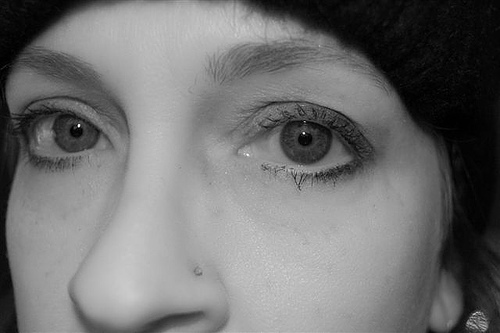
These eyes, …

The recent events in Egypt have struck me in a strange way.

I was driving along the road this week listening to NPR and I find I am reacting emotionally to the news of the dictator Mubarak — like I did to my father’s treatment growing up.

The fear and the almost frantic way in which the people of Egypt stayed in Freedom Square — the fear of a vicious dictator. I know that feeling.

This is something I wrote in 2007. I am so, so grateful that most of these emotions are not still with me today.

These eyes, …

What you see there in my eyes is pain.  All the things I try to push away in order to do — this — day.  Yes, I was yelled at, raged at almost daily growing up when he wasn’t working or traveling for more than eighteen years. Oh, she was so sad — always sinking into the pretext of being sick so that she wouldn’t have to face the fact that he was yelling, rebuking, bullying.  Making his children shrink into a ball of tears and fear.  Stunted, unable to process the world around.  Yes, she drank, and drank, until a week before he died; she was burying herself in a bottle of Vodka.  Yes, he died, his brain slowly crumbling around him.  Yes, that melancholy that has followed me — sometimes chased me — through my life.  It comes in and intends to stay.  Until I rise up and scream,  NOoooooooo!  You are not welcome!  These are the demons that come and sometimes I can’t make them go away.  I just crawl up into a ball and let the waves of pain wash over me.

I did that.  But today these eyes, which have been trying to tell the world what he did and how it feels, today these eyes are saying it hurts, but I am strong.

I am not going to repeat history. 

I am going to be someone who can stop the rage, listen to my fears, process my pain, and I will NOT, above all, take it out on my beautiful husband and children.

These eyes are saying, I am strong.

Something God has slowly wrestled away from me one finger at a time …

“I went to the woods because I wished to live deliberately, to front only the essential facts of life, and see if I could not learn what it had to teach, and not, when I came to die, discover that I had not lived.”

— Henry David Thoreau

For many years now Tom and I have felt like we’re playing the Game of the American Dream.

Although it looks perfectly delightful on the outside, the conspicuous consumption of our lives keeps us awake at night.  It’s no secret that we must make pretty good money, since I don’t have to work but we’re not even very careful with our money.  We know we are lucky to have a such a good income and we have our retirement funds, and because of his business we’re insured up to our eye balls.   But at the same time have no short-term savings and live month-to-month.  And we’ve gotten ourselves in trouble a few times wanting a vacation or bedroom furniture or to build out a studio and putting it on credit because we don’t save for those eventualities.

I shop compulsively — like I do so many things — with more than twenty years of bad spending choices and not living deliberately.  I confess to my own addictive spending habits which have taken years to reform and I must say I am not fully there.  It has been an area where I have had a two-fisted grip on that “need” to have things and this is something God has slowly wrestled away from me one finger at a time.

In 2008 we decided enough was enough and with the help of a family member stopped spending on credit (for good we hope) by getting a personal loan to end the endless high interest chase of debt.  And we are paying that off at low-interest over several years.   So far, as it comes to credit, we are reformed.

But we are continuously asking how do we live more deliberately?

We have begun to ask each other hard questions about cultural expectations, the influence of media on our world view and our children’s minds and souls, asking what is “life-giving, important, and meaningful?” and how should that change the way we spend our money.  A recent series at church on Generosity (aptly titled Let’s Get Fiscal) has also had interesting timing  for us.  And right in the midst of this sermon series and our personal discussion and prayer about fiscal irresponsibility and generosity we had someone in our life that really needs our financial help.   We have to face that we don’t have money on hand to help.  Because of our financial irresponsibility we cannot help someone that we love and whom we want to help.  That hurts and convicts and fits right in to what God’s doing. The timing is striking and as we have sought to listen to God, because he is clearly speaking to us.  The sermon series told us startlingly that 3.6 billion people in the world live on $2 or less a day. (Passing the Plate, by Smith, Emerson and Snell)  And I heard recently on NPR that more than half of the Egyptians now protesting for a better life live on $2 a day.

I am the “Rich Man.”

As Jesus was starting out on his way to Jerusalem, a man came running up to him, knelt down, and asked, “Good Teacher, what must I do to inherit eternal life?”  “Why do you call me good?” Jesus asked. “Only God is truly good. But to answer your question, you know the commandments: ‘You must not murder. You must not commit adultery. You must not steal. You must not testify falsely. You must not cheat anyone. Honor your father and mother.’e” “Teacher,” the man replied, “I’ve obeyed all these commandments since I was young.” Looking at the man, Jesus felt genuine love for him. “There is still one thing you haven’t done,” he told him. “Go and sell all your possessions and give the money to the poor, and you will have treasure in heaven. Then come, follow me.”  At this the man’s face fell, and he went away sad, for he had many possessions. Jesus looked around and said to his disciples, “How hard it is for the rich to enter the Kingdom of God!” This amazed them. But Jesus said again, “Dear children, it is very hardf to enter the Kingdom of God. In fact, it is easier for a camel to go through the eye of a needle than for a rich person to enter the Kingdom of God!”  The disciples were astounded. “Then who in the world can be saved?” they asked. Jesus looked at them intently and said, “Humanly speaking, it is impossible. But not with God. Everything is possible with God.”  Then Peter began to speak up. “We’ve given up everything to follow you,” he said. “Yes,” Jesus replied, “and I assure you that everyone who has given up house or brothers or sisters or mother or father or children or property, for my sake and for the Good News, will receive now in return a hundred times as many houses, brothers, sisters, mothers, children, and property—along with persecution. And in the world to come that person will have eternal life. But many who are the greatest now will be least important then, and those who seem least important now will be the greatest then.g” (Mark 10, New Living Translation)

Now more than ever, we are thinking about living intentionally and thinking it through carefully.  What we do and how we do it impacts, or should, how we spend, how generous we are, how we are able to make choices deliberately and carefully.  A recently blog entry by Rachel Held Evans talked about our purpose and essential living in this way:

“It seems to me that there are all of these voices telling me that I need certain things—privacy, boundaries, a 3-bedroom house, a two-car garage, clean neighbors, cool friends, fashionable clothes, TV, junk food, exercise equipment, a plan, a religion, a career, certainty, approval, stacks and stacks of books, and lotion that gives my skin a healthy-looking glow.  Rarely do I stop, take stock of how I spend my money and my time, and ask myself—Do I really need this? Is this really essential? What is its purpose?

Donald Miller, in A Million Miles in a Thousand Years, put this way:

The ambitions we have will become the stories we live. If you want to know what a person’s story is about, just ask them what they want. If we don’t want anything, we are living boring stories, and if we want a Roomba vacuüm cleaner, we are living stupid stories. If it won’t work in a story, it won’t work in life. 

Why do I write about this?  I believe it is a defining sin — conspicuous consumption and the love of money.  It is a lack of contentment — my pastor calls it a “cancer of discontentment.” He also reminded us of the prayer of Agur in Proverbs 30.  It says:  

Surely I am more stupid than any man,  And I do not have the understanding of a man.  Neither have I learned wisdom,  Nor do I have the knowledge of the Holy One.   Who has ascended into heaven and descended?  Who has gathered the wind in His fists?  Who has wrapped the waters in His garment?  Who has established all the ends of the earth?  What is His name or His son’s name?  Surely you know!  Every word of God is tested;  He is a shield to those who take refuge in Him.  Do not add to His words  Or He will reprove you, and you will be proved a liar.

Two things I asked of You,  Do not refuse me before I die:  Keep deception and lies far from me,  Give me neither poverty nor riches; Feed me with the food that is my portion,  That I not be full and deny You and say, “Who is the LORD?”  Or that I not be in want and steal,  And profane the name of my God.

Tom and I begin a journey tonight, taking a Financial Peace University by Dave Ramsey.  I don’t know where it will lead.  I don’t know what God is doing.  But I invite you to follow along, because surely, I believe, we are not alone. I am tired of this heavy and oppressive way of life.

Are you too suffocating from the weight of the “American Dream?”  Are you burdened by consumption without knowing what to do about it?

I invite you to follow along and see what we learn.


dance on the tightrope of life

The feet of a tightrope walker.
Image via Wikipedia

That cosmic space

where we balance so gingerly,

where we so often live

between discontent and content.

Surely it has a name?

Presuming I know, I believe we are meant to live in that space as Christ followers.   If one becomes too content we become apathetic to the cries of the world and to God’s priorities.  We forget to listen for his voice .  We may even stop believing that Jesus has the power to do something important in our life.  We forget what it was like to just be walking in the garden of Eden with Jesus.  An easy stroll in the twilight of the day — a peaceful not frantic moment. We just forget when we are too content.

But I can easily fall into discontent and quickly be overcome by bitterness and then I become hard to be around.  Yeah, I know this about myself.

And so there I am dancing on the tightrope of life.  Right now.

D i s c o n t e n t.  With a capital D.

God’s quiet voice seems to be saying “Don’t push so hard Melody.”

I have wrestled hard.  With myself.  With God.  With the voices in my head.  I feel angry. And anxious.  And lost.  And frustrated and simply scared to be in the place that I am.

No real job (at least not for money) and no real prospects in the middle of the recession of the century.  I am ten years out of the marketplace and have only worked at one organization for my entire short career of thirteen years.  I do have certain abilities and gifts that have risen to the surface over the last ten years but they have little to nothing to do with my previous job experience. I could go on, but I won’t.

I am not content.  I am so not!  Right now, I am anxious.  Feeling uncertain if God, Jesus or the Holy Spirit truly care about this conundrum I am in.

(But before you despair for me read to the end — there is hope in the struggle.)

Psalms 75 says “The righteous do not exalt themselves.  God will promote them in the proper time.”

RT Ritenbaugh says of this, “In the meantime, it is best for all of us to be content with where He has put us …  The cure for presumptuous behavior is realizing what God has given us, where He has placed us, and what is best for us at the time. If we work within the parameters He has set for us,we will grow and we will perform the task He has asked us to do.”

Eventually!???

There is a verse in Song of Songs that talks about “bringing contentment.”  Wow, that strikes me like a fist in the face, as even in my best days I am not that kind of person.  I am afraid that my very soul is defined by what is aggravating me.  By what is causing agitation.  I look for it.  Yes, I seem to seek it out.  I’ve always seen this as a asset, or at least a (somewhat) good thing, in that my voice is one that (perhaps) needs to be heard?   But I also have my doubts about whether this is true, or effective, with such a state of discontent radiating through it?   Yes, my heart and mind and soul gets shaken and moved by the things of this world — stories of the downtrodden, powerless and those that are experiencing injustice. And yet, I so long to be a person that brings contentment.  It’s an amazing concept.

It’s so not me.
The dance on the tightrope of life just became more challenging because of this.  And it’s more than trite smiling while you balance there on your tippy-toes.  True contentment is peace.  Bringing shalom (contentment or peace) to a world that is so chronically dissatisfied, stale, empty, barren, hungry, and afraid.

My soul longs for that to be true.  Of me.

In the Hebrew, the word that is translated “contentment” is shalom.  Completeness, soundness, safety, peace, quiet, tranquility, contentment, friendship, peace (from war). The noun comes from a verb that means to be in a covenant of peace, to cause to be at peace, to be complete, to be finished, to make safe, to restore.

Being that person won’t just happen.  It is uncomfortable to think about how little I bring that to people I meet every day!  May I have courage enough to ask God for that!  That is my prayer.

These are the questions I wonder:

Am I a safe person? Do I help others to be more at peace?  Do I cause others to hide from me?  What aspects of my life bring restoration, peace and safety to others?  Even the Apostle Paul says he learned to be content. (Philippians 4.)  If Paul the great agitator can learn it, surely I can.  Apparently that didn’t just happen for him when he became a follower of Jesus, but he found over time that he could count on Christ to meet his every need.

I guess being discontent conveys that we don’t totally trust that God has a plan.  Something good.  It makes me remember the Israelites in the OT who were such a terrible group, an example of  lack of trusting God for any goodness in their lives.  Such chronic whiners they were constantly rejecting the manna, which was provided by God, a daily source of strength.  They thought wasn’t good enough.  Too blah, too bland.  That is eerily familiar.  Yikes, I have to ask myself honestly:

Am I also rejecting God’s provision saying “Too bland Lord.  Surely there is m o r e?”

Jesus is the “true manna which came down from heaven.” (John 6:33)  Am I not throwing my own cosmic tantrum saying  that it’s inadequate?

Is Jesus enough?  Can I forget about my surroundings (of being a jobless stay-at-home mom) long enough to walk with him in the garden?

The dance on the tightrope of life just became more challenging if true contentment is:
  • to be with Jesus in the garden.
  • to trust Jesus to make me into a person of peace, safety and restoration.
  • to not allow my circumstances to distract me from what is important and true.

And then, and only then, I may be a person that brings peace, Jesus’ shalom, to a world that is so chronically dissatisfied, stale, empty, barren, hungry, and afraid.

My soul longs for that to be true.

——————————————-

This is what got me writing today which was not in the plan.  Reading the blog: A Holy Experience.

Being Merciful with Ourselves

Snow days are good.

Slow down.

Seek some silence.

We need silence in our lives. We even desire it.  But when we enter into silence we encounter a lot of inner noises, often so disturbing that a busy and distracting life seems preferable to a time of silence. Two disturbing “noises” present themselves quickly in our silence: the noise of lust and the noise of anger. Lust reveals our many unsatisfied needs, anger or many unresolved relationships. But lust and anger are very hard to face.

What are we to do? Jesus says, “Go and learn the meaning of the words: Mercy is what pleases me, not sacrifice” (Matthew 9:13). Sacrifice here means “offering up,” “cutting out,” “burning away,” or “killing.” We shouldn’t do that with our lust and anger. It simply won’t work. But we can be merciful toward our own noisy selves and turn these enemies into friends.

[from Bread for the Journey by Henri Nouwen.]

What are the inner noises that disturb you?

We must learn the meaning of mercy and extend it to our own noisy hearts.


Snow from 2006

What Kind of Mother is She?

taken at the dane county fair

It occurs to me that I don’t write much about being a mother.  The reasons are simple.  I have no idea what I’m doing.  I use my instincts.  But I have no exact answers.  It took me years to accept that my mom and dad “did their best.”  They didn’t purposefully f*ck with me.  And now, I take all that and do the same. I do my best.  And I think that has to be enough. I will look back, when my children are gone, and know that I did my best with what I had.  No matter the outcome.

interruptions & change

My daughter just woke up, her face is red and puffy from sleep.  She’s regaling me with a play-by-play of a book she finished late last night.  She is going on, and on, and on! Step-by-integral-step of the harrowing story of a boy who escapes an earthquake.  I don’t care, but — it’ is important that I listen.  All I want to do in this moment is sip my first cup of coffee of the day and write.  But I listen.  Nodding and “Um humming” at what I hope are the right moments.  I am listening.  Sort of.  I am also distracted and hoping she doesn’t notice.  Ironically, in this moment being her mom means listening to her.

That pull of my desires against the desires of my children is one of the most complicated things about being a mother.  The choices we make, day by day, hour by hour.  We’ve all felt that tension.

Children are always “interrupting” all the other things I’m doing.  But when one comes running up the stairs in tears because they got walloped in the eye playing Wii they still run for the comforting kiss right on the spot, my ‘magic’ kiss still has power to heal.   (Mothers have magic kisses if you didn’t know.)   The day they stop wanting those kisses will mean they have moved on to the next stage of their development.  I have four very different kids so that day will be different for each of them.  I cannot prescribe it.  But I won’t stop until they push me away.

They grow.  I grow.  We keep adapting, all of us.  The whole family continues to change.

Tom declared on Wednesday that he thinks the kids are too old to sleep in our bed.  This has been a  long time in coming.  It’s really the nine-year old that likes to go to sleep in my bed.  Being a musician Tom is often up late in his studio, perhaps five nights a week.  I get up at 5 am so I go to bed when the kids do.  I savor those few minutes of reading myself to sleep.  J just likes to be with me and so we’ve developed a habit (some might say an unhealthy one, to which I say rubbish!)  of letting him “warm up” Tom’s spot by falling asleep there.  I like the companionship.

Is this a bad habit?  I don’t know whether I’ve let it go on for so long for myself or for J.  Is he too old?  Parenting is full of lots of conflicting ideas.  And when Tom says J is too old to do it anymore, I really think Tom feels too old to do the required transporting back to the boy’s room, up the ladder and back into his own bed.  And then we also have to deal with the other two who are jealous of this time.  It then becomes something “special” for which they are compelled to compete for Mom.  I’m sure plenty of expert mothers would want to tell me all the ways this is harmful.  I don’t know. Mostly, I don’t care.  But I respect Tom’s wish to fall into bed at one in the morning and not have to move a near comatose child.  So we changed.  And I must learn to go to bed alone.  And so does J.  It’s hard to grow up no matter your age.

unconditional love

I have had moments over the last seventeen years of asking myself what were you thinking becoming a parent?  I write about how I was raised and what that did to me knowing that based on what I experienced I am not qualified. I realized the other day that I don’t know what it feels like to believe you are loved unconditionally by your parents.  If that’s true, and it is, then how do I possibly convey unconditional love to my kids?  Can I?  I believe in it intellectually and even on a spiritual level.  But I don’t get it.  Tom shows it to me – for sure.  So I wrestle with what he does that helps me believe him?  And to this day, my internal voice is pure disbelief.  You surely cannot love without conditions, without criticism, without expectation, without a grumpy disapproval, without your own insecurity pushing you to love  … If you haven’t experienced it.  Then how do I know my kids are feeling it from me?

I think unconditional love is the most important quality a parent should have.  Then you can push, and you can encourage, and even disapprove.  They will know they are okay. Somehow Tom’s parents managed to show him that kind of love.  These are the things that I think make me unqualified to be a parent.

learn from others & trust your gut

Some days I think I’m just a reactionary.  I react to how I was parented.  I react to things my kids are doing.  I react to books.  I react to teachers.  I react to the culture.  I am not very good at deciding a good way of doing something and sticking with it — mostly because I don’t think there is a right way.  I really needed about five years of study on parenting before I even got started.  And that’s an absurd impossibility.  Who has the time?   So we learn as we go.

I became a mother the day we married in 1993, a year before I was a footloose single woman planning on heading to the mission field.  I didn’t think about kids.  They simply weren’t.  They didn’t exist in my worldview.   Falling in love with Tom, hard and fast meant learning to love his four and a half year old daughter.  And when we married I became an instant mother – the “extra” mom to a five-year old daughter.  Extra or Other — whatever you get called, being a step-mom was a crash course in parenting.  And like nothing I had experienced before in my life, it brought out my insecurities and need for control!  Wow!   Perhaps some day, perhaps, I will write about the years that I worked in full-time ministry while parenting a step child and having three biological kids.  I’ll call it “How I was an Ugly, Paranoid, Controlling Step-Monster.” My daughter M graciously loves me still and has forgiven me for those years.  When she moved back in recently, at 22, I realized God is gracious and gave  me a do-over.

Here’s the thing.  I believe kids just want to be loved and kids are the most forgiving of all people.  All they know is you. You are their parent.  Okay, later they will figure some things out.  Like perhaps you didn’t know anything.  That’s the risk.  That’s the fun!  And then when they become a parent, well, perhaps you won’t look quite so crazy.

Luckily we have twenty years with our kids and have time to make adjustments.

I have learned is that there are no rules.  Rules in parenting is crap. The best guide for me has been my gut.  My gut has never failed me.  My gut disagrees or sometimes agrees with parenting books.  My gut disagrees or sometimes agrees with other parents giving advice.  My gut disagrees or agrees with pediatricians, teachers, supposed experts.  If you follow your gut, your intuition, I believe you’ll be okay, eventually.

For many years I doubted my gut and my voice because I doubted myself.  My own insecurities played into who I listened to and what I believed.  I’d boomerang from one theory to another intellectually.  But in practice usually my inner voice said do this or don’t do that.  We make mistakes.  We are unusually lax in response to having strict parents or vice versa.

asian vs. any other parenting

I have not read Amy Chua’s book, The Battle Hymn of the Tiger Mother mostly because there’s a lot about the stereotypical Asian parenting style that I respect, but I know I don’t have the will power to follow through on.  So it would just make me feel bad and I am really not in to feeling bad about myself right now.  So I’ve ignored the articles, reactions and furor.

Frankly many modern parents are far too lax with their children, but I have seen this with every kind of parent  from many different cultures. I know that I could and perhaps should push my children harder.  I mean, now I wish I had been pushed academically.  In hind sight, I was a slacker, intelligent but insecure and I would have benefited from my parents lovingly pushing me just a bit more (or a lot more!)  On the other hand, I felt I never measured up to what my dad expected of me.  I lived in that limbo of that craziness.   His insecurities drove him and we were a reflection of him.  We were a mirror of his success or not.  This is a very Asian characteristic I have been told by one of my friends who is also Asian.

And so I push my intelligent but lazy daughter, but not too much I hope.  I consistently fight the internal shame that says I don’t expect enough of her and I am the thing standing between her and Harvard or Yale Law school.  Me.  And then the countering voice reminds me what I really believe.  That she needs to find the balance herself.  Know that she’s loved no matter what she chooses but also know that more opportunities will be open to her if she applies herself academically and learns to work hard.   I want each of my children to be able to ask the question what they want?  Then help them to see what they have to be willing to do, in order to get it.  By empowering my daughters especially in those moments they learn their own power.  It is a choice.  I hope I am right.  My gut tells me I am.  In the end that’s all I have.  My boys are different, completely and my approach is also different but instilling in them a sense that they control their future is important.

I have a Japanese friend and I love how she parents.  She is an incredible mother and I learn from her every time we get together.  “When I am cleaning my children are cleaning“, she tells me.  Wha?  I am so not there! To be honest my kids emulate Tom and I who hate to clean. Do I want to be more like my friend?  Hell yes!  I guess what I am saying is that there is something to be learned from a culture that promotes hard work, excellence, pride and discipline. I admire it.  I want those to be things my children learn from me.  But no, my ten year old does not know how to clean the toilet.   I find that reflexively parent like I was parented — growing up cleaning is a pain!  To be avoided or to be endured, …  If I want to change this little legacy in my family it will take effort and discipline. I don’t know if I want to make the effort.  I don’t know if I have the discipline.  Which is where I started above.  I find a lot of things are great ideas but practically speaking I am unable to maintain them.  We all have to know ourselves.

what’s your highest calling?

This morning I read something that startled me but I agree with it:

“… parenting is not our highest calling! Faithfully serving & following after Christ is our highest calling!  —  SortaCrunchy

We are going to make mistakes, perhaps even a lot of them.  You’ll compare yourself to others and wonder if perhaps their way is better.  But in the end you have to look at your kids, unique individuals that they are as well as look at yourself and your partner/spouse who are also unique people, and do your best.

Parenting is its own religion, and engenders its own faith. Debating it serves no purpose other than inciting holy war.  –@kmaezenmiller

Our calling is to follow Christ.  Behave as he did.  Emulate him.  Do our best.  And if I can let go of all of the above and relax, well then there’s hope for us all.  It’s not simple nor would I ever want to imply that.  But there is a level of trust you must have in yourself, in the person you partner with to parent and in God.

MH

——————————————————-

This is what got me thinking this morning.  http://rachelheldevans.com/moms-scare-me

A Poem: No Vacancy

The summer I was eighteen

I wanted one thing — a boy named Tommy LaRue.
He was my first boyfriend.  My first kiss.
I learned three things from him.
What is a French kiss? To drink cheap Champagne. That I was expendable.
In those days, I knew nothing of myself.  How to be with people.
Life mystified me.  What was its purpose?
I had no aspirations.  I didn’t know what I was meant to do.
And that scared him.  My dad
who wanted more for me. More than
whatever it was that I wanted.  That I hadn’t figured out.

The summer that I was nineteen

After sleeping through my first year of university he told me

“You will go there.  You will do that.”
You will find more than whatever it was that you think you want.
I didn’t know that I had the power to say no.  Or the power

to think or want anything.  And so, I went.  I did
As I was told.
And slept

through two more years of university.  Literally.
Mostly.  Not. There.  Not really anywhere.

My junior year I was told

to choose.
“What is it that you want?” they said. “Why are you here?”
I want nothing.  I have no aspirations.  I have no
Hopes, dreams or desires.  Life mystifies me.

This coma that was my life became clear
Twenty years later.  It was a slow awakening.
Thawed by unconditional love, I found
Safety.  No one was telling me
Where to go.  What to do.  Who could have known, that I needed
S p a c e to figure it all out, whatever it is that I wanted.
For I did want
More.

Ever since I can remember, I have
spun words.  They were flying out of my mouth
Faster than I could think them.  These words, the flying kind,
Cut flesh.  They hurt the people I loved over the years.
And all because I was too afraid
To say anything to him.
And so
I stopped.  Speaking
in that manner.  I gave up
my voice. That was easier than saying
anything.

When he died it began.  The trance was over and it was a
Dreamy awakening.  A discovery.
Almost trembling I came to understand.  No longer
Could he tell me — anything.
And for a while, with no one telling
Me anything, I was lost.
And then though I was afraid
Of hurting, and afraid of his ghost that watches
And lingers even now. I began
to unearth my voice again. No longer
Is this a vacant place inside me.
I have dreams.
I have words.
And I use my words to heal.  Yes, I have found my purpose.
This moment, here. These words.
Now. There is no vacancy.

ALL MY OLD POETRY

I just realized that most of my older poems are not on my blog.  Rather than transport them, I will offer a  link here to more than fifty poems & photographs offered on my flickr site under the set “My Words.”  They can be found here.

What I wrote a few years ago about this group of work:

These poems are a reflection of my life’s journey which includes many things including faith or lack of it, love given and received, acceptance of myself and others, and those uncomfortable feelings toward people you rub up against in life. 

I have the utmost regard for my parents and so while acknowledging that they did their ‘best’ with what they were given, I can only hope that I somehow do ‘better’ for my children.

This journey is mine, I share it so that others who battle with self-loathing, doubt, depression, anger, even suicide can move to a place of acceptance and renewal.  As a person of faith, there is also an element of hope in the written word.  A declaration of the past as well as a statement of hope in the future.

A Poem: love in the shadows


.love in the shadows.

Originally uploaded by M e l o d y

Said it before, but I am thankful for my home which is a peaceful haven and for the love I experience there.

Love in The Shadows

What do you see
in the shadows?
What are you searching for?
I see you wanting;
hoping for more.
Can you hear the music,
the song lingering here?
Shelter, comfort, home;
fragrant with his scent and sound.
What is the color of
the shadows,
the songs,
the scent
of love?
Tranquility,
it has no color, sound,
or smell,
but it is abundant.

by Melody Hanson, 2007

A Poem: good dad, bad dad


good dad, bad dad

Originally uploaded by M e l o d y

My Dad’s death stirred up so much turmoil for my sisters and me. Processing that, I wrote this poem.

Good Dad. Bad Dad.

I shed no tears today
for the warrior who has fallen.
Taken down by Cancer’s sword.
My heart is full of memories,
good and bad.

Good Dad. Bad Dad.
Constant worry.
Constant change.
Who could have foreseen
the Cancer overtaking his mind;
that became my liberation
in five short months.

The danger —
of loving too much;
needing tenderness,
and all the things Daddy’s are supposed to be.

PAIN. FEAR.
Emotions jangling around me
like some kind of white noise;
pushing their way into my conscious thoughts.
Invaders, threatening to undo
the weak hold I’ve found on a Good Life.
So many memories
good and bad,
bad and good.

Who was he? Why was he MY dad?
MY tormentor.
MY warrior;
Finally broken,
beaten by the cancer
that was to become my friend.

Betrayal,
these thoughts which plague me.
Broken;
the unspoken promise
to keep our secrets to the end.
How do I remember?
How do I stay true and honest,
when the Truth causes an ache
too strong to feel,
to face,
to bear.

Good Dad. Bad Dad.
Who was he in the end?
A demon? A saint?
Now simply a Muse —
remembered, but no longer feared.
Thought of
in furtive,
anxious moments.

Good Dad. Bad Dad.
Who is he to me now?
A man driven to despair
Living a chaotic, frantic life.

Not the Good Life I choose,
Not the legacy I will repeat.

Good Girl. Bad Girl.
Who will I listen to?
Who will I believe?
I am the woman I choose to become
today,
tomorrow.
These are the Good Days
that I can change.
Yesterday is Dead.
Burned in the funeral pyre.
Vapors
Mist
Dust settling around me.

Good Girl. Bad Girl.

Good.

Bad.

Good.

by Melody Hanson, 2004

Aging, Legacies and more Time with our Family

my parents did as well as they could

I often wonder if I am too hard on the memory of my father.  As the years go by the memories fade good and bad ones.   A couple of things happened this weekend that made me think of my father.  He died in his early sixties.  He should have had another thirty years.

92-year old Billy Graham was interviewed recently.   He has come to the time of his life when he spends a lot of time alone, requiring the care of others.  I suppose that stage of things makes one reflective.

When asked to give advice to those who are aging he said “Accept it!  And thank God every day for the gift of that day.”

I do dread getting old.  And yet I have this idea that I will just sort of live on in perpetuity with my body and mind falling apart.  I have joked that I want to be euthanized to save everyone the misery of my madness gone out of control.

My father wouldn’t accept that he was sick or was going to die, so much so that he refused to talk about when he was gone.   Even when he was diagnosed with brain tumors in regions of his brain that would leave him without speech and would impact his ability to sort out emotion.  And yet as he slowly left us, his body breaking down from the chemotherapy and his mind  slowly slipping away from us, he became meaner. And more confused about reality.  And eventually he couldn’t form words.  One or two here and there in the week that he died were like small gifts to those who received them.

His very last words to me, when I told him I loved him, were “I love you more.”

When he was still cognizant and before the surgery he did to his credit want to clear the air. Those last conversations differed for each of us daughters.  In mine, I spoke more than he did.  Fearful, I told him his anger and disappointment with me over the years had shaped my life.  He listened and accepted.  He spoke the words of apology.  It would have been miraculous and life changing had he not then gone on to spend an hour with my sister berating and criticizing her for how she managed money.  He wanted some money my parents had loaned her.

I felt responsible for that.  My conversation had been unexpectedly positive and though a lifetime of experiences told her not to she trusted him and met with him.  He crushed her as he had each of us so many times over the years.

That’s what he left us.  He left no letters for us.  He left without any parting advice or even the last word.  Ironically, the man who always had the last word in life refused to believe he was going to die.  He was going to get back out there to continue God’s work.  He believed he had time.

When asked of his regrets Graham said “he would spend more time at home with his family, study more and preach less.”  Wow! I think every MK and PK alive today longs to hear those words from their parents.  He wished he had spent more time with his family.  My dad prayed for healing to get back out there, not a few more months of life so that he could treasure his family and say his goodbyes.  He wanted to get back out there and reach our world for Christ. (At that time it was his work in China.)

Graham continued:

“God has a reason for keeping us here (even if we don’t always understand it), and we need to recover the Bible’s understanding of life and longevity as gifts from God—and therefore as something good. Several times the Bible mentions people who died “at a good old age”—an interesting phrase (emphasis added). So part of my advice is to learn to be content, and that only comes as we accept each day as a gift from God and commit it into his hands. Paul’s words are true at every stage of life, but especially as we grow older: “Godliness with contentment is great gain” (1 Tim. 6:6).

I miss my dad.  He was never content.  And I’ve concluded that he had to die for the rest of us to live.  I know those are harsh thoughts.  Do I really believe that God “took him” or did his life finally just end?  I will never know and it doesn’t really matter does it?  What I do know is the result of his death.  I could not break free from the chains of my experiences with him and my mother.  I did not have the strength or the knowledge of how to do that.   In the end, he left and I became free.

Could I have experienced the growth of the last eight years with him still alive?  Not so quickly.  Or intentionally.  Or in the same way.  He was such a force.  He was IRON in my life, but as iron sharpens iron, iron on something weak shapes it in the ways it wants.

So why so much talk of legacy and more time and regrets?  Because it is a bittersweet thing to lose a parent when they were a coercive fury in your life.  Choking.  Compelling.  And yet all that you knew of love.

Yeah, it’s mixed up.

MH

PK: Preacher’s Kid and MK: Missionary’s Kid

Good Dad, Bad Dad (A poem I wrote in 2004)

I Have No Therefore

Faith is the bird

that sings

when the dawn

is still dark.

~Rabindranath Tagore

At times I cannot imagine that I am raising children in the world today. Nor can I imagine expecting them to live in the world we are creating for them.  I can only respond with the discipline of faith, hope and love to this world full of suffering, poverty and injustice — genocide, food crises, unjust and expensive wars, oil dependency and overpopulation. And I’m just getting started.  It is all devastating.

On a blog this morning I read the term post-evangelical1 so I went to the web to figure out what he meant.  After reading just a bit my knee jerk reaction I must admit is that I am a post-evangelical too.

But looking at it more closely I think the term is stupid — ill named.  Evangelical means “gospel” or “good news.”

I am a believer in the gospel.  What I do not believe in are the many people who call themselves Christians but they are truly fringe, fundamentalists — I believe some in the media call them ironically “the religious right.”  I think the term post-evangelical came out of a reaction to fundamentalists. And out of the desire to distance themselves, get as far away as one can from being identified like one.    I can relate!  I feel like I am constantly denying that I am a “FOX News Christian…”

I used to call myself a recovering evangelical because I felt those sort of Christians tarnish the witness of Christ and are frankly embarrassing.  So as much as I want to remove myself from the label and image of evangelical Christian I cannot say I am a post-evangelical. I’m still an evangelical.

I cannot get away from the truth that I attend a 75% white mega-church in middle-class America.  It’s of the EFCA denomination which I mostly know nothing about.  But I have chosen not become a member officially because they don’t ordain women or allow them, — er– us, to be considered for eldership.  But, for better or worse I am a part of “evangelicalism” because I attend, give and take part in an evangelical Christian church.

But the world is changing around the evangelical church and I believe there are areas that we must be responsive to the culture.

  • We must find ways to talk about these things within the Church without it creating partisan or contentious quarreling.   Without being perceived as a trouble maker.
  • We must forcefully adhere to the Word of God.  But study it first and foremost ourselves and not base our assumptions on what others tell us!
  • We must understand the cultural times we’re living in... Loaded words I know…

I feel strongly that these three things are incredibly important for the future of the Church and the future of our witness, yes us, evangelical Christians.  And with that in mind there are real barriers to people feeling welcome in our churches.

These are the things that I think are wrong with (many) evangelical churches.  The reasons that Christianity is so distasteful to many people outside of the church.  These are the barriers as I see them.

  1. Excessive focus on personal psychological growth and individualism
  2. Lack of theological depth coming from lack of personal study, understanding or wish to know the scripture individually
  3. Narrow and/or partisan political views which are unsubstantiated by scripture
  4. Lack of engagement in the culture: art, media, and society and/or a withdrawal from society and culture.
  5. Lives caught up in the pursuit of materialism and consumerism
  6. Insensitivity toward and lack of love for people who are LGBT or Q
  7. Lack of engagement of the role of women in leadership of the church.
  8. Ignoring social justice within the church.
  9. Ignorance as it relates to white power and male power and how that impacts minority groups and women within the Church.
(I got this originally off Wikipedia amazingly.  I rewrote it to better express my views. )

I have no therefore.

I simply think that this list is worth mulling over.

As Christ has made himself real to me — through a growing understanding and awareness of the incarnation and God’s grace in my life — I have had to face that God wants something from me.  Do I have any idea what this looks like long-term?  No.  And it is a constant heartache not knowing exactly how to respond to Him.   Yes, faith is a mystery and to wrestle with the what, and the who, and to respond has become the most challenging call in my life to date.

I continue to pray for peace, hope and love in my choices and actions and attitudes. For that is our challenge and lifelong discipline to figure out how to do that daily.  Forif we lose hope of receiving from Jesus soon will come despair.  We must be steadfast in our unconditional love of others and today do peace. Do hope.  Do love.  For in the end that is the Church of Christ.  Isn’t it?

MHH

1″The term evangelical has its etymological roots in the Greek word for “gospel” or “good news”: ευαγγελιον (evangelion), from eu- “good” and angelion “message.” In that sense, to be evangelical would mean to be a believer in the gospel, that is the message of Jesus Christ.”

/whimsy/


/whimsy/

Originally uploaded by M e l o d y

I am trying to decide what to “do” with this blog in 2011.

Is there anything you, dear reader, think that I should focus on?

I would love your thoughts, one and all.

— MHH